
Simon Singh is one of my favourite non-fiction writers and I have previously read three of his books. Of those three, two I would count amongst my favourite non-fiction books (Fermat’s Last Theorem and Big Bang). The third – Trick or Treatment – I would still highly recommend as a book that ought to be widely read for the practical benefit it could make to your life.
What makes Singh a great non-fiction writer is his ability to deal with complex subjects and explain them in a way that makes them comprehensible to the general reader as well as infecting the reader with enthusiasm for subjects which might otherwise be too dry and intellectual to be engaging for most.
So, when I heard one of my favourite writers had written a book about one of my favourite television shows, it sounded like a perfect pairing!
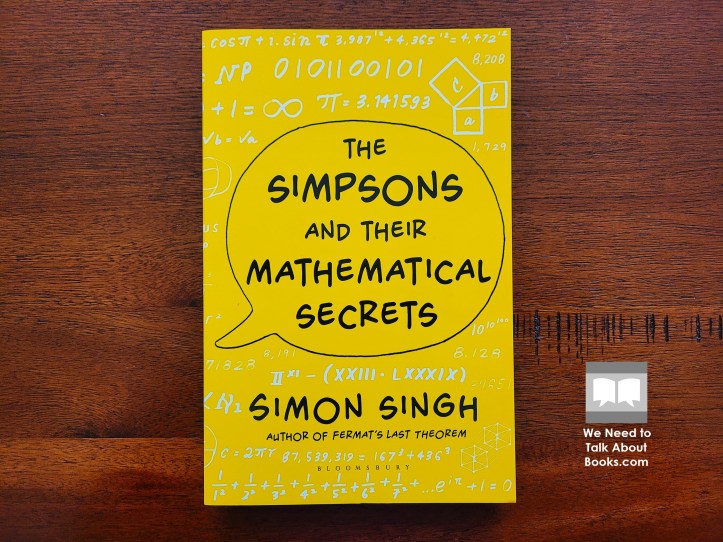
But The Simpsons and Their Mathematical Secrets is a less serious and more fun book than his previous ones. That is not to say that it won’t challenge you at times with the ideas it introduces.
Singh instead focuses on how the writers of The Simpsons have hidden sophisticated mathematical references throughout the series, using them as a way to tell the history of mathematics through the cultural phenomenon of the show.
An aspect that distinguished The Simpsons from its inception were the allusions it contains. Rather than being occasional gags, the allusions were the core of the show, holding up a mirror to Western culture to satirise our tastes and trends. But, Singh argues, while other books have analysed The Simpsons for its philosophical, psychological and religious allusions; mathematics has not had the same attention. Yet, Singh says, the math trumps all.
There are good reasons for saying so. The Simpsons has a disproportionately large number of writers who hold advanced degrees in mathematics from prestigious institutions. And the series is full of references to advanced mathematics for those who can spot them.
The truth is that many of the writers of The Simpsons are deeply in love with numbers, and their ultimate desire is to drip-feed morsels of mathematics into the subconscious minds of viewers. In other words, for more than two decades we have been tricked into watching an animated introduction to everything from calculus to geometry, from π to game theory, and from infinitesimals to infinity.
In researching this book Singh was able to meet with several of these writers and hear the anecdotes of how these references got added to episodes. If that was not enough to make fans jealous, he was also able to sit in on a table read (for the Four Regrettings and a Funeral episode, S25E3) and read a preliminary script (for The Saga of Carl episode S24E21).
The Simpsons and Their Mathematical Secrets is a short book of seventeen pithy chapters. In most, Singh will begin with a story taken from a Simpsons episode and then take us to the meaning of the math behind it.
For example, in the episode where Homer is inspired by Thomas Edison and tries to emulate him (The Wizard of Evergreen Terrace, S10E2), Homer’s work area includes a blackboard with four items on it and Singh proceeds to explain each. There is a prediction of the mass of the Higgs boson, an equation for the density of the universe (which causes two explosions in Homer’s work), a topology argument that you can convert a donut into a sphere by biting it and a near-disproof of Fermat’s Last Theorem.
These four items were written into the script by David S Cohen, yet another Simpsons writer with mathematics credentials.
Cohen is very proud of his blackboard in “The Wizard of Evergreen Terrace.” In fact, he derives immense satisfaction from all the mathematical tidbits he has introduced into The Simpsons over the years: “I feel great about it. It’s very easy working in television to not feel good about what you do on the grounds that you’re causing the collapse of society. So, when we get the opportunity to raise the level of discussion – particularly to glorify mathematics – it cancels out those days when I’ve been writing those bodily function jokes.”
As well as these chapters sharing the stories behind the math jokes and allusions on the show and of the writers who created them, Singh has included five exam papers in the book! Each is different and if you are the type for whom the idea of a math test turns you off, you should know they are there for fun. The first is titled ‘Arithmetickle and Geometeeheehee’, consisting of eight math jokes, scored by how much they made you either laugh or groan.
If the combination of mathematics and The Simpsons was not enough, you should know this book extends a bit further. Singh will also look at the mathematics references contained in Futurama and devote the last four chapters to them.
This book is filled with fascinating diversions. Singh examines a method for ranking Simpsons writers by a combination their mathematical and Hollywood credentials. The They Saved Lisa’s Brain episode (S10E22) leads to a discussion of women in STEM. A favourite was the story of Futurama episode The Prisoner of Benda (S6E10) which resulted in Ken Keeler producing a mathematical proof (‘The Futurama Proof’).
In the episode, minds swap bodies leading to a tangled mess of minds in the wrong bodies. Keeler’s proof showed how you could best go about returning every mind to its original body. It is easy to imagine Ken Keeler’s keenness to tackle the problem and the joy and satisfaction in finding the solution.
In many ways, this episode is the pinnacle of all the mathematical references that have ever appeared in both The Simpsons and Futurama. Mike Reiss and Al Jean began by introducing mathematical freeze-frame gags into the first season of The Simpsons, and two decades later Ken Keeler created an entirely new theorem in order to help the Planet Express crew. Indeed, Keeler can claim the honour of being the first writer in the history of television to have created a new mathematical theorem purely for the benefit of a sitcom.
The only reservation I have is an unavoidable one. Explaining jokes inevitably diminishes some of their spontaneity. Like a variant of the ‘ignorance is bliss’ paradox, it is an example of where knowing more can be less fun. But it is a minor issue. As I read The Simpsons and Their Mathematical Secrets, the jokes, anecdotes, trivia and fun facts really started to accumulate to make reading this book a very enjoyable experience.
It would be easy for non-nerds to dismiss the mathematical shenanigans that appear on The Simpsons and Futurama as superficial and frivolous, but that would be an insult to the wit and dedication of the two most mathematically gifted writing teams in the history of television. They have never shied away from championing everything from Fermat’s Last Theorem to their very own Futurama Theorem.
As a society, we rightly adore our great musicians and novelists, yet we seldom hear any mention of the humble mathematician. It is clear that mathematics is not considered part of our culture. Instead, mathematics is generally feared and mathematicians are often mocked. Despite this, the writers of The Simpsons and Futurama have been smuggling complex mathematical ideas into prime-time television for almost a quarter of a century.
Being a fan of The Simpsons might be a necessary prerequisite to enjoying this book. Fortunately, you do not need to enjoy mathematics to get a great deal of pleasure from this book. Instead, Singh shows how mathematics offers a new way of appreciating great comedy while providing the perfect excuse to revisit your favourite episodes with a fresh perspective.
 We Need to Talk About Books
This sounds like a birthday present for The Offspring!
LikeLiked by 1 person
We just started watching The Simpsons with the kids this winter. Though the frequent sexual references make me squirm, they like it a lot and I like telling them this will make a lot more sense once they watch more films, read more books, learn more history, science and math.
LikeLiked by 1 person
Yes! I used to tell my students that if they wanted a career in developing video games, (and most of the 10-12 y.o. boys did want that) then they needed to read the tales of Ancient Greece &c because that’s what most of the games were based on.
LikeLike
Yes! I used to tell my students that if they wanted a career in developing video games, (and most of the 10-12 y.o. boys did want that) then they needed to read the tales of Ancient Greece &c because that’s what most of the games were based on.
LikeLike
Yes! I used to tell my students that if they wanted a career in developing video games, (and most of the 10-12 y.o. boys did want that) then they needed to read the tales of Ancient Greece &c because that’s what most of the games were based on.
LikeLike
Yes! I used to tell my students that if they wanted a career in developing video games, (and most of the 10-12 y.o. boys did want that) then they needed to read the tales of Ancient Greece &c because that’s what most of the games were based on.
LikeLike