
What if the freedom you fought so hard to achieve was only the beginning of your problems? That is the unsettling premise of Eva Figes’ Nelly’s Version, a neglected feminist novel that combines psychological mystery, surrealism, and existential philosophy into an exploration of identity, memory, and what it really means to reinvent yourself.
Nelly’s Version: Review Introduction
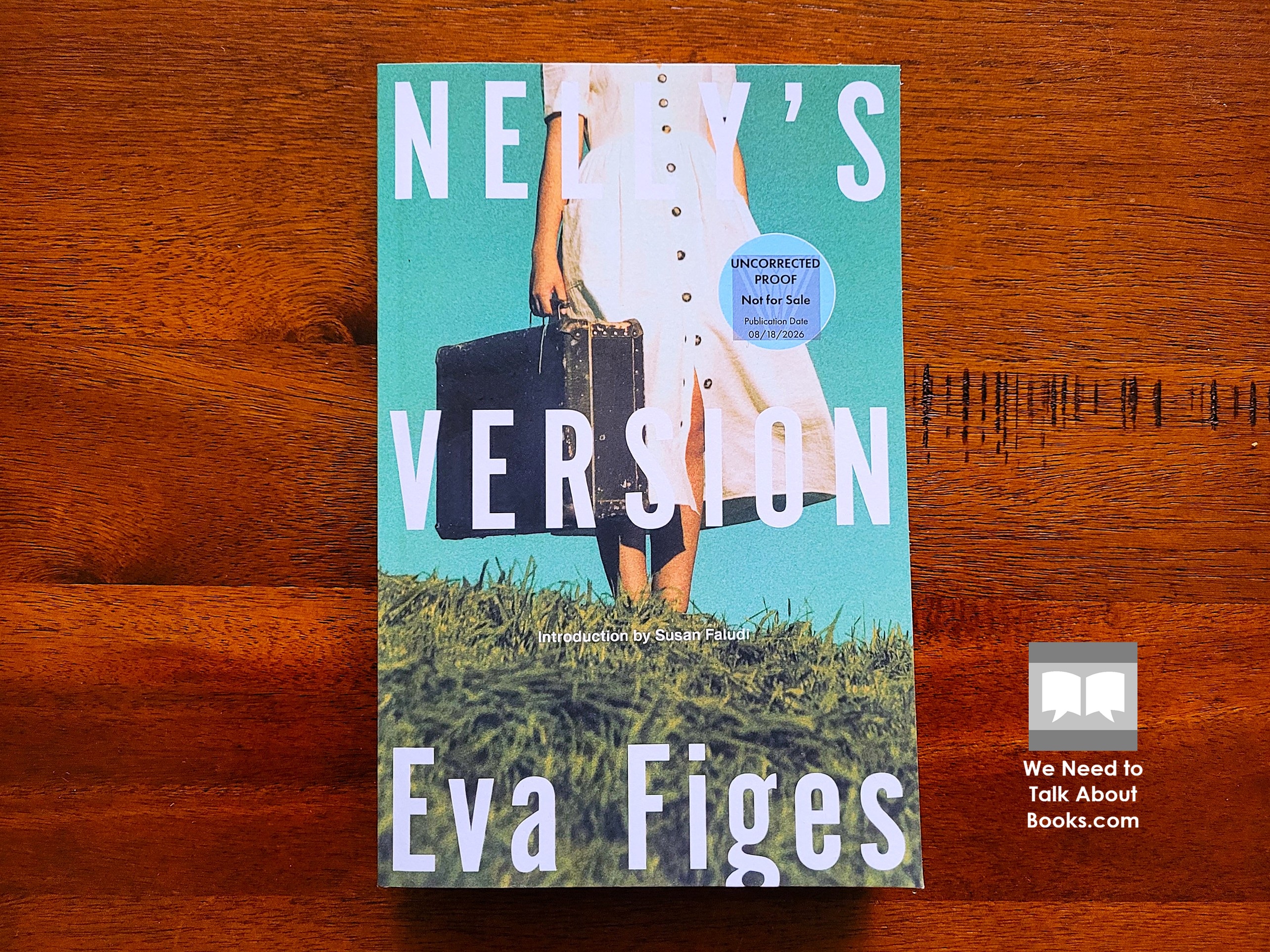
Nelly’s Version by Eva Figes was previously published first in 1977 and then in 2002. The edition I read is soon to be published in 2026.
In this review of Nelly’s Version, I examine the novel’s unusual premise, its fragmented and often surreal style, and the feminist ideas that underpin its exploration of identity and memory. I’ll discuss why I found it difficult to engage with at first, how Susan Faludi’s introduction helped place it within the tradition of 1970s feminist fiction, and why this demanding but rewarding novel deserves to be rediscovered by modern readers.
Nelly’s Version is to be rereleased on August 18 2026. I was provided with an advanced copy in return for an independent review.
Nelly’s Version: Plot Overview
A middle-aged woman finds herself facing the reception desk at a small hotel. Unable to remember who she is or how she arrived there, she checks in under a false name – Nelly Dean – the name of the servant and narrator of Emily Brontë’s novel Wuthering Heights. She lies and says her husband will be joining her shortly – a woman like herself travelling alone would arouse suspicion.
Once alone in her room she is no less comfortable. She does not know who she is, what she is doing there or what she is meant to do. The suitcase she has with her has bland clothes, designed to blend in and only enough for a short trip. It also contains a large amount of money, mostly new bills.
She goes for a walk. Her hotel is called The Black Swan. It is at least a couple of centuries old, probably started as a small inn and expanded. She stops at a bridge and watches the water flow underneath. Her thoughts take philosophical digressions here. Like Heraclitus’ reflection that one cannot step into the same river twice, she reasons that she cannot be the same woman she once was.
Feeling somewhat exhausted already, I wondered why I had bothered to come, but then, that is not a question I am as yet able to answer. Had I deliberately chosen this dull little place, for reasons now lost to me, or was it an accidental stop-off on a route from nowhere to nowhere? I hoped that time would tell, but I could not be sure even of that: how would I know whether any drama that did unfold against this modest and somehow unlikely background was planned, and not a mere accident?
With nothing to do she tries exploring the surrounding village, it shops, its library, the bank, the real estate office and the doctor’s practice. She interacts with others staying at her hotel, with town folk and visitors who claim to know her.
But without an identity she remains trapped, unable to know how she is supposed to move forward with her life.
‘But,’ he persisted, ‘where would any of us be without a past?’
I shrugged. ‘Who knows? Here perhaps.’
Nelly’s Version and 1970’s Housewife Rebellions
This edition of Nelly’s Version I have been offered has an Introduction written by Susan Faludi in 2001, presumable for an earlier edition. In it she briefly describes Eva Figes’ life up to the point of writing the novel. Having fled Nazi Germany as a child with her family, Figes had a difficult life in England dealing with alienation, an unhappy marriage and economic burdens.
Amidst these troubles, Figes found deep connection with the characters of Nelly and Catherine from Emily Brontë’s Wuthering Heights, which she describes as the greatest English novel. Figes also writes what Faludi calls a key feminist tract of the 1970’s (Patriarchal Attitudes: Women in Society, 1970) though she seems to not want to be defined by it or to allow her other work to be interpreted in terms of it.
Faludi places Nelly’s Version in the context of other fiction of the 1970’s. She says this was a high point for novels about housewife rebellions and journeys of self-discovery. Though I can’t claim to possess much knowledge of the genre, a brief search led me to titles and author’s I have heard of such as The Women’s Room by Marilyn French (1977), Wifey by Judy Blume (1978) and The Stepford Wives by Ira Levin (1972).
Figes’ novels, brief and shimmering jewel-like compositions, meditate on the emotional world of unknown women, women muted and missing from the public stage, women forgotten in shadowy corners of a bedroom, women in service to “great” men. Her novels that imagine the lives of real women are concerned not with the creative genius of a Georgia O’Keeffe but with how Monet’s grieving wife gets through the day (Light); Figes would rather plumb the inner life of one of Milton’s yoked daughters (The Tree of Knowledge) than recount George Eliot’s achievements. Figes finely calibrated evocations of the moment, her penetrating impressionists eye, and her modernist challenge to the artifice of coherent narrative have led many critics to compare her with Virginia Woolf. Like Woolf, Figes is also an exquisite navigator of domesticated female experience; she evokes the underwater murkiness and muffled silence that is so much a part of being a woman in a realm arranged for men’s wants.
- From the Introduction
Nelly’s Version: Surreal and Requires Persistence
Nelly’s Version certainly throws the reader in the deep end. If you don’t read the Introduction (I never do as they often contain spoilers as Faludi’s does) then like Nelly, you are without firm ground to stand on. Several incidents and discoveries in the early novel certainly count as bizarre.
In addition, the style can be somewhat unnerving. Almost stream-of-consciousness, Nelly takes the reader along for the ride. Understandably, with no knowledge of her past, she notes the details of everything she observes. It can get a bit tiresome at times.
I stood on the pavement and considered my next existential choice: whether to enter the shop. I would, of course, have to purchase something. But that was not important: anything would do, and I did not have to worry about paying for it. I stood in a state of indecision for some time, glancing at the ice cream sign, the dusty windows which had not been refurbished for some time, as though they offered some sort of threat. My indecision might have seemed odd, even absurd, to an outsider, but then most people have never experienced what it is like to function in a vacuum where one course of action might be just as meaningless or pregnant as another, and where total freedom can become an intolerable weight pressing on one’s shoulders. If I went into that shop, I thought, any number of things might happen. And the sense of familiarity made me uneasy: I wanted to fill the vacuum with elements of my own choice, not to be invaded by those which I preferred to forget. Even if I did not know what they were. Or because I did not know.
It is also a bit surreal. I started finding the story to be Kafkaesque and likened it to The Trial. Nelly is trapped in bizarre circumstances without a way out. A local train station appears in both her dreams and her reality yet in both she cannot leave. Passages from the books she finds at the library seem to be referring to her own life.
‘I’m afraid we shall need your permanent address.’
I hesitated, conscious of walking into a possible quagmire. Then I said, in what I hoped was a tone of quiet authority: ‘I have no other address at present.’
‘I see. And how long have you been staying at the Black Swan?’
‘Look here,’ I said, getting annoyed. ‘What is this? I booked in this morning, but I really don’t see…’
‘Travelling without a ticket is a very serious offence,’ he interrupted firmly. ‘If you have only been staying at the Swan since this morning I am afraid I must ask you for your previous address… where you came from.’
I stared at him. He stared back. ‘I’m afraid I can’t tell you that,’ I said with more truth than he realised. ‘Look, if you’ll only ask the Porter, I spoke to him… he’ll remember me.’
‘That won’t be necessary. If you’ll just sign here. Purely a formality, you understand.’ he held out the notebook and watched as my hand signed the false name with his blunt pencil.
But the novel started to grow on me as I persisted. As Nelly begins to encounter men, including men who claim to be from her past. Things started to come together, and Nelly’s Version began to sound like an allegory on the entrapment of women by patriarchal society.
What did people do in houses? I asked myself, and found that I did not know. I suppose I must have known once. Perhaps they moved from room to room trying to stop the dust settling on the wallpaper, adjusting the one picture that had always hung crooked, in spite of numerous attempts to get it straight, until somebody had finally given up trying. Or had been forced to stop.
Nelly’s Version: Rebellion is Easy, Knowledge of Self is Difficult
This was confirmed by reading Faludi’s Introduction. Nelly’s Version is a cautionary tale for women dreaming of escape from patriarchy. Rather than a liberating experience, Figes’ main message in Nelly’s Version is that rebellion and release will not grant the key ingredients for happiness and success after independence – namely, identity and knowledge of self.
But this brings me back to the first reason I gave for going out for a walk: for the moment there was nothing else to do. As yet I had no notion why I was here, and until I received instructions of some kind, telling me what to do, I had not the least idea who I was meant to be, the purpose of my presence in this place, or the exact nature of the action I was supposed to take part in. I was waiting for a queue of some sort, anything which could be regarded as a clue. I lacked definition. Meanwhile, the scenario for life in a small country hotel is notoriously thin, at least in outline. The mood is gentle tedium. Walks were bound to be written into the script.
Nelly has escaped from her former life. Her amnesia compounds the need to form a new identity and embark on a journey of self-discovery. When she is confronted with her past, it triggers what might be interpreted as a multiple-personality episode. At one point she converses with an old woman, probably representing a previous generation, who tells Nelly that she needs to be told who she is and only then can he know what to do.
But Nelly does not see how this relates to her. Understandably given her feelings, she rejects opportunities to rediscover her past. But opportunities for discovering a new self also pass her by. Figes perhaps is emphasising the difficulty of the task that confronts her. An attempted make-over fails, probably making the point that superficial attempts at reinvention are bound to fail as well.
Nelly’s Version: In Conclusion
Nelly’s Version is not an easy novel. It is a surreal, fragmented, digressive novel where not a lot takes place. But beneath the surface is a thoughtful exploration of identity, memory and female autonomy.
It challenges many traditional stories which treat escape as the end. I am reminded of Ben and Elaine at the back of the bus at the end of The Graduate, as the thrill of freedom fades and reality begins to sink in.
For readers who can embrace the ambiguity and persist with it, Nelly’s Version is a feminist novel awaiting rediscovery by a new generation.
 We Need to Talk About Books