
Some novels ask us to see the world differently. Perfume asks us to smell it. Patrick Süskind’s disturbing masterpiece transforms scent from a forgotten background detail into the most powerful force in human existence, using it to explore beauty, obsession, genius, and the terrifying ease with which people can be manipulated.
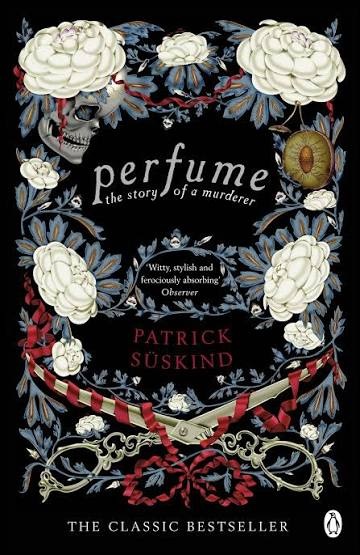
Perfume Review Introduction
Though not published that long ago (1985) Perfume: The Story of a Murderer by Patrick Süskind has achieved the status of a modern classic. A gothic fairytale, a dark fantasy, Perfume follows the life of Jean-Baptiste Grenouille in his quest to become the world’s greatest perfumer, a path that led him to commit several murders in pre-revolutionary France.
This review will look at why this novel and its anti-hero protagonist holds so much appeal, what its themes and messages are, and the aspects that make it unique. It will also look at where it has commonality with other stories, how it impacted one particular fan (Kurt Cobain) and his own output, and what the film adaptation has to offer.
Perfume: Plot Overview
Perfume, our narrator tells us, is the story of Jean-Baptiste Grenouille:
In eighteenth-century France there lived a man who was one of the most gifted and abominable personages in an era that knew no lack of gifted and abominable personages. His story will be told here. His name was Jean-Baptiste Grenouille, and if his name […] has been forgotten today, it is certainly not because Grenouille fell short of those more famous blackguards when it came to arrogance, misanthropy, immorality, or, more succinctly, wickedness, but because his gifts and his sole ambition were restricted to a domain that leaves no traces in history: to the fleeting realm of scent.
Paris, like other major cities of the time, is swathed in a disgusting stench. Without the modern amenities of sanitation, sewage and refrigeration, the overcrowded city sweats with human, animal and food waste while graveyards are full and collapsing.
In the period of which we speak, there reigned in the cities a stench barely conceivable to us modern men and women. The streets stank of manure, the courtyards of urine, the stairwells stank of mouldering wood and rat droppings, the kitchens of spoiled cabbage and mutton fat; the unaired parlours stank of stale dust, the bedrooms of greasy sheets, damp feather beds, and the pungently sweet aroma of chamber-pots. The stench of sulphur rose from the chimneys, the stench of caustic lyes from the tanneries, and from the slaughterhouses came the stench of congealed blood. People stank of sweat and unwashed clothes; from their mouths came the stench of rotting teeth, from their bellies that of onions, and from their bodies, if they were no longer very young, came the stench of rancid cheese and sour milk and tumorous disease. The rivers stank, the marketplace is stank, the church is stank, it stank beneath the bridges and in the palaces. The peasant stank as did the priest, the apprentice as did his master’s wife, the whole of the aristocracy stank, even the King himself stank, stank like a rank lion , and the Queen like an old goat, summer and winter. For in the eighteenth century there was nothing to hinder bacteria busy at decomposition, and so there was no human activity, either constructive or destructive, no manifestation of germination or decay in life, that was not accompanied by stench.
Amongst this, Grenouille’s mother works at a market gutting fish. It is there that she gives birth to Grenouille and faints. When the baby she gave birth to cannot be found she is charged with infanticide and decapitated.
Due to bureaucratic reasons, the baby Grenouille is not sent to an orphanage but to the cloister of Saint-Merri and handed to a paid wet nurse. But the wet nurse returns Grenouille to the cloister as soon as he no longer needs her. She complains he overeats making her unable to feed the other babies she is charged with.
Denying she is after more money, she has other reasons to be rid of Grenouille. She says he is a child of the devil and as evidence points to the fact that unlike other babies, who have a pleasant buttery scent, baby Grenouille has no smell.
Father Terrier of the cloister dismisses the wet nurse from her duty and her superstitions from his concerns. He is initially charmed by the baby boy. Until the baby wakes and begins to smell Father Terrier. Immediately, Father Terrier feels exposed, naked and sick and wants to be rid of the child. He sends Grenouille to an orphanage far out of the city paying for one year of his care in advance.
Madame Gaillard has no sense of smell ever since she was hit with a poker by her father. The injury also seems to have robbed her of all empathy and human passion but she can run an efficient orphanage.
As Grenouille grows into childhood he shows himself to have a strong constitution. He can survive on bad food, illness, the violent intentions of the other orphans and the lack of love and affection. He does seem to be a slow developer though, late to begin speaking. Because of her lack of a sense of smell Madame Gaillard does not notice Grenouille’s vocabulary is limited to describing what he can smell nor that he can already distinguish thousands of smells.
Instead, she suspects he possesses supernatural powers. Disturbed by this she seeks to offload the eight-year-old Grenouille as an apprentice to a tanner.
It is dangerous work but Grenouille understands he will not survive if he does not work hard and follow orders. He even survives a bout of anthrax which leaves him disfigured, even more ugly than he already was. His value as a worker rises, however, and this allows him greater freedoms and privileges.
In his free time he goes hunting for new scents. On one such night he follows a faint scent unlike any he has previously encountered and traces it to a teenage girl sitting outside cutting plums. In her scent, Grenouille experiences beauty and happiness for the first time and knows his purpose – to be a crafter of perfumes.
That night, his closet seemed to him a palace, and his plank-bed a four-poster. Never before in his life had he known what happiness was. He knew at the most some very rare states of numbed contentment. But now he was quivering with happiness and could not sleep for pure bliss. It was as if he had been born a second time; no, not a second time, the first time, for until now he had merely existed like an animal with the most nebulous self-awareness. But after today, he felt as if he finally knew who he really was: nothing less than a genius. And that the meaning and goal and purpose of his life had a higher destiny: nothing less than to revolutionise the odoriferous world. And that he alone in all the world possessed the means to carry it off: namely, his exquisite nose, his phenomenal memory and, most important, the master scent taken from that girl in the rue de Marais. Contained within it was the magic formula for everything that could make a scent, a perfume, great: delicacy, power, stability, variety and terrifying, irresistible beauty. He had found the compass for his future life. And like all gifted abominations, for whom some external event makes straight the way down into the chaotic vortex of their souls, Grenouille never again departed from what he believed was the direction fate had pointed him. It was clear to him now why he had clung to life so tenaciously, so savagely. He must become the creator of scents. And not just an average one. But, rather, the greatest perfumer of all time.
Perfume: Its Appeal, Genres and Uniqueness
Perfume: The Story of a Murderer by German writer Patrick Süskind was first published in 1985. It was a bestseller at the time and remains widely read. I think it would be fair to say it has achieved the status of a ‘modern classic’.
In some respects it is easy to see why it is so enjoyed. The novel has a great opening, plunging the reader into eighteenth century France. A bildungsroman, the narrator takes your through Grenouille’s life in distinct stages – structure like this is something that always appeals to me. Though not a long novel, Süskind manages Perfume’s pacing well to keep the reader turning pages.
Perfume also belongs to those novels where the author has skilfully combined fiction and non-fiction. As well as telling us his engaging story, Süskind educates the reader on the evolution and craft of perfumery, places the story within the context of the Enlightenment and development of modern science as well as considering the societal environment of pre-revolutionary France.
Perfume is a little difficult to categorise. While being the ‘story of a murder’ it is not a crime or mystery novel. Though Süskind vividly imagines the settings for the reader giving the novel its palpable realism, the story itself has almost supernatural aspects to it in the form of Grenouille’s talent and the impact his craft has on others. It could be described as fantasy. There is also a distinctly gothic nature to the novel as well. We are following the trail of a monster like readers have experienced reading Frankenstein or Dracula.
In Perfume, Süskind forces a perspective on the reader very different to what they might be used to reading. Whereas most novels bring their settings to life with what can be visualised, Perfume naturally focuses on describing through smell. Similarly, characters and their relationships take shape for the reader through their interactions. Perfume, though has relatively little dialogue and the reader’s responses are aroused via alternative routes.
Grenouille saw the whole market smelling, if it can be put that way. And he smelled it more precisely than many people could see it, for his perception was perception after the fact and thus of a higher order: an essence, a spirit of what had been, something undisturbed by the everyday accidents of the moment, like noise, glare or the nauseating press of living human beings.
Perfume: Themes of Isolation, the Halo Effect and Power
In Perfume, through Grenouille we see a conflict between the impulses that leads us to seek society and those that seek isolation. Grenouille is probably more given to the latter. But in order to fulfill his calling, he must seek out those who can help him. And like any art, it is nothing in isolation but instead requires an audience.
The disgust the reader might have for Grenouilles actions are mutual. Grenouille is equally disgusted by normal human behaviour. In this way, Perfume leads the reader to sniff out those aspects of culture we may find distasteful if only we gave them some independent thought instead of succumbing to norms or taking them for granted.
In our protagonist Grenouille we have yet another anti-hero. It is a feature of storytelling that has early antecedents we can find if we look for them but has really come to the fore in the last few decades with many popular iterations and shows no sign of disappearing soon.
While we might sympathise with Grenouille over the harsh way he is treated from childhood, the prejudices against him and the terrible obstacles he has overcome, there is no doubt that by his own actions and the beliefs that guided them that Grenouille gives the reader plenty to be disgusted by.
This disgust is complicated by the reader’s natural admiration for Grenouille’s considerable skill and gifts. Perfume asks us at what point does a lack of humanity, a lack of respect for the rights of others, even the right to life, overcome our admiration for a person’s talents and achievements? When can a deficiency in morality no longer be covered for by an abundance of genius?
It is a question people find themselves asking increasingly in the current world where those who have profited immensely from their talent (or just from luck) have an inordinately large say in the diminishment of the rights of others. A ‘Halo Effect’ persists where we allow our admiration for some traits distort our judgement and make excuses for the same person’s other behaviour.
Perfume is also a story about power. The ability of scent to influence people’s moods, responses and even actions is at the heart of the novel. Grenouille’s talent, therefore, does not merely allow him to produce a superior product for sale, to beat the market and amass a fortune; it allows him to manipulate people.
Odours have a power of persuasion stronger than that of words, appearances, emotions or will. The persuasive power of an odour cannot be fended off, it enters into us like breath into our lungs, it fills us up, it imbues as totally. There is no remedy for it.
Perfume can therefore be interpreted as an allegory for the ways we are being manipulated. By those who appeal to baser instincts, by those who control access to information, by those with ulterior motives. Despite all the misdeeds that count against Grenouille’s character, we might at least be thankful that he would rather remove himself from society than take full advantage of his power over us. I’m not certain real-life examples would make the same choice.
Perfume: Kurt Cobain and Nirvana’s In Utero Album
Perfume has a famous fan. Kurt Cobain was apparently obsessed with the novel, carrying it around with him and said to have read it perhaps more than ten times.
I had long known that the Nirvana song, Scentless Apprentice, from the band’s In Utero album, was a reference to Perfume and Grenouille. But I had no idea how far and deep the connection ran. According to Nathan Dunne at Literary Hub, several songs on the In Utero album, as well as its artwork contain references and inspiration from the novel.
So why was Cobain so taken with the novel? Is it that he relates to Grenouille? At the beginning of the novel, Grenouille is an outsider, ignored by others. But he finds a way to hide amongst them, become somewhat accepted. He rises by being an unconventional master of his craft, a man whose talent exceeds all, yet he can never truly become included. In the end he is still not understood and is devoured and destroyed by fans and fame. There is no place for him in society. Did Cobain sympathise with Grenouille’s arc?
Dunne suggests Cobain saw in Perfume the story of tortured artist struggling to produce art from the fragments of his difficult life. Cobain said he related to Grenouille’s disgust for other humans and his yearning to isolate himself from society. Such misanthropic feelings are something Cobain had confessed to possessing in various forms.
Perfume: The Tom Tykwer Film
Perfume was adapted into a 2006 film directed by Tom Tykwer and starring Ben Whishaw, Alan Rickman and Dustin Hoffman.
These days I avoid watching adaptations of novels I want to read but that was not yet the case when this film was released. I watch a lot of films and usually have a poor memory of them. Yet, the Perfume film has stuck with me despite seeing it only once before and that a long time ago. I can still vividly picture scenes from the film.
I have more television subscriptions than I should and yet Perfume was difficult for me to source. Eventually I found service where I could stream it and enjoy it again.
It is a good film and a fair adaptation of the novel. Tyker does well to impress the viewer with a sense of what the scenes must have smelled like and what the characters must have been experiencing, at least in the early part of the film. The sets and costumes were impressive too though I would have wished for all French actors or at least French accents rather than the British-American mix. It follows the plot fairly closely yet probably only gives a light touch to the themes as I have experienced them above.
Yet, the film is not as enjoyable as the novel. It cannot include the detail that made the novel interesting and engaging without over-narration or excessive dialogue. One other fault I found with the film did serve to illustrate something the novel also lacks and perhaps a reason why I found it good but not great.
Grenouille is very one-dimensional. He is simple and his life does not extend beyond where his talent and obsessions lie. He does not possess the complexity or the charm of other monsters such as Hannibal Lecter, Patrick Bateman or Count Dracula. Like the novel, the film humanises Grenouille in the end, perhaps more profoundly than the novel does.
Final Verdict: A Novel Whose Appeal Lies Both in what is Unique and what it has in Common
Perfume has a lot to offer. An anti-hero story that has things to say about human nature and culture may remind some of Ellis’ American Psycho. The isolated loner disgusted by society may also remind readers of Dostoyevsky protagonists. A serial killer whose victims are difficult to connect due to his unusual motive is reminiscent of The Silence of the Lambs.
But Perfume combines this with unique features. For the most part, there is the focus on the world seen through the olfactory sense. There is also the message that as far as we may think culture has distanced us from our animal past, we remain exposed to influences waiting to be weaponised that can easily reduce us to basic instincts.
See also:
 We Need to Talk About Books
Strange that you should post this today. It’s many years since we read the book and saw the film, and haven’t mentioned it in years, until my husband spoke of it yesterday for some reason. And then your review appeared … Thanks for sharing. 🙂
LikeLiked by 1 person
Thanks for commenting. It certainly has that effect, that is pulls you back even years later. A bit like The Talented Mr Ripley for me.
LikeLiked by 1 person
And now I need to rewatch Mr Ripley! Great film. 😊
LikeLike