
We have all fantasised about what we would do if we won a lottery and became instantly rich enough to never need to worry about money. Yet, we have also heard stories that such events often end in divorce and even bankruptcy. John Steinbeck’s The Pearl, follows a poor pearl diver whose discovery of an extraordinary treasure appears to offer freedom, prosperity and opportunity for his family.
Yet Steinbeck uses this tale to show that in a corrupt society, a sudden rise from poverty to wealth can instead attract greed, exploitation and violence. The Pearl combines emotional and social depth with the universality of a parable to make a short yet powerful work. Experimental but staying focused on character and story, The Pearl shows what made Nobel Laureate Steinbeck one of the twentieth century’s greatest writers.
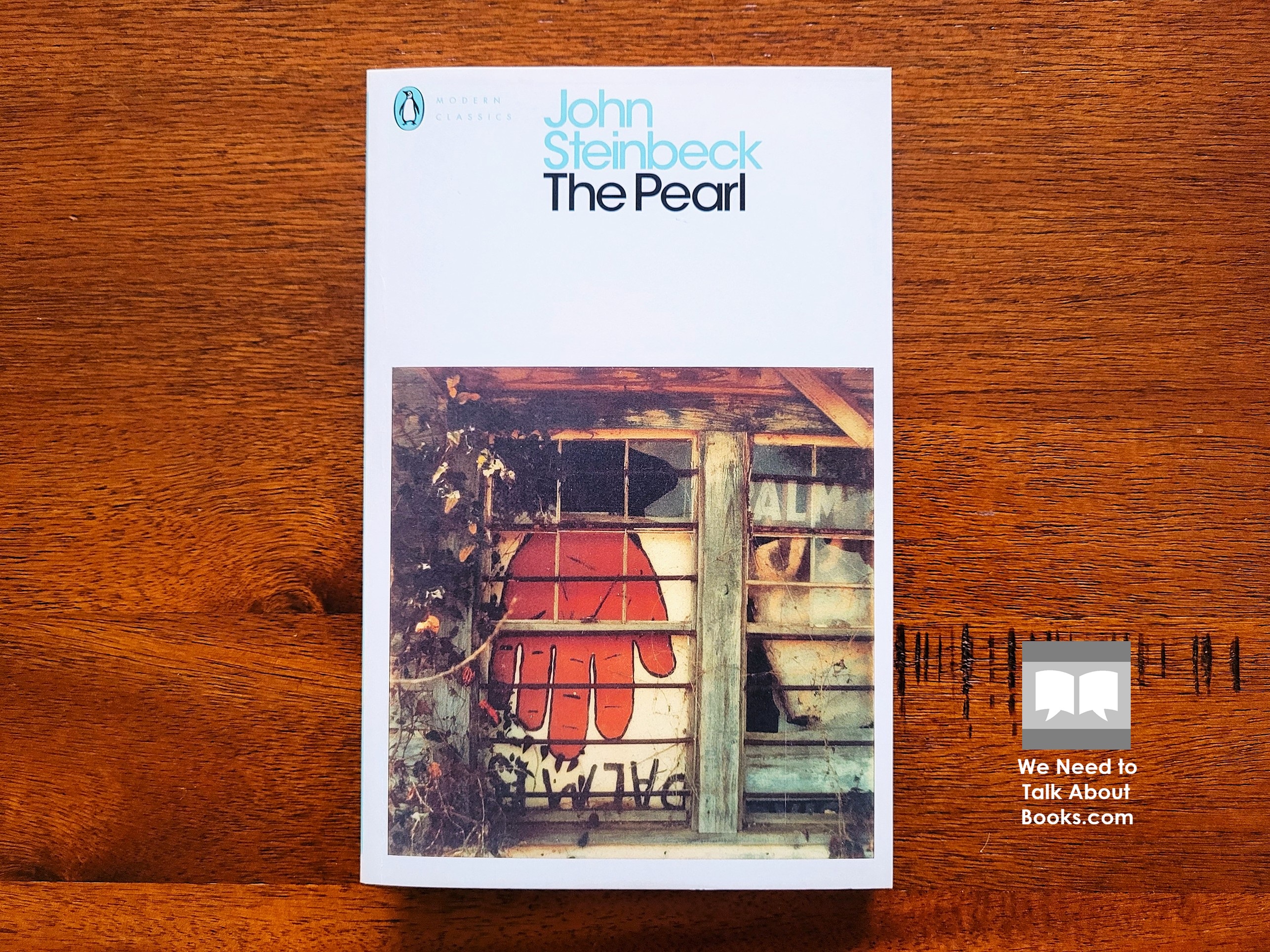
The Pearl: Review Introduction
John Steinbeck’s The Pearl (1947) was the result of inspiration on several fronts. The first was the interest Steinbeck received from those wishing to make a Mexican film and were seeking a screenplay. This played into Steinbeck’s own desire to write a story featuring Mexican characters at a time when Mexican-Americans were increasingly the target of racial discrimination.
For the story, Steinbeck may have taken inspiration from certain antecedents including the Bible. He nevertheless created an original work utilising an experimental format to create a novella which has been interpreted as critiquing the American Dream, capitalism and their assumptions.
This review will introduce the plot and discuss the format and major themes of The Pearl. It will show The Pearl is necessary reading for fans of Steinbeck and might also be one of the best introductions for those unfamiliar with his work.
The Pearl: Plot Overview
Kino wakes in his brush hut in the early dawn to the sound of cocks crowing and waves on the beach. His wife, Juana, starts a fire to make them a breakfast of corn cakes.
It was a morning like other mornings and yet perfect among mornings.
But danger strikes before the day has barely started. A scorpion has stung their baby, Coyotito. Juana sucks as much poison from the wound as she can but the baby might still die. The commotion draws a crowd of neighbours to their hut. Juana wants to call the doctor but the neighbours say the doctor won’t come. A defiant Kino says they will go to him.
Arriving at the gate of the doctor’s house, his doorman will not give them entry. Showing them the small, misshapen pearls in their possession – their only collateral – is not enough to persuade the doctor to see them.
Returning to their home, Coyotito’s swelling has spread but there is no sign of fatal stomach cramps yet. Meanwhile, Kino goes diving for oysters. Juana prays for a great pearl that will pay for the cost of a doctor. Kino spots a large old oyster and brings it up. Inside he finds a large pearl, perfectly round. And Coyotito’s swelling is receding.
Asked by his neighbours what he will do now that he is rich, Kino says that he and Juana will get married in a church, they will have new clothes, he will get a rifle and Coyotito will go to school.
But news of his new wealth has swiftly travelled all over town. The priest visits to remind Kino to give thanks. The doctor visits too. Coyotito has improved but the doctor warns of reversal. Kino’s fears for his son melt his scepticism and rage at the doctor.
Kino feels trapped as the doctor gives the baby pills and says an attack will come within the hour, which it surely does. The doctor returns and cures Coyotito’s stomach cramps and gives Kino the bill.
At night Kino hears an intruder in his hut. Kino attacks but is hit on the head. Juana wants Kino to throw the pearl away, she says that it is evil and will destroy them. But Kino does not want to abandon his dream of a better life for his family.
The Pearl: Another Excellent Story by my Favourite Author
Before I had read The Pearl, John Steinbeck was already my favourite author. I had thus crowned him after reading Of Mice and Men, The Grapes of Wrath and – especially – East of Eden. Before I read any of his work, those three books were the only ones I intended to read but by becoming my favourite author I had to read more. I have since enjoyed Tortilla Flat and Cannery Row.
So, before reading The Pearl I already had a sense of what to expect and Steinbeck did not disappoint. The scene creation is extraordinary. The economy of words is exceptional. Altogether the writing is simply beautiful.
A town is a thing like a colonial animal. A town has a nervous system and a head and shoulders and feet. A town is a thing separate from all other towns, so that there are no two towns alike. And a town has a whole emotion. How news travels through a town is a mystery not easily to be solved. News seems to move faster than small boys can scramble and dart to tell it, faster than women can call it over the fences.
In the six works of Steinbeck I have read, making comparisons is difficult. That is because he never settles on a style or format but is continually experimenting and trying his hand at something different. His skill allows the diverse works to still come across as readable, literary and powerful.
Of Mice and Men ventures into terrain between a play and a novella. The Pearl has similar features. In the Introduction to the 2000 Penguin Modern Classics edition that I read, Linda Wagner-Martin says The Pearl grew out of Steinbeck being encouraged to write a screenplay for a film that was to be produced by a Mexican film company bypassing the Hollywood system.
The screenplay model possibly encouraged the minimalism and directness of Steinbeck’s approach here.
Inspiration Behind The Pearl
The Pearl was first published in 1947 when Steinbeck was already an accomplished author. Apart from East of Eden (1952) all the works I mentioned above had been published by then. But why approach Steinbeck for a screenplay for a Mexican film?
Dissatisfied as he had become with American materialism and the pressure to be loyal to a system that oppressed the poor, Steinbeck focused on the chance to write something truthful. He also hoped his screenplay would promote understanding among races.
– From the Introduction
Wagner-Martin points to Steinbeck’s upbringing where he had Mexican-American friends, his lifelong curiosity with Mexico which he visited and his sense that Mexico’s importance to American culture was being overlooked.
The story also came shortly after the Zoot Suit Riots and other violent events that suggested growing racial tensions.
As for the specific story and its themes, Wagner-Martin again looks at the lower-middle-class values Steinbeck grew up with. She also cites the influence of stories, poems and parables that Steinbeck would have been familiar with such as the parable in the Gospel of Matthew of the jewel merchant among others.
The Pearl: A Critique of the American Dream and Capitalism
The Pearl could be said to belong to that catalogue of novels, short stories, plays and films that critique the ‘American Dream’, which also includes Steinbeck’s The Grapes of Wrath. These stories tackle the American Dream from various angles. Some show how the dream is not accessible to all.
Kino hesitated a moment. This doctor was not of his people. The doctor was of a race which for nearly 400 years had beaten and starved and robbed and despised Kino’s race, and frightened it too, so that the indigene came humbly to the door.
Some show the fallacy of rewards awaiting those who work hard and have good character.
And this Kino knew also – that the gods do not love men’s plans, and the gods do not love success unless it comes by accident. He knew that the gods take their revenge on a man if he be successful through his own efforts. Consequently Kino was afraid of plans, but having made one, he could never destroy it.
The Pearl appears to belong most to the set whose message is to attack the presumption that wealth alone can solve the problems of poverty. For the family in The Pearl, their sudden riches create escalating dangers. So much so, that it is not surprising Juana urges Kino to get rid of the pearl.
Kino felt the rage and hatred melting toward fear. He did not know, and perhaps this doctor did. And he could not take the chance of pitting his certain ignorance against this man’s possible knowledge. He was trapped as his people were always trapped, and would be until, as he had said, they could be sure that the things in the books were really in the books.
Wagner-Martin also suggests the story is a critique of capitalism. Perhaps it is, given its setting and what we know of Steinbeck.
For every man in the world functions to the best of his ability, and no one does less than his best, no matter what he may think about it. Quite apart from any reward they might get, from any word of praise, from any promotion, a Pearl buyer was a Pearl buyer, and the best and happiest Pearl buyer was he who bought for the lowest prices.
However, I feel the impulse to greed and power are endemic in human society. The crime, violence and corruption these impulses inspire occur under all socio-economic systems and, in theory, are the enemy of them all. In practice, the manner in which these vices manifest might vary between systems, but the extent to which they are permitted to exist and have influence is more owing to the faults in the people in power than to the faults of the system necessarily.
Instead, I feel the best method to subdue these vices and those who wish to benefit from them is to strengthen democracy. Pointing the finger at whichever economic system is in force is probably a scapegoat. Further, (and agreeing with Wagner-Martin) I think the format Steinbeck has used in The Pearl, similar to a parable, implies the story is archetypal and universal to all.
All manner of people grew interested in Kino – people with things to sell and people with favours to ask. Kino had found the Pearl of the World. The essence of pearl mixed with the essence of men and a curious dark residue was precipitated. Every man suddenly became related to Kino’s pearl, and Kino’s pearl went into the dreams, the speculations, the schemes, the plans, the futures, the wishes, the needs, the lusts, the hungers, of everyone, and only one person stood in the way and that was Kino, so that he became curiously every man’s enemy.
Juana and Kino and their Contrasts
Despite the story’s brevity, Steinbeck has clearly given the reader a lot to dwell on regarding the characters and motivations of Juana and Kino.
In some respects, they resemble stereotypical male and female roles. Juana is supportive, accepting and forgiving. She has more wisdom and common sense than Kino. In contrast, Kino is a risk-taker, a dreamer and is unrealistic. But he is not selfish. His motives for using the pearl to turn his family’s life around are respectable until fanaticism takes over.
I won’t say more here. Wagner-Martin gives plenty more to consider such as Kino’s spiritual journey, his psychological transformation and the role of his son who is an added feature to Steinbeck’s version of the story compared to his antecedents.
Conclusion: The Pearl is a Worthy Member of Steinbeck’s Oeuvre
Like his more famous works, The Pearl is a powerful tragic story with a profound social message. It short and simple format belies the complexity it contains and the different ways it may be interpreted. While experimental, Steinbeck again shows both his versatility and the versatility of literature when in the hands of master who knows to keep the basics of story and character in focus. For fans of Steinbeck like myself who have read his major works and want more, The Pearl is a must read. For those new to Steinbeck it possibly provides an easier introduction than Of Mice and Men or his other shorter works.
 We Need to Talk About Books
I’ve got a first edition of this novel, and I bought it for only $10AUD. It’s not such a bargain as it sounds, because when I looked it up at Abebooks, it’s not so rare, they must have printed thousands of them for distribution all over the world. Without a dustjacket they sell here for about $80-100.
Anyway, I haven’t read your review yet because I haven’t read the book, but I will make a note of it to come back to when I have read it! (Which ought to be soon, I’ve had it for ages.)
LikeLiked by 1 person
It will be worth your time and it won’t take much time at that!
LikeLiked by 1 person