
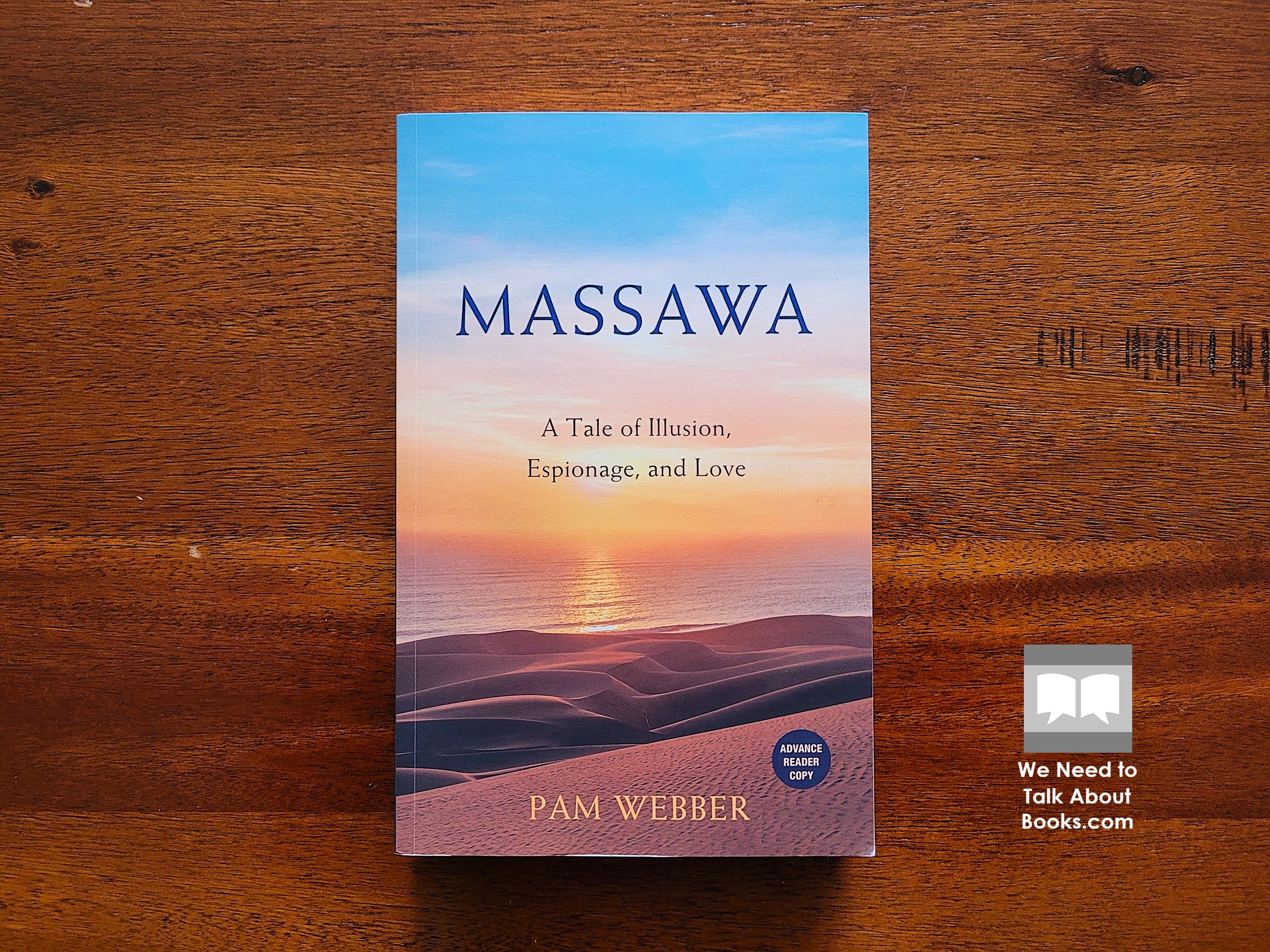
In Massawa, Pam Webber takes readers to a forgotten corner of the war — the blistering ports and mountain roads of Eritrea — where spies, smugglers, colonial tensions, and hidden loyalties may decide the fate of North Africa. What could have been merely an intriguing historical footnote becomes, in Webber’s hands, a tense and remarkably accomplished espionage novel.
Massawa Review Summary
Massawa is the latest novel by Pam Webber. Based on real events and inspired by real people – particularly the American women who worked as spies in North Africa – Massawa takes readers to Eritrea at the height of World War II. With the war in the balance, undercover operations in overlooked Eritrea will play a large role in the outcome of the war.
Webber follows two spies – the fledgling American Kit Thomas on her first mission and British MI6 agent Mark Williams – to investigate fraud that is thwarting the Allies efforts in the country and aiding the Fascist advance to Egypt and the Suez.
In a deadly and beautiful landscape, various factions are vying to turn the momentum of the war in their side’s favour. Other groups and individuals have their own agenda. After a rocky start, Kit and Mark have to learn to trust each other. There is very little else they can trust in the world they have entered.
This review will show that Massawa is not just an intriguing idea for a story, but that Pam Webber has succeeded in converted it into a novel with excellent writing and clever use of tempo and misdirecting the reader.
Massawa will be published in June 2026. We Need to Talk About Books was provided with an advanced copy in return for an independent review.
Massawa: Plot Overview
In Washington DC, Katherine – Kit – Thomas is rushing to an emergency meeting. It is 1942 and the US has entered the war in Europe. Kit was previously an intelligence analyst for the Department of War. She has now been recruited by Jake Morgan, the Assistant Director of the OSS (Office of Strategic Services); America’s first international spy agency. Kit hopes Jake’s reasoning for recruiting her are both professional and personal, not that Jake has shown any interest in her personally.
Their meeting is with a Special Committee to investigate the National Defence Program. On their way they are intercepted by Mark Williams, a navy lieutenant. It seems plain to Jake and Kit that they are being watched.
The committee, headed by Senator Truman is endeavouring to uncover fraud endangering the war effort.
In less than a year, the Truman Committee had uncovered numerous instances of private contractor fraud, embezzlement, waste, and shoddy workmanship in buildings and supplies essential to the war effort. Not only were these contractors swindling American taxpayers out of billions of dollars, but they were also contributing to the deaths of an untold number of American and British soldiers, seaman, and airman. Today, in an attempt to catch one of these corrupt contractors, she and Jake were going to ask this powerful committee to put their work on hold, at least for a while, and just in a small, unknown corner of the world.
Kit has uncovered that millions in payroll money for civilian workers at a US naval base at Massawa, Eritrea, is being diverted. The private contractor insists it is just a bookkeeping issue. But marked bills have been traced to a bank in Cairo that is known to do business with Nazis. MI6 intercepts suggest the contractor’s manager and Nazi sympathisers may be responsible.
The matter has significant urgency. Rommel is moving across Libya in an effort to take Egypt and the Suez. It would be a strategic disaster for the allies if he were to succeed. Despite this, Jake manages to persuade Truman to give them two weeks to uncover what is going on in Eritrea with an OSS agent and an MI6 agent working together.
The country, an Italian colony, has been seized by Britain. But the retreating Italians destroyed much of the military infrastructure in their retreat leaving the British unable to make best use of the region. America’s entry into the war promised a renewed effort to make its bases functional again. Now these missing funds are giving the Rommel and the Nazis the advantage in the war of North Africa.
Kit is to be the OSS agent in Eritrea. Her cover will be to act as a courier for messages between US and British offices in the capital, Asmara, and those in the coastal city of Massawa where the naval base is located. She will be given an Eritrean driver for the journey that is 70 miles each way.
He turned to her with angst in his eyes. “Do you know what the Nazis and Vichy are doing to spies, Kit? A firing squad if you’re lucky. Rape, torture, mutilation, prison, a concentration camp, gas chamber, or human oven if you’re not. They have spies everywhere, including Eritrea, and they’re ruthless.”
Despite her training and confidence, arrival in Eritrea presents several complications. The country is full of Italian POWs living freely – the allies lack the resources to imprison them. Italian colonists have also stayed behind. Eritrea being the only home they have known, they live segregated from the indigenous locals. There is also an active Eritrean resistance movement conducting their own operations against their enemies.
The journey she must take as courier from Asmara to Massawa is a perilous route through difficult mountain roads and baking desert. Extreme measures must be used to survive the climate in Massawa.
“We’re guzzling water and downing salt all the time. It’s the only way you can work in this hellacious heat. The rule of thumb is if you work inside an office with fans, you should drink half a litre of water and take a salt tablet every two hours. If you’re working in and out of the mechanical shops, you drink at least a litre of water and take two salt tablets every hour.” She paused and pointed down to the quay where dozens of shirtless men were working. “And if you’re one of the poor guys working in direct sun, it’s two litres of water and four salt tablets every hour. Commander Ellsberg has trucks circulating around the base constantly to make sure every building and work station is fully supplied with fresh water and salt.”
Then there are the personalities she must handle. From the staff at the American and British offices and her hotel, the senior military leaders and her Eritrean driver.
Most of all is her chief suspect; the manager of the contractor at the centre of the fraud. A Frenchman with possible Vichy connections, Jacque Dumas is known for his drinking and womanising and Kit’s arrival has not escaped his notice. Kit would like to avoid him but as he is central to her mission, she may have to risk returning his attention.
Perhaps equally vexing is her partner. It turns out the MI6 agent she is to work with is the same Mark Williams who she came across in Washington. A dual citizen and a more experienced agent he makes no effort to hide the preparations he made for her arrival. Feeling somewhat manipulated, Kit finds Mark to be arrogant and dangerous. Both will need to find a way to work together and keep the focus on their overlapping missions.
Against their dangerous mission to solve a mystery that could turn the war is the backdrop of the country of Eritrea. Like other colonies during WWII, it faces a period of revolutionary change and an uncertain future. Kit and Mark cannot help but be affected by its harsh but beautiful landscape, ancient history and culture, and resourceful people. Yet they cannot yet see how these will play a role in their mission.
The Padre sighed. “Eritrea has been a pillaged country since before Moses parted the Red Sea. Marauding countries, one after the other, came here to take the resources, enslave the people, and steal the children to fight in foreign wars. The Italian Fascists have been the worst. They’ve done their best to annihilate the countries indigenous people, their culture, and their history – to bury everything that is Eritrean under their Romanesque buildings and tree-lined boulevards. Eritrea is struggling to save itself.”
A Novel that is Well-Researched and Skilfully Infused
My over-arching response to Massawa is that Pam Webber is a very good writer who has produced a well-written novel.
We have all read novels set in a non-contemporary time or a setting unfamiliar to most readers that required extensive research by the author. Often, the details included have little to do with the story and it feels like the writer is trying to show the reader they have done their homework.
Sometimes it is relevant but poorly infused with the story. Reading these novels can feel like you are switching from reading fiction to non-fiction and back.
Sometimes it feels poorly timed. The relevant information comes up too close to the event in the story as if to say ‘See? My unlikely plot event is plausible!’
But Webber avoids all these traps. Her research builds a world for the reader and serves several purposes. It is successfully merged with the fictional story. And I did not feel toyed with as a reader but that care was taken in how to allow the story unfold naturally.
A Cleverly Considered Structure
That care is also apparent in how Webber has structured Massawa. The novel has a slightly unusual flow. The plot builds to a dangerous, action-packed peak before easing back to an aftermath that might be assumed to be the conclusion of the story.
Except that it occurs earlier in the book than you might expect and is somewhat prolonged. It turns out that there is still more to the story to come.
A cynical reader might suspect this was added to create an opening for sequels. Except it is no afterthought. Webber has clearly crafted the first two-thirds of the novel in such a way as to leave room for alternative interpretations of events.
It is rather cleverly done. Like many WWII stories, Massawa is a microcosm of seemingly minor events that will impact a much larger global war. Webber has let her characters, and hence the reader, believe that scenario too. That assumption is discredited in the last third of the novel where we see the undercover world Kit and Mark have entered has wider scope than they or the reader assumed. This is enough to quiet the cynic in me.
“I feel like such a fool.”
“Then welcome to the world of espionage. It’s where people are fooled every day. Illusion is the basis of everything we do. Sometimes we’re better at it than the enemy and sometimes we’re not.”
A Novel with Broad Appeal
I had some quibbles about Massawa but they all seem either too trivial to trouble with or were successfully defeated by Webber’s writing.
Is Massawa a ‘romance’? It certainly has a romance element, mostly subdued for much of the novel but appearing strongly in small parts. But I don’t believe readers like me who dislike romance should miss out on experiencing Massawa.
Is Massawa ‘literary’? As you might expect, from an espionage novel with a romance element, Massawa is more focused on plot and character than on larger themes. Yet, the historical, cultural and geographical setting, and the care with which it has been used, will appeal to those who wish to feel that what they are reading goes beyond the plot and characters.
In other words, Webber has written a novel that can claim to have broad appeal.
In Conclusion: Massawa is a Great Idea Webber has Turned Into an Accomplished Novel
I think a wide range of readers will find Massawa enjoyable. Those who like their overlooked WWII stories, spy novels, historical fiction and colonial settings will find much appeal here. In addition, the character dynamics and their motivations against a dangerous exotic setting gives the story genuine tension and excitement.
Pam Webber is already working on the sequel to Massawa.
Massawa will be published in June 2026. We Need to Talk About Books was provided with an advanced copy in return for an independent review.
 We Need to Talk About Books