
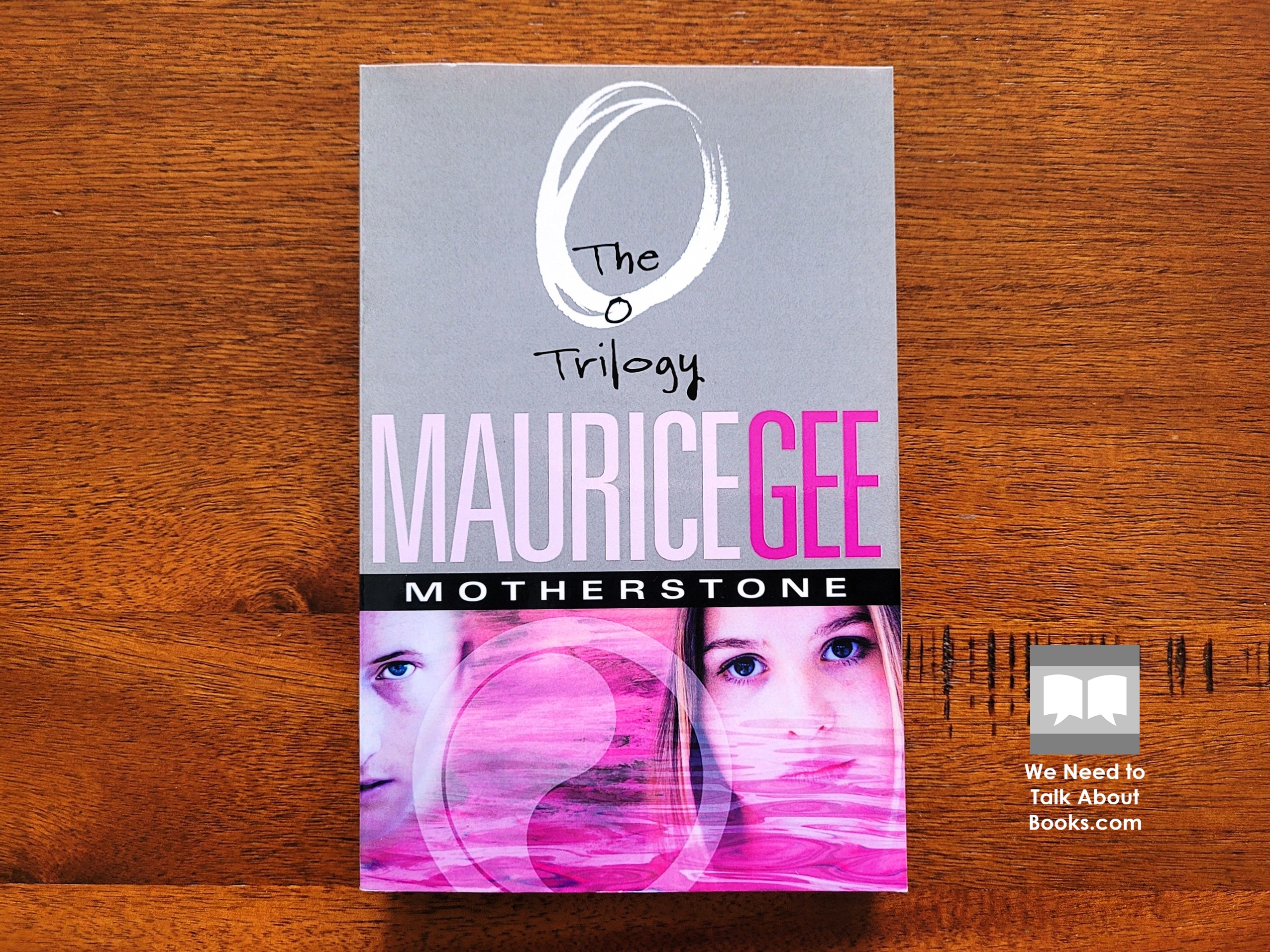
What if one of the most endearing Cold War novels on the 1980’s was actually a New Zealand young adult fantasy? Maurice Gee concludes his excellent O Trilogy with Motherstone; a novel that considers weapons of mass destruction, wars to end all wars and defeating division with unity.
Motherstone Review: Introduction
Motherstone completes Maurice Gee’s excellent O Trilogy. Breaking with the episodic format of the first two books, Motherstone is full of surprises. Again, Gee gives the readers a tense, exciting and action-packed story in a short young adult novel.
And again, he has arguably included themes that go far beyond the scope of a typical young adult novel; addressing real world issues and giving young minds much food for thought.
This review looks at parallels between Motherstone and other fantasy and spy novels such as His Dark Materials, The Lord of the Rings and Tom Clancy’s novels. It will also place Motherstone in the context of the Cold War period it was first published in. This review will also argue for Motherstone’s distinctly New Zealand feel in its characters and themes.
Motherstone also differs from some other fiction in its treatment of how to prevent inevitably bad outcomes.
New readers are advised that since Motherstone is part three in a trilogy, this review contains spoilers with regards to the first two books, The Halfmen of O and The Priests of Ferris.
Motherstone Review: Plot Overview
In The Priests of Ferris, the previous novel of The O Trilogy, Susan and Nick, two preteens from Earth have once again saved the world of O from itself. This time by taking down the organised religion that had established totalitarian rule over O since their adventures in the first novel, The Halfmen of O.
Thanks to them the religion and its High Priest have fallen. The humans of O have risen up, ready to govern themselves. The prospects for O are potentially bright but uncertain, though this is not for Susan and Nick to concern themselves with. Their only worry is to get themselves back home.
They reach the cave where they can travel from O to Earth. They have the shy – the herb that has the power to transport them. But before they can return, a gang abducts them, their shy is taken and they are prisoners, not for the first time.
The leader of the gang is Osro. He is a former Candidate – a priest who was in line to becoming High Priest. He has faked his death and discarded his priests robes. As he tells his accomplices, the time of the priests is over, they are not coming back, but he can still become all powerful.
Susan’s revolution thwarted his plot to overthrow the High Priest and take his place. But he can still achieve the rest of his plan. He has uncovered designs for the construction of a powerful weapon that would make him unmatched in battle. He will travel north to the Hotlands where he has been in contact with the nomadic human tribes. With them and his weapon he can form an unbeatable army to rule all of O.
He needs Susan as a hostage but only until he reaches the Hotlands. He will keep Nick alive for now but only in case he can be of use. Nick and Susan must bide their time until there is an opportunity to escape.
Meanwhile, Kenno – father of Limpy who brought Susan and Nick from Earth to rescue his sister Soona from the priests – has been made Chief Minister, leader of the freemen of O. Kenno is overwhelmed with the task of preventing human society from collapse following the revolution.
Bandits and former priests roam the increasingly lawless land. And, like the aftermath of any revolution, different factions are forming. Some, seeking power for themselves are challenging Kenno for his position. Another totalitarian ruler seems far more likely for O than anything resembling liberal democracy.
When news of Osro’s plans and his weapon reach the freemen, its leaders are dismissive and incredulous before recognising both the danger and the opportunity. Soon both sides are marching towards a war that seems more likely to destroy O and leave the victor the ruler of a wasteland.
Once again, Susan and Nick must recruit help from the non-humans of O – the Birdfolk, Stonefolk, Woodlanders and Seafolk – come up with a plan that can subvert the path the world seems set on and save O from itself. As often in life, doing things the right way has little chance of success, but it is the route they must take to show the would-be rulers of O what real unity looks like.
She could not believe humans had ever passed this way. And she needed humans, she needed friends, she had to talk and find out what it was she had to do. She knew her bond with O was special one. Twice she had been called, and somehow not completed her task. Now it seemed three was the special number. Three would make things whole. But what must she do?
It seemed to her Jimmy would not know; or Nick. Or Limpy or his father. They were too practical, too violent. The Birdfolk might. They belonged on O. And Ben, the Varg. And Soona – especially her. She seemed to have intuitive knowledge. And the Woodlanders. They had it too. A knowledge and a wisdom thousands of years old, bred in them by their long communion with Oo. She must find Woodlanders, and find Soona.
The O Trilogy: A Great Series
The O Trilogy blew me away. I was not at all prepared for how entertaining, well-written and surprisingly sophisticated this young adult series would be. Maurice Gee employs great imagination and has produced tense, action-packed storylines. He gives his characters a feeling of wholeness and depth. And he has achieved this despite the brevity of the three short novellas.
And yet these stories cover themes such as the balance of good and evil within all individuals; the totalitarian instincts of organised religion; mutually-assured destruction within a Cold War setting; and the potential offered by cooperation over domination.
I hope the series continues to be discovered by new generations of readers.
The O Trilogy’s Likeness to Other Series
In my reviews of the previous two novels – The Halfmen of O and The Priests of Ferris – I wrote of similarities to other series I have experienced. The O Trilogy had striking commonalties with Phillips Pullman’s His Dark Materials.
That trend continued in Motherstone. Here the human-animal pairings became more common, the bonds deeper and took many forms. Again, it feels like a precursor to those found in His Dark Materials, particularly the first novel, Northern Lights (aka The Golden Compass).
The northern human tribes who we had not encountered previously and were no recruited by Osro, brought to my mind the humans that fought for Sauron in The Lord of the Rings. In both cases, it seemed to suggest a divide among humans represented by the settled contrasted with the nomadic, with an accompanying strong racial and cultural divide.
Motherstone: A Cold War Novel
While The Priests of Ferris dealt with the totalitarian instincts of organised religion, Motherstone, has the feel of a cold war novel.
We have two emerging superpowers, rising after revolution. Each are constructing weapons of mass destruction. Each are heading towards war, oblivious of the likelihood of mutually assured destruction and the prospect of the victor ruling over the O equivalent of a nuclear winter.
All that can prevent this is a small group of agents acting independently. If it sounds a bit like a Tom Clancy novel, it is a bit. First published in 1985, Motherstone is right in that period where Clancy made his name.
But Motherstone is not an American novel but a New Zealand one. The agents make no claim of possessing moral superiority and neither belong to nor favour either side. Instead, they are engaged to prevent the worst possible outcome, taking into account all who call O their home. Their lack of pretensions are evident by the fact that success will win them no power or even acknowledgement of what they have achieved.
[Nick] thought of the statues of Susan and himself at the Temple. They were broken too. His fame would not live in this world any longer than Claw’s. He found the thought oddly comforting. More and more he had the sense of not belonging on O. It was as if he and Susan had been called to do a job – like carpenters or plumbers – and when it was done they would go back home and be forgotten, and their work would be just a part of things.
Motherstone appeared in the period leading up to New Zealand’s Nuclear Free Zone, Disarmament, and Arms Control Act of 1987.
The Inevitability of the Possible
There is an idea that appears in storytelling from time to time. The idea that if only Pandora’s Box had not been opened, all that is ill and evil might have been prevented. Doc Brown in the Back to the Future Trilogy comes to regret ever building a time machine. Victor Frankenstein is another. Recognising the dangers of the method he has invented, he will never give up its secrets.
But Doc Brown and Victor Frankenstein’s efforts to keep secrets and destroy knowledge will prove in vain. If it is possible to open Pandora’s box then given enough time and opportunity, it will inevitably be opened. If they can build a time machine or create life there is nothing to stop others from replicating their work independently.
We can see this in our current world. The knowledge, ability and resources to build a nuclear weapon are not difficult to obtain. The basic technology is almost a century old. In fact, if it had been kept secret we might have expected worse outcomes by now since no one would be prevented from using them by the knowledge that others had them too.
The worst possible outcomes cannot be prevented by destroying knowledge and living in ignorance. If turning their possibility into an impossibility by physical means is not an option, then you have to develop systems to make their likelihood satisfactorily low or making the cost of employing them unsatisfactorily high.
Easier said than done. But it is something readers like me will dwell on while reading Motherstone.
‘Listen! Here is what I have found. The fire that consumes the world. The fire that eats up stone, that swallows O. I have made it – and shall unmake. I shall tear all knowledge of it from my brain, I shall carry all the work of my hands to the deepest place and bury it, and no one will ever find it again. I shall do that. But – what I cannot do is tear it from the brains of those who follow. I cannot. And one day some clever human will find it – and then, be he good or evil, the last days are come.’
Appreciating Jimmy Jaspers
Having reached the end of the series I wish I had said more in my reviews about Jimmy Jaspers. He is a crucial part in all three novels and quite a character. Despite his villainous beginnings, he provides a moral compass second only to Susan’s and becomes a gritty but loveable member of the ensemble.
Providing a bit of lightness and comedy, Jimmy is probably the most ‘Kiwi’ of the main characters. Rugged and outdoorsy, with a no-nonsense attitude and a strong sense of loyalty, he belongs to a pantheon of blokes in New Zealand literature. I wished I had noted his various quips and witticisms to share.
Final Verdict: Is Motherstone and the O Trilogy Worth Ready?
I am so glad I collected and read Maurice Gee’s O Trilogy. Even for an adult reader these were a pleasure to read. Gee’s writing is exceptional to produce entertaining stories rich with deeper themes in volumes of only about 180 pages. As I said previously, each book could have been three times as long and it would not have diminished its impact.
I hope new readers continue to discover and enjoy Gee’s work and those who read him in childhood to rediscover him with fresh eyes. His series deserves to be widely read and their deeper meaning appreciated.
 We Need to Talk About Books