
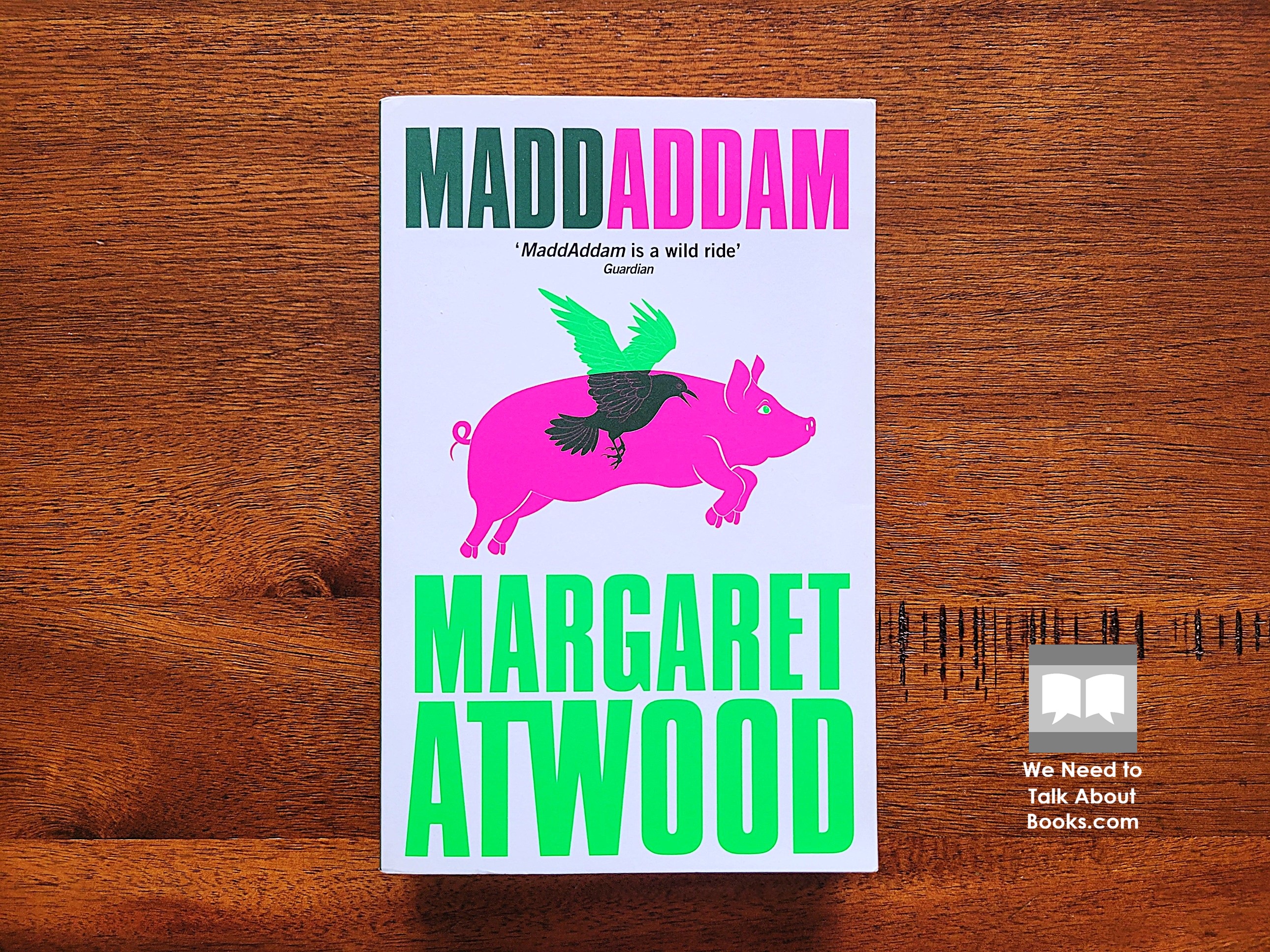
How do you end a story that is about the end of the world? In MaddAddam, Margaret Atwood concludes her dystopian trilogy not with a clean resolution but rather a fragile new beginning. The survivors of the destruction of the world must navigate not just a new way of living but negotiate with those they will now share the world with.
MaddAddam Review Introduction
Margaret Atwood’s MaddAddam brings her dystopian MaddAddam Trilogy to a close. Reuniting the scattered survivors of a global pandemic, this third novel moves the story forward from the first two. Like the survivors the reader must appreciate the new world taking shape will be very different to the ruined old one. Humans will have to share the world with two other genetically modified species and will have to buy into a new mythology developing to explain this new world order.
MaddAddam Review Summary
MaddAddam picks up at the dangerous moment where the two previous novels jointly left the reader on edge. As well as the broader struggle for post-apocalyptic survival, Jimmy, Toby, Ren and the Crakers must deal with violent Painballers and increasingly intelligent Pigoons.
Like the previous novels, MaddAddam prioritises worldbuilding and character backstories over a tight plot. Though it still benefits from Atwood’s writing skill and creativity and explores some new interesting themes, it also shares some of the issues of the previous novels while its strengths are not as strong.
New readers are advised that since MaddAddam is the third part of a trilogy, this review will contain spoilers with regards to the first and second parts; Oryx and Crake and The Year of the Flood.
MaddAddam Plot Overview
The two previous novels in the MaddAddam Trilogy – Oryx and Crake and The Year of the Flood – both build to and end at the same cliff edge.
Jimmy the Snowman, survivor of a global pandemic has realised he is, after all, not the last human alive. He has found a few other survivors camped by a fire in the woods and dares to approach them. What he does not realise is that two of them are Painballers – criminals who have survived participation in a guerilla-warfare-style incarceration known as Painball. They are armed, violent and dangerous.
With the Painballers is Amanda – a young woman who is their captive. They are holding her to sexually abuse her and possibly ransom her.
Also approaching the camp is Toby and Ren on a mission to rescue Amanda. Prior to the pandemic, Toby was a member of a commune known as the God’s Gardeners and Ren and Amanda were her students there. The God’s Gardeners preached of the coming of a ‘waterless flood’ that would eradicate most of mankind. Their time there gave Toby, Ren and Amanda the skills to survive the pandemic in their own way.
Ren also knows Jimmy from her past; they were once in a relationship.
Following behind all of them are the Crakers. The Crakers are a humanoid species bioengineered by Jimmy’s brilliant once-best-friend, Crake.
The Crakers arrival on the scene throws the situation into chaos. They are terrified to see Jimmy, whom they consider a prophet, to be succumbing to the fever from an infection on his wounded foot. They are appalled to see the Painballers tied to a tree by Toby and assume they need to be freed. They are also thrown in confusion by Amanda and Ren who they perceive as being ready to mate.
Toby is powerless to intervene. They manage to make it back to Cobb House where they had been staying but the Painballers escape with their weapon. Toby feels guilty she did not kill them when she had the chance but the moral lessons she imbibed from the God’s Gardeners left her confused in the moment.
Cobb House is where the MaddAddams have set up base post-pandemic. Many of them were once God’s Gardeners. They left following a split between two of the Gardener’s founders – the leader, Adam One, and Zeb, also known as MaddAddam and who happens to be Adam’s half-brother. Unsatisfied with the Gardener’s more pacifist approach, the MaddAddams became an ecoterrorist organisation.
Their activities attracted the attention of Crake, who offered them immunity from their crimes in return for their skilled work on his project – bioengineering the Crakers. So, when Toby returns with Jimmy, Ren and Amanda, the MaddAddams know all about Crakers who come with them.
Toby unexpectedly finds herself the centre of the Crakers attention. With Jimmy in an induced coma while he recovers from his infection, they look to Toby to fill Jimmy’s role as a prophet and storyteller. They especially want to hear about Zeb. They sense an aura about him with his physicality, his intelligence, his proactivity and his history of embarking on and surviving dangerous missions. Zeb is like a Hercules or Odysseus figure to them.
Toby has also begun a relationship with Zeb and in their spare time together she scours his life story for material to tell stories to the Crakers.
‘Help me out here,’ says Toby. ‘I need more to go on, for the Crakers. They’re insatiable on the subject of you.’
‘Like what?’
‘You’re their hero. They want your life story. Origins, your supernatural deeds, your favourite recipes. You’re like royalty to them.’
‘Why me?’ says Zeb. ‘I thought Crake did away with all that. They aren’t supposed to be interested.’
‘Well, they are. They’re obsessed with you. You’re there rockstar.’
‘Lord fuck a dog. Can’t you just make up some piece of crap?’
‘They cross-examine like lawyers,’ says Toby. ‘At the very least I need the basics. The raw material.’ Does she want to know about Zeb for the sake of the Crakers, or for herself? Both. But mostly for herself.
‘I’m an open book,’ says Zeb.
‘Don’t be evasive.’
Zeb sighs. ‘I hate going back to all that. I had to live it, I don’t like reliving it. Who cares?’
‘I do,’ says Toby. And so do you, she thinks. You still do care. ‘I am listening.’
But there is also the matter of figuring out how they all can survive in the post-pandemic world. The Painballers – and who knows who else – are still out there.
Equally dangerous are the pigoons; pigs that have been genetically modified to grow human organs for transplant. Since the pandemic they are loose, dangerous and have been increasingly clashing with the territory human survivors assume is theirs. The pigoons were also modified to grow human brain tissue and there are signs they are developing high level intelligence of their own.
Also troubling Zeb is the fate of his half-brother, Adam One, whom he believes has survived as well.
Unlike The Year of the Flood, MaddAddam Does Advance the Plot
In my review of Orxy and Crake, the first novel of The MaddAddam Trilogy, I said that I enjoyed it more than I expected.
However, in my review of the second novel of the trilogy, The Year of the Flood, I said I was disappointed. Mainly because, while The Year of the Flood gave us insights into new characters and expanded this pre-and-post-pandemic dystopian future, it did not advance the story much beyond what we’ve already read in Oryx and Crake.
Together the two novels seemed a strange take on a trilogy. Rather than an overarching story, the focus instead seemed to be on these few characters and the world they inhabited.
MaddAddam does at least begin where the two previous novels ended and does advance the story. But it does take a while before a plot begins to take shape. And again, much of the focus is not on the main plot but on telling the life story of one of the main characters. This time it is Zeb.
The Diminished Return of Previous Characters and Coincidental Reunions
Toby too has a large role as compiler of Zeb’s story and substitute prophet for the Crakers. In a way, the mythology she crafts takes the place of the sermons of Adam One from The Year of Flood. But I was disappointed that Jimmy the Snowman had almost no role in MaddAddam. I even missed Ren’s voice. To have two of the main characters from the first two novels sit on the sidelines for much of the third seemed a waste. What was the point of giving us their life stories only to drop them now?
Another aspect I found a little odd from the previous novels was how the survivors of this pandemic were all closely connected through their pre-pandemic lives. True, what connected them also happened to be something which made it more likely for them to be among the survivors. But it still stretched credulity at times and MaddAddam was no different.
There’s a chance that some of the God’s Gardeners have survived because if anyone would know how to wait out the pandemic that killed almost everyone else, it would be them. During all the years that she spent with them, first as their guest, then as an apprentice, and finally as a high-ranking Eve, they’d planned for catastrophe. They’d built hidden places of refuge and stocked them with supplies: honey, dried soybeans and mushrooms, rose hips, elderberry compote, preserves of various kinds. Seeds to plant in the new, cleansed world they believed would come. Perhaps they’d waited the plague out in one of these refuges – one of their sheltering Ararats, where they hoped they’d be safe while riding out what they termed the Waterless Flood. God had promised after the Noah incident that he’d never used the water method again, but considering the wickedness of the world he was bound to do something: that was their reasoning. But where will Zeb look for them, out there among the ruins of the city? Where to even begin?
MaddAddam: The Story of Zeb
I had said how much you liked The Year of the Flood would come down to how much you got from reading the life stories of Toby and Ren. The same is true for MaddAddam and the story of Zeb. His life as an adult certainly has some extreme turns and wild adventures, but it was the story of his upbringing that I found most interesting.
Adam and Zeb’s father was a reverend. In perhaps a tongue-in-cheek prediction of the future of American Evangelicalism, their megachurch was a Church of Petroleum. It had put together a theology to support the fossil fuel industry and raked in money as a result.
As children, Adam and Zeb couldn’t be more different. Adam, the older half-brother, was quiet, methodical and contemplative. Zeb was impulsive and, not only indulged bad behaviours, but was adept at them. He becomes a lockpicker and a hacker. Adam increasingly became a model with which to shame Zeb which resulted in Zeb lashing out and pranking Adam.
But the brothers have each other’s backs as well. And as they grow up and come to understand the perils of their future with their father, they can see mutual advantage in finding a way out.
The relationship between Adam and Zeb made me feel like here lies another common thread in this series. They are not the same as Crake and Jimmy from Oryx and Crake. But they feel similar.
Adam, like Crake, seems to possess a devious intelligence behind his calm and quiet exterior. Their relationship at times seems to be one more of convenience and mutual interest than genuine affection. Like Crake, below the surface Adam is formulating plots and plans. Jimmy and Zeb, clever as they are, can be caught off guard by the conclusions Crake and Adam have reached. And you wonder if one or both are being used.
The plotting against one’s parents is also a common factor in the novels. Parricide seems a strange choice of theme and I can’t say what it means but it is there.
‘No matter what was at stake, he couldn’t go on the offensive, not directly. Remember, he was the first born; the Rev got hold of him early, before either of us figured out what a fraud the murderous old bugger actually was. What stuck with Adam was that he had to be good. Gooder than good, so God would love him. Guess he was going to do the Rev thing himself, but do it right – everything the Rev had pretended to be, he would be in reality. It was a tall order.’
MaddAddam: Final Verdict
Looking back on the trilogy, Oryx and Crake is still my favourite of the three novels. It has the advantage of the being the formative novel and it manages the backstory of its main character with an unfolding plot in the present best. It left me optimistic for the rest of the series.
The Year of the Flood was a disappointing follow up for me. I did not engage strongly with the main characters and the plot did not advance. But the imagination of Atwood’s worldbuilding was a highlight.
I think I enjoyed MaddAddam least. Zeb’s life story and the new elements in the world had their moments but I preferred those of the earlier novels. And though the plot advanced and, like Oryx and Crake, it built up with some tension, it did not feel like it was the focus of the novel.
Altogether, it is a somewhat odd trilogy. The character backstories and worldbuilding were given priority rather than any overarching plot. It almost felt more like episodes in a continuing story than a self-contained trilogy.
I was reassured to see that several reviewers were also disappointed with the series and for similar reasons to my own. We are very much in the minority however. The series remains highly-rated by most readers.
Throughout, Atwood’s writing and imagination were excellent. I am glad to have experienced the series but these will not be books that I will revisit. Atwood remains the author of one of my favourite novels (The Blind Assassin). I had hoped this series would help cement her as one of my favourite authors but I will have to look to her other works for support for that.
 We Need to Talk About Books