
Kingsley Amis’ famous comic novel had me expecting a hapless but lovable academic stumbling from one disaster to another. Instead, I found Jim Dixon to be anxious, petty, socially awkward and frequently his own worst enemy. Lucky Jim is funny, but perhaps not quite in the way I expected.
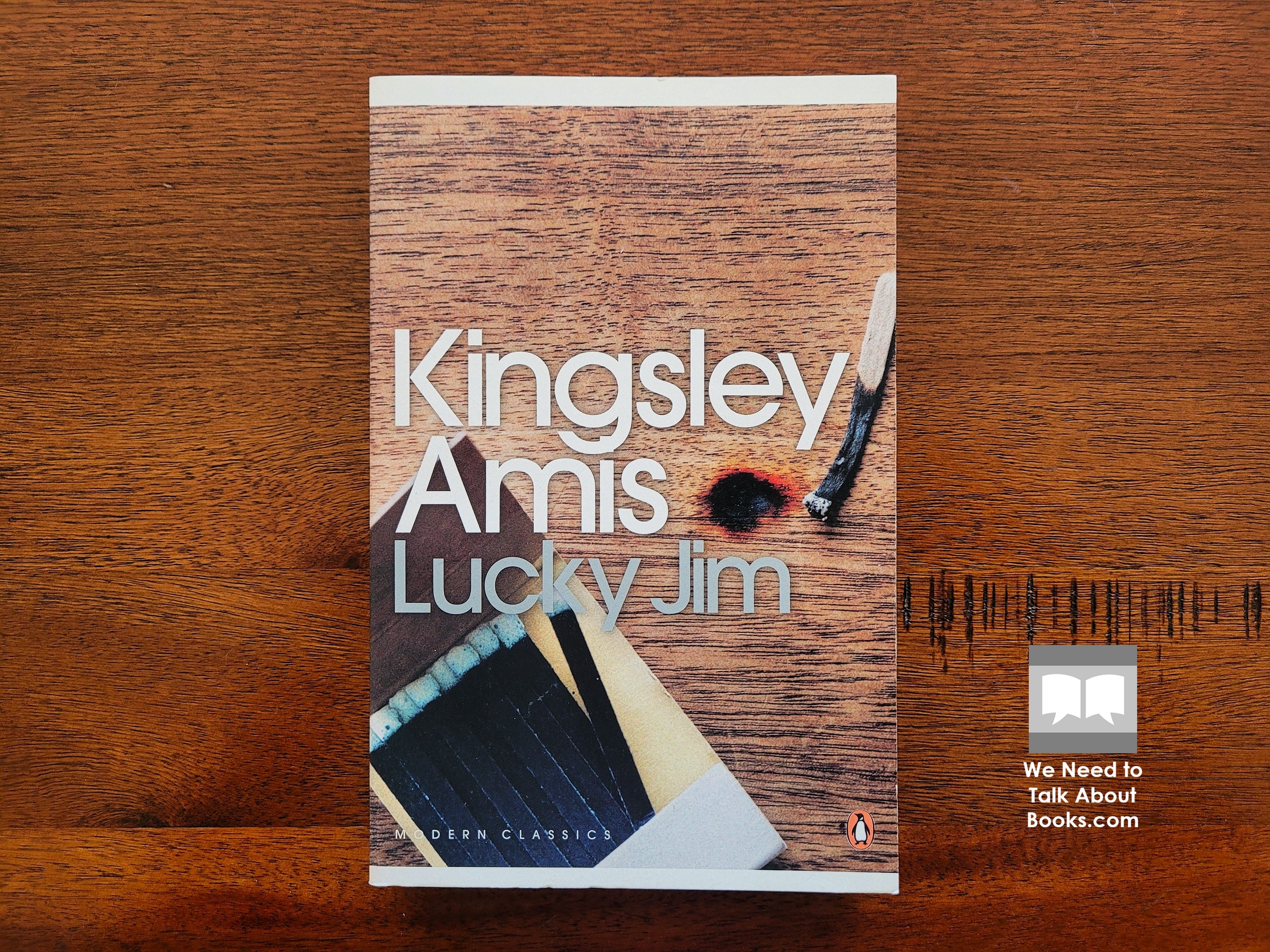
Review Introduction
I came to Kingsley Amis’ Lucky Jim (1954) because of its reputation. A breakthrough hit for Amis, it is often held up as one of the great comic novels of the twentieth century. That was enough to pique my interest and, having enjoyed Amis’ Everyday Drinking, I had a good idea of what style of humour to expect.
At the centre of the novel is Jim Dixon, a junior history lecturer desperately trying to keep his precarious academic career afloat while navigating an equally precarious romantic life. A weekend with his pompous head of department and his family promises to be an opportunity to impress the right people. Instead, it becomes a catalogue of social disasters and poor decisions. Lucky Jim is certainly funny, but not as funny and rather darker than its reputation had led me to expect.
Plot Overview
Jim Dixon is painfully close to achieving satisfaction, if not happiness. He has accidentally landed a job in the history department of one of Britain’s new red brick universities. His on-again-off-again relationship with a young woman named Margaret might be back on again. And he might actually get his academic paper published.
But his life is far more precarious than he would like. His position is only probationary and the offer to publish his paper sounds a little non-committal. Until he can land a permanent position he needs to suck up to his head of department, Professor Welch. Part of that means spending the weekend with the Welch’s as they host a gathering of friends and family.
His date with Margaret is hardly encouraging. Small, thin and bespectacled, Margaret is also a lecturer like Jim. She tells him all about her overdose of pills, a suicide attempt over a breakup with another man. Though Jim is unsure Margaret is right for him, and Margaret probably has similar feelings for Jim, she is not about to let him off the hook.
He’d been drawn into the Margaret business by a combination of virtues he hadn’t known he possessed: politeness, friendly interest, ordinary concern, a good-natured willingness to be imposed upon, a desire for unequivocal friendship. It had seemed only natural for a female lecturer to ask a junior, though older, male colleague up to her place for coffee, and no more than civil to accept. Then suddenly he’d become the man who was ‘going round’ with Margaret, and somehow competing with this Catchpole, a background figure of fluctuating importance.
Jim has several other worries as well. Dealing with overzealous students on subjects he is barely interested in teaching. Interacting with the other low paid academics he lives with in their lodgment house, the nearest people in his life to friends. Preparing for a big lecture he needs to deliver on ‘Merrie England’. And barely having enough money to find escapism in alcohol.
The weekend at the Welch’s sounds torturous. Jim has even asked someone to call the house to give him an excuse to leave. He is expected to participate in madrigal singing. Then, to his horror, he is asked to solo. Fortunately, the arrival of Professor Welch’s son Bertrand interrupts proceedings.
Things go from bad to worse for Jim at the Welch’s. Gaffes, faux pas, arguments and drunkenness threaten disaster. Meanwhile, Jim comes to realise he is attracted to Bertrand’s girlfriend Christine.
Lucky Jim’s Early Impressions and Legacy
The publication of Lucky Jim (1954) was something of a breakthrough hit for Kingsley Amis. It became popular and successful, was adapted into a film as soon as 1957 and helped establish Amis as a young new writer on the literary scene. Amis got included with others of his generation as part of the ‘angry young men’ movement, an implication he repudiated.
Lucky Jim was also recognised as a great comic novel. It is frequently said to contain the best hangover scene in all literature. Recommendations like this is how it came to pique my interest. Having read Amis’ collection, Everyday Drinking, I had something of an idea of what to expect. Not necessarily laugh-out-loud, but dry, witty, old-school British humour.
Jim Dixon’s Likeability
For most of the novel, I found Jim Dixon is a difficult character to like. He is an overthinker; his inner monologue full of thoughts flying at high velocity. He is painfully socially awkward. This sets up much of the comedy which is of the situational, comedy of manners, type. But as difficult and precarious as his life may be and the situations he finds himself in, Jim does himself no favours with various acts of self-sabotage and sometimes mean-spirited argument.
Everybody hates you, Dixon, and my God I can see why.
Jim’s mistreatment of Margaret, probably worse than anything he can claim from her treatment of him, I found unbecoming. I had to wonder if Jim really wanted either of Margaret or Christine, if either of them were right for each other or if Jim was simply too jealous and possessive to allow anyone else to have them.
As Jim says later to Christine, ‘I’m sticking to Margaret because I haven’t got the guts to turn her loose and let her look after herself, so I do that instead of doing what I really want to do, because I’m afraid to.’
– From the Introduction
By the end, though, I think I found some sympathy for Jim. He is a young man with no good options for his life. No occupation seems fulfilling, no partner seems complementary, no friend has his best interests. And lacking the self-knowledge to know what he wants, he pursues what he can get.
How wrong people always were when they said: ‘it’s better to know the worst than to go on not knowing either way.’ No; they had it exactly the wrong way round. Tell me the truth, doctor, I’d sooner know. But only if the truth is what I want to hear.
Lucky Jim in the Context of the Campus Novel and 1950’s Britain
The Introduction by David Lodge to the Penguin Modern Classics Edition I read adds more context to this interpretations of mine.
The campus novel is mostly an American invention and Lucky Jim was an early British iteration of the genre. As opposed to a varsity novel, which is about student life, the campus novel is about the faculty. Yet, Lucky Jim avoids the topics of typical campus novels such as academic politics, intellectual competition and inappropriate sexual relationships.
Instead, Lucky Jim is centred around social events and gatherings. In this, it is like older English literature about the elite though told from the view of an outsider. Lodge considers what works influenced Amis as well as who Lucky Jim has influenced in turn such as Malcolm Bradbury and Howard Jacobson.
While the comedy aids the reader in forgiving Jim his faults, especially his treatment of the women in his life, the novel is probably not as funny as memory or legend has led people to think. I was a victim of this. And it also possesses a darkness around the fringes. In Jim’s anxiety about his career and social prospects there is a sense of a post-war Britain of austerity and uncertainty.
It was one of those days when he felt quite convinced of his impending expulsion from academic life. What would he do afterwards? Teach in a school? Oh dear no. Go to London and get a job in an office. What job? Whose office? Shut up.
Lucky Jim Final Thoughts
Lucky Jim concludes well. It is to Amis’ credit that he gives the reader a satisfying story arc in the end. I could not help feeling well of this novel and pleased for Jim. Though Lucky Jim is probably a novel whose reputation exceeds its reality, it is worth investing in. Especially if you are interested in the evolution of the campus novel genre and in the popular culture that spoke to those Brits who grew up in the war years and who faced an uncertain future.
 We Need to Talk About Books