
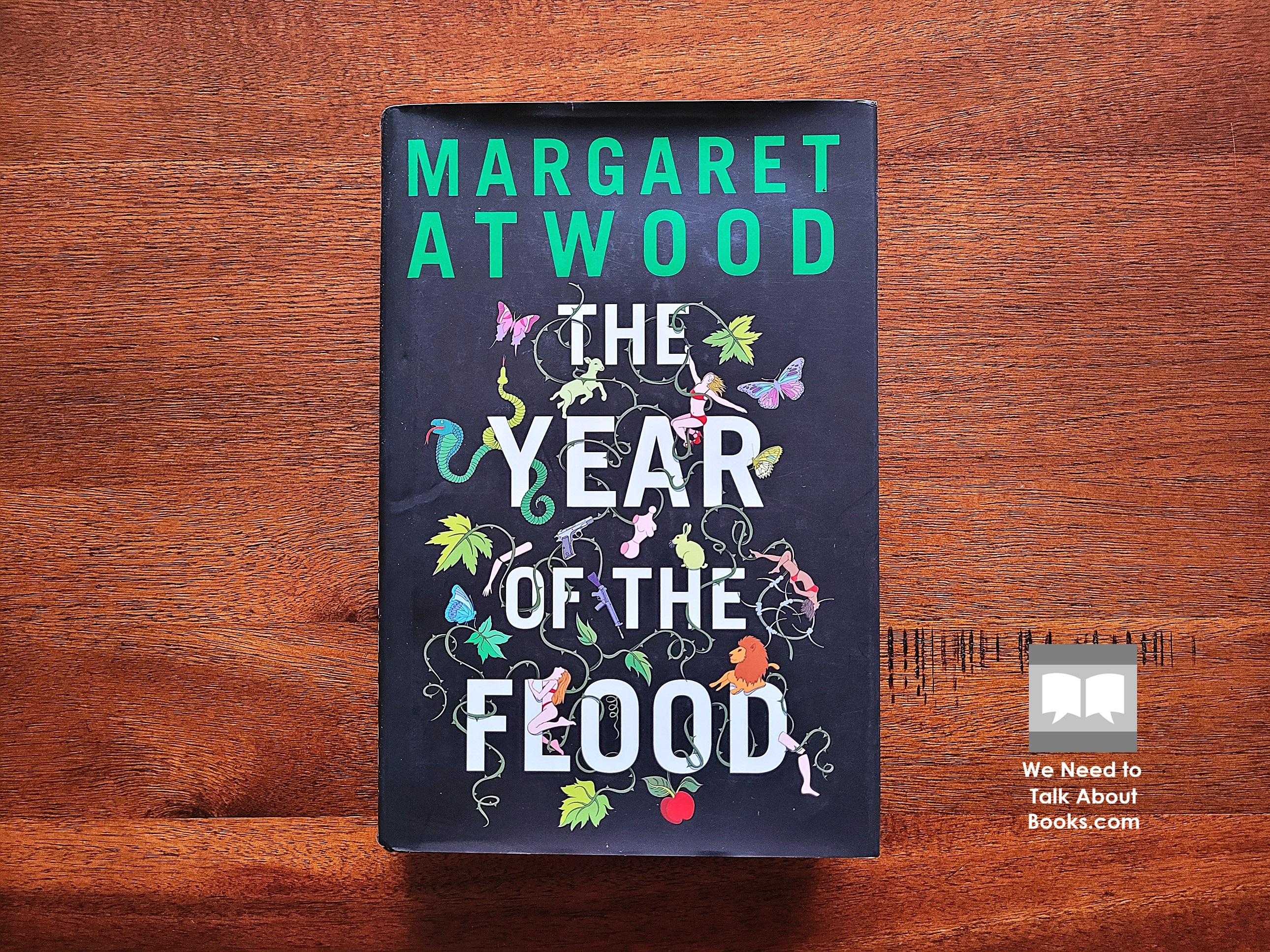
This The Year of the Flood review covers plot summary, themes, and analysis of Margaret Atwood’s second MaddAddam Trilogy novel, and examines whether it improves on Oryx and Crake or repeats it.
The Year of the Flood Review: Introduction
Margaret Atwood’s The Year of the Flood, the second instalment in the MaddAddam Trilogy, returns readers to the post-apocalyptic world of the first novel, Oryx and Crake. Rather than advancing the timeline, Atwood shifts perspective, retelling the collapse of civilisation through the intertwined lives of two women, Toby and Ren.
The Year of the Flood Review Summary
Readers familiar with Margaret Atwood’s work will see strengths in The Year of the Flood that they have come to expect. Such as the quality of her writing that makes for easy reading; her creativity in conceiving this pre and post-apocalyptic world; and the playing out of consequences that create sharp social commentary without explicit moralising.
Yet, there are also similarities to her other work such as religious revivalism and the sexual exploitation of women. While it cannot be disputed that these are relevant and important, they do contribute to a sense of repetition across her works. Within The Year of the Flood, there are also a series of increasing coincidences between characters that undermine the story’s realism.
Rather than continuing events from Oryx and Crake, The Year of the Flood is a parallel narrative and more of a companion than a sequel. Having the story told by two new female characters does add depth and new perspective. But by not being a true sequel the story does not advance in a meaningful way. How much you enjoy this novel will depend on how much the life stories of the two main characters, Toby and Ren, engage you.
New readers are advised that since The Year of the Flood is the second novel in a series, this review may contain spoilers for the first novel Oryx and Crake.
The Year of the Flood Plot Summary
Toby is busy tending her rooftop garden when she spots pigoons – genetically modified pigs – attempting to dig into her ground level garden. If they manage to get in, her long-term food supply will be gone and so will her sanctuary. She gets her rifle but has become conditioned against killing. The pigoons spot her and flee but she manages to kill one.
The building Toby has barricaded herself within was once a spa. Anooyoo was a chain of facilities for the ultrawealthy to undergo extreme and often experimental enhancements. Replacement skin for their entire body being on their newest popular offerings. Toby was the manager at this spa but was secretly hoarding supplies for the global pandemic she assumed was coming.
Once it arrived, she still took the dangerous risk of venturing far from her sanctuary to recover the illegal rifle she buried under a neighbour’s patio.
This was not an ordinary pandemic: it wouldn’t be contained after a few hundred thousand deaths, then obliterated with biotools and bleach. This was the Waterless Flood the Gardeners so often had warned about. It had all the signs: it travelled through the air as if on wings, it burned through cities like fire, spreading germ-ridden mobs, terror, and butchery. The lights were going out everywhere, the news was sporadic: systems were failing as their keepers died. It looked like total breakdown, which is why she’d needed the rifle. Rifles were illegal and getting caught with one would have been fatal a weak earlier, but now such laws were no longer a factor.
Toby’s knowledge of how to survive on her own is thanks to her time in the God’s Gardeners. A sect that merged Christianity with science and prophesised the coming of a ‘Waterless Flood’ that would wipe out most humans, the God’s Gardeners prepared for their prophesy by learning to live off the grid and create their own food, energy and medical supplies.
Toby wonders how long she can last on her supplies, how long she can deter the pigoons and whether anyone else is still alive.
She might be surprised to learn that Ren, who was a student of hers at the God’s Gardeners has also survived. When she left the God’s Gardeners, Ren went to work at Scales and Tails – a franchise of strip clubs and brothels.
My Dance Callisthenics teacher said I should talk to Scales and Tails. I was a good enough dancer, and Scales was part of SeksMart now, which was a legitimate Corp with health benefits and a dental plan, so it wasn’t like being a prostitute. A lot of girls went into it, and some of them met nice men that way and did very well in life afterwards. So I thought I might try for it. I wasn’t likely to get anything better without a degree. Even a Martha Graham degree was a lot better than none. And I didn’t want to end up as a meat barista at some place like SecretBurgers.
Girls who work there are often underage runaways, the clients can be dangerous and drugs are rife. When a client got a little carried away, Ren had to be isolated in the ‘sticky zone’ while she awaited her test results.
She was fortunate to be still inside when the pandemic reached her. As long as the solar generation still works she has filtered air and clean water plus enough food for now. But she is locked in from the outside and expects anyone with the passkey is now dead.
Both Toby and Ren have harrowing life stories to share. As young women, alone and without reliable parents, they have had to navigate a path for survival in the Pleeblands – the increasingly lawless and impoverished urban world the majority of people now inhabit. They have had to endure and escape from sexual and physical abuse. For a time they found a home amongst the God’s Gardeners but the Gardeners powers of protection were not absolute.
Even now, they know they are not safe. The have survived the pandemic but survival post-apocalypse is a different matter. Self-sufficiency is a dangerous assumption and they will each have to venture out, find new shelter and supply and risk encounters with other survivors.
Themes and Writing Style in The Year of the Flood
I have enjoyed Margaret Atwood’s writing ever since I read The Blind Assassin. She has a style that I find very easy to read and the pages fly by much more rapidly for me than for other writers. Her stories are well-crafted as well and make for memorable reads.
She also has great imagination. I mentioned the Anooyoo spa and the Scales and Tails sex clubs above. In my review of the previous novel of this series, Oryx and Crake, I mention some of the products of the genetic engineering corporations. Two more worth sharing from the near-future world she has created are SecretBurger and Painball.
SecretBurger are burger franchises. The ‘secret’ is that you don’t know what is in the meat they are serving. Is it cat, racoon, human? No one can be sure. But in a world where ‘normal’ meats like beef are rare and unaffordable except for the wealthy, SecretBurger is where most people can get their fill. For people looking for work in the Pleeblands SecretBurger offers minimum wage and free ‘food’. Toby is one who seeks employment there.
Painball is where those found guilty of crimes are likely to end up. Sounding a bit like The Hunger Games, a bit like a Roman gladiatorial contest, Painball pits criminals against each other in a guerrilla warfare-style scenario. Though, possibly not intended for entertainment, they have inevitably attracted an audience. Survivors are released from their sentences. The problem is that these criminals are far more dangerous on release. They now possess all of their unrepented criminal past combined with real combat experience.
These and more populate Atwood’s world of the near-future and speak to the inventiveness, playfulness and cautionary tales of her imagination. If anything, she showed restraint. The services available at Anooyoo potentially open the possibility of a whole other thematic can of worms – racial engineering – which she stopped short of exploring being beyond the scope of the novel.
And yet, I could not help feel there is also much here we have seen before.
Having read The Handmaid’s Tale, Oryx and Crake and now this companion novel; religious revivalism and the sexual slavery, exploitation and abuse of women in the dark near-future are recurrent themes. Atwood is probably not wrong in imagining these dangerous in a dystopian future (and as commentary on the path of our present) and if these were a series of speculative non-fiction books they would have a place. But in fiction readers don’t want to feel that what they are reading is predictable, even tiresome, no matter how relevant or important the issues are.
Does The Year of the Flood Offer Anything New?
Compared to its predecessor, this second MaddAddam novel has two female protagonists to Oryx and Crake’s one male. The story flicks back and forth between them and from past to present and from first to third person. The novel is also interspersed with hymns from the God’s Gardeners and sermons delivered by their leader Adam One. Despite this potential for confusion, Atwood is a skilled enough writer to make this flow easily.
The Year of the Flood covers the same timeline as Oryx and Crake. Toby and Ren in their sanctuaries are in a parallel time to Jimmy the Snowman in his tree in Oryx and Crake (it means Jimmy is not as old and the pandemic not as historical as I assumed them to be in Oryx and Crake). Their life stories up to that point also overlap.
Having the perspective of two women in this world in this post-apocalyptic sequel does offer new opportunities for the story. It is probably subjectivity on my part that I struggled to relate to their stories. Also, the reader can be somewhat sympathetic to Jimmy in Oryx and Crake as our lone protagonist giving his version of events. Seeing him here from the perspective of the women who knew him reframes his character and his story granting more complexity and less sympathy.
But it also means readers who already read Oryx and Crake will know much that will unfold in The Year of the Flood. And I think the question has to be asked if the occurrences in the story are too unnecessarily coincidental. It is as if in the post-apocalyptic world most of the survivors happen to be from the same high school or workplace or know each other by just one or two degrees of separation.
As the story goes on the coincidences mount without much underlying cause to explain them. Connections to the God’s Gardeners and their preparation for the apocalypse are not sufficient for all of them. The coincidences serve to add depth to big moments in the plot as the characters know how events may impact others. But it comes at the expense of realism.
Like the themes in common with some of her other works, the plot of The Year of the Flood was predictable at times and that is not what you want.
Final Verdict: Is The Year of the Flood Worth Reading?
I am surprised The Year of the Flood has such a high rating on Goodreads. Even with Atwood’s clever imagination, her skill at making her books easy to read, I felt the novel needed to deliver a bold ending to redeem it. I assume readers engaged with Toby and Ren’s life stories to a greater extent than I did.
The Year of the Flood did very little to advance the story from Oryx and Crake. That left me needing to summon more enthusiasm to proceed to the third novel – MaddAddam – than I should have required. Readers wanting a true sequel to Oryx and Crake may be left wanting more.
 We Need to Talk About Books
Really interesting review, you make some great points. I’d be frustrated too if I was expecting a sequel and didn’t really get that.
LikeLiked by 1 person
It is a strange ‘trilogy’. Thanks for stopping by!
LikeLiked by 1 person