
When we think of Jimmy Carr, we often picture rapid-fire one-liners, razor-sharp wit, and puns that land with surgical precision. So, it’s natural to assume that any book bearing his name would be a playful romp through the mechanics of comedy. Yet The Naked Jape, co-authored with Lucy Greeves, defies those expectations. While it is infused with humour and littered with jokes – as one might hope – it is, at its core, a serious and probing exploration of humour’s psychological, historical, and social dimensions. The book dares to ask uncomfortable questions about the ethics of laughter, the cultural impact of offensive jokes, and the shifting boundaries of what can be considered funny.
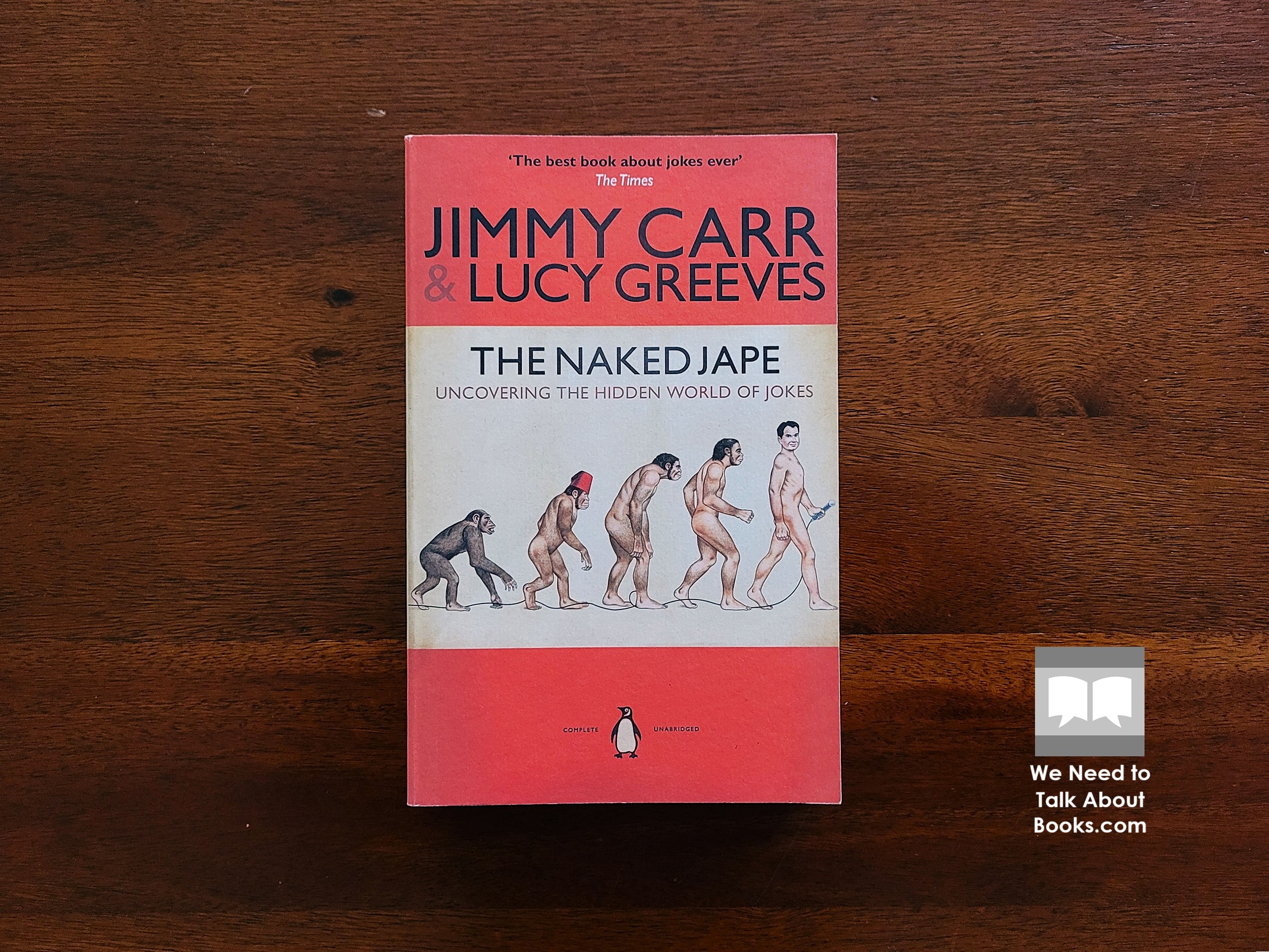
Jimmy Carr is one of my favourite stand-up comedians. Given his style of comedy – featuring a lot of puns and minimalist jokes of just a few lines – it would not surprise anyone that he would have some thoughtful things to say about the structure and appeal of good jokes and how they are created. But if you expected, as I did, that his book, co-written with his friend Lucy Greeves, would be mostly along these lines, you would be surprised.
Despite its subject and despite containing hundreds of jokes, The Naked Jape is actually a very serious book. As well as making a thoughtful examination of the psychology and evolution of humour, it also dives into controversial topics. For that it can also be called a courageous book.
It’s easy for people to dismiss jokes as trifling and insignificant because they are designed to be laughable, because they are such short, sharp shots of pure entertainment. In fact, although a joke on the page is a fairly straightforward proposition, as soon as it gets out into the open it’s quite a different matter. The context in which the joke is heard can change it from an innocent riddle to a complex, coded social message, one that is usually ambivalent and open to a range of interpretations. The act of telling a joke can be profoundly serious.
The early chapters of The Naked Jape look at the science, history and philosophy of humour, jokes and the agents who deliver them. Tickling the Naked Ape looks at evidence that other animals make jokes, theories for the evolution of humour, and, though this was published before major breakthroughs in AI, looks at why computers are unable to write puns despite their formulaic structure. Writing good jokes still appears to be something AI is struggling with.
Send in the Clowns predictably looks the history of clowns from their depression-era origins of depicting homelessness and alcoholism to their modern incarnations such as Mr Bean and David Brent. It also looks at how dark clowns have entered our culture more recently, though without mention of the Batman villain, the Joker, who precedes most examples.
How joking develops during childhood and what it tells us about brain and social development is covered in Only Kidding. While the chapter Nuts, Bolts and Hydraulic Brains distils possibly hundreds of theories of humour into four main principles – superiority, incongruity, ambivalence and release.
The way I have listed these topics may sound like the authors are confident in their assertions. But the book is actually full of scepticism of these ideas and point out the flaws of even those that have much to support them or that the authors generally agree with. While they agree that the four principles behind humour are useful, they warn against championing any one of them over others.
After a chapter on the difficulties of being a professional with some advice on how to tell jokes, No Way to Make a Living, the book if anything gets even more serious.
Take My Wife… No, Please: Take My Wife is a chapter that looks at gender differences in sense of humour and joke telling; the impact of political correctness and feminism on humour; sexist jokes and the rise of meta-bigot comedy.
The jokes don’t create the issue; they do hold up a mirror that shows us our flaws only too clearly.
The important role of jokes to shock, their ability to cause of offence and the licence to be inappropriate in the context of comedy is covered in Beyond the Pale. The authors look at how the allowability of jokes can vary by context and audience. They look at how offence can be simultaneously understandable as well as subjective and irrational. And they list example of comedians getting in trouble for saying the wrong thing, including the famous example of Bill Maher saying something politically incorrect on his show named Politically Incorrect.
Comedians are not the kind of people you want to put in charge of protecting minority views. As a breed they’re instinctively with the mob. Far from being fearless mavericks, riding roughshod across popular sensibilities in pursuit of a laugh, most stand-up comics, and most ‘offensive’ jokes, are not taboo-busting at all: they are inherently conservative. By mocking situations that we would otherwise find uncomfortable, by legitimising our anxieties about people who are different and hard to relate to, these jokes perpetuate the status quo. They don’t make things worse for the people they mock, but nor do they help us to understand them. That’s not their job: they are jokes. It isn’t the function or purpose of jokes to enlighten. Their use is to amuse. And as we established in our earlier look at the mechanics of the joke, cruelty alone isn’t funny. What makes an ‘offensive’ joke work is that the cruelty rings true with some aspect of the listener’s experience, and that’s not always a pleasant aspect. It’s often a prejudice, a resentment, a guilty pleasure, something we are ashamed of.
Humour that uses regional, social and ethnic stereotypes are examined in An Englishman, an Irishman and a Rabbi.
[…] some conflict situations are just so terrible that they kill jokes, and the possibility of jokes, as effectively as they kill innocent victims. So the existence of a large number of playfully insulting ethnic jokes could be an indicator of a fairly healthy and sustainable cultural relationship between two groups. It’s the complete absence of such jokes we should look out for. In fact, in Mein Kampf Hitler warned the bourgeoisie of the danger of making jokes about the Jews, on the grounds that laughing at such jokes would undermine their implacable opposition to the Jewish threat. In other words, it’s very difficult to hate something that you are accustomed to find funny.
These three chapters were the highlight of the book for me and I would argue are the best reason for reading it. These are emotionally and politically-charged topics where there can be a tendency to form opinions without the openness to debate. One of the challenges of our social media age is the difficulty in examining controversial topics that require a longform appreciation of nuances and context.
These chapters achieve that. Various perspectives and contexts are considered, excellent points are made and nuances appreciated in these chapters that are worth reading, noting and remembering. To give a couple of minor examples, the point is made that a problem with jokes that make fun of racists is that they can be used by racists to be racist. Another, is that simply having a sense of humour is not evidence of humanity in a person – you also have to allow others the same privilege.
The problem […] is that it’s sometimes very hard to distinguish between an intentionally racist joke and an ironically racist joke that’s appreciated in a straightforwardly racist way. The threat in the latter type of joke lies in its ambiguity, not its apparent aggression towards a particular group of people.
Out of respect for how well these chapters tackle their controversial subjects, it will not do for me to discuss them here. If I were to dilute the skilled arrangement of their arguments I would be inviting the same narrow blind discourse that is the problem in the first place. To do them justice I would have to reproduce them. Instead, I will just encourage you to read them yourself.
And there is more thoughtful analysis of controversy that follows these three chapters. Sometimes the Joke Gets Elected looks at the role of humour as subversive and ant-establishment.
This is the paradox at the heart of the joke as subversive political act. Even in highly policed totalitarian societies, where a misplaced joke can be severely punished as an unacceptable flowering of intellectual freedom, jokes can also serve an inherently conservative function. By providing a safety valve for anarchic sentiments, they may actually help people to endure the prevailing political climate and so perpetuate the status quo. Making light of things, we gain temporary relief by refusing to take them seriously. But in the long term we may fail truly to challenge the state of the nation because we joke it into familiarity instead.
While Knock, Knock. Who’s There? The Police contains long pieces on the campaign by Christian opposition group to Jerry Springer: The Opera and of the career of Lenny Bruce.
Comedian Rowan Atkinson spoke eloquently in defence of our right to joke about other people’s ideologies, a right he and many others felt would be threatened by the new law:
To criticise people for their race is manifestly irrational but to criticise their religion, that is a right. That is a freedom. The freedom to criticise ideas – any ideas – even if they are sincerely held beliefs – is one of the fundamental freedoms of society, and a law which attempts to say you can criticise or ridicule ideas as long as they are not religious ideas is a very peculiar law indeed. It promotes the idea that there should be a right not to be offended, when in my view, the right to offend is far more important than any right not to be offended, simply because one represents openness, the other represents oppression.
I have probably over-emphasised the serious aspects of this book due to the fact that I did not expect it. Also unexpected was how well-considered it is on such serious topics. As well as for those who are generally interested in the history and appeal of popular forms of humour, I think this is a book that an altogether different readership will find interesting. Those for whom the issues of political correctness, bigotry, freedom of speech and others which impact our popular culture will be enlightened by the author’s take.
Before reading The Naked Jape, I had thought I would be writing a review of the different types of jokes with examples and yet I have not included a single joke. Let me end with a typically Jimmy Carr-style joke from the chapter on causing offence:
Say what you want about the deaf…
 We Need to Talk About Books
This was a far more serious book than I’d expected when I started reading your review. I recognised Jimmy Carr’s face when I did an internet search before commenting, but haven’t seen him perform – now I’m very keen to, and to read the book, which sounds fascinating.
LikeLike
Hi Rose. Thanks for your comment, sorry for the late reply. Jimmy Carr is definitely worth checking out. He’s very funny, using more puns and one-liners than the usual anecdotal style of most stand ups today. His quick wit when engaging with the audience is a standout as well. It all points to him being clever in his art. And though he flirts with the inappropriate, he shows in his performances and in this book too that he has considered the issues thoroughly and compassionately. As I say, it is a good book, not just on joking, but for those interested in issues of freedom of speech, politcal correctness, etc.
LikeLiked by 1 person
My library has Before and Laughter, so I’ll start with that one.
I like that you can tell he’s thinking about the issues he’s joking about, rather than just making jokes – I say ‘just’, but it is an art form.
LikeLiked by 1 person