2025 seems to have gone by especially fast for me. Milestones and changes at work and in private, with family and other responsibilities, have made for a time-poor year with very little rest. While it feels like my reading has suffered as I did not read everything I intended to, in terms of page numbers read, it is up there with some of my best years.
2025 Recap
In 2025 I failed to complete the Reading List I had set for myself at the beginning of the year. I think this may have been the first time this had happened since I started making annual lists for myself perhaps as early as 2007. Sometimes I may have gone over by a few days or even a couple of weeks but not to this extent.

This came about because of a variety of factors. One book from my 2024 List I was not able to finish last year, so it took up time at the beginning of the year. I also read seven more books that were not on my original 2025 List. Some were new novels offered to me by publishers and publicists. Some were books I had hanging around that for one reason or another I bumped up the queue. Overall, I expect I will have read more pages this year than I ever have when the year ends.
To make things fit I had to cull two books from my 2025 List – a collection of the writing of Dorothy Parker and a coffee-table book on Science. But I am probably going to start 2026 with three books from my 2025 List. I hope this won’t become a trend – starting each year with a big overlap from the previous year. Hopefully I can stop the rot in 2026.
My best reads of the year include Orwell’s Nineteen Eighty Four – which is no surprise given that it is one of my favourites that I was rereading. I also admired Delilo’s White Noise. Ghosh’s The Glass Palace was good, and got better as it progressed, but I did not enjoy it as much as his other novels. It is difficult to find the right words for Ellis’ American Psycho – I can’t say I ‘enjoyed’ its depravity but I am still glad to have experienced it!
But it was a middling-to-disappointing year for me in fiction. The classics I read were respectable but not enjoyable – Pushkin’s Eugene Onegin and Cooper’s The Last of the Mohican’s.
White Noise aside, I have been reading a lot of postmodernism that I have not been greatly enjoying – Joyce’s A Portrait of the Artist as a Young Man, Pynchon’s Gravity’s Rainbow and Sheck’s Cyborg Fever.
I probably enjoyed non-fiction more than fiction this year. Hazard’s The Crisis of the European Mind – on the early European Enlightenment – is an excellent book that I learned a lot from. Mukherjee’s biography of cancer – The Emperor of All Maladies was also very good and very informative. I also have a lot of good things to say about Wilson’s history of the Thirty Years War – Europe’s Tragedy.
Carr & Greeve’s The Naked Jape and MacDonald’s Holy Cow! were both enjoyable and surprising. Dalrymple’s Nine Lives was also a book I can recommend.
There is a clear winner for the book I liked the least – Funder’s Wifedom. But given its enormous popularity and the nature of the subject matter I am not sure I should explain why via review or just keep my fingers off my keyboard!
My 2026 List
So, on to my 2026 List. As always, I have a list of genres I tick off each year. Like recent years, simply making sure I have these genres covered doesn’t provide sufficient page numbers for a year of reading. Unlike recent years I also find myself troubled by a lot of ‘maybes’.
If the basic genre list isn’t long enough, maybe I should add the books I did not get to in 2025 first? Maybe I should stick to a small list to make room for offers of new books to review? Or maybe I should stop accepting new book offers? Maybe I should not top up my list with others from my backlog even though I have also been waiting years to get to them.
Another ‘maybe’ is that I should add more genres. I don’t have a slot dedicated to science-fiction or fantasy and I am increasingly itchy to do so. Though my rule about reading only completed series and all in one go makes it difficult for many of the books I am considering for these genres.
So, many ‘maybes’. But I have stuck with the formula for now – covering established genres, topping up with backlogged books, and trying to get through them quickly enough to have room for new offers.
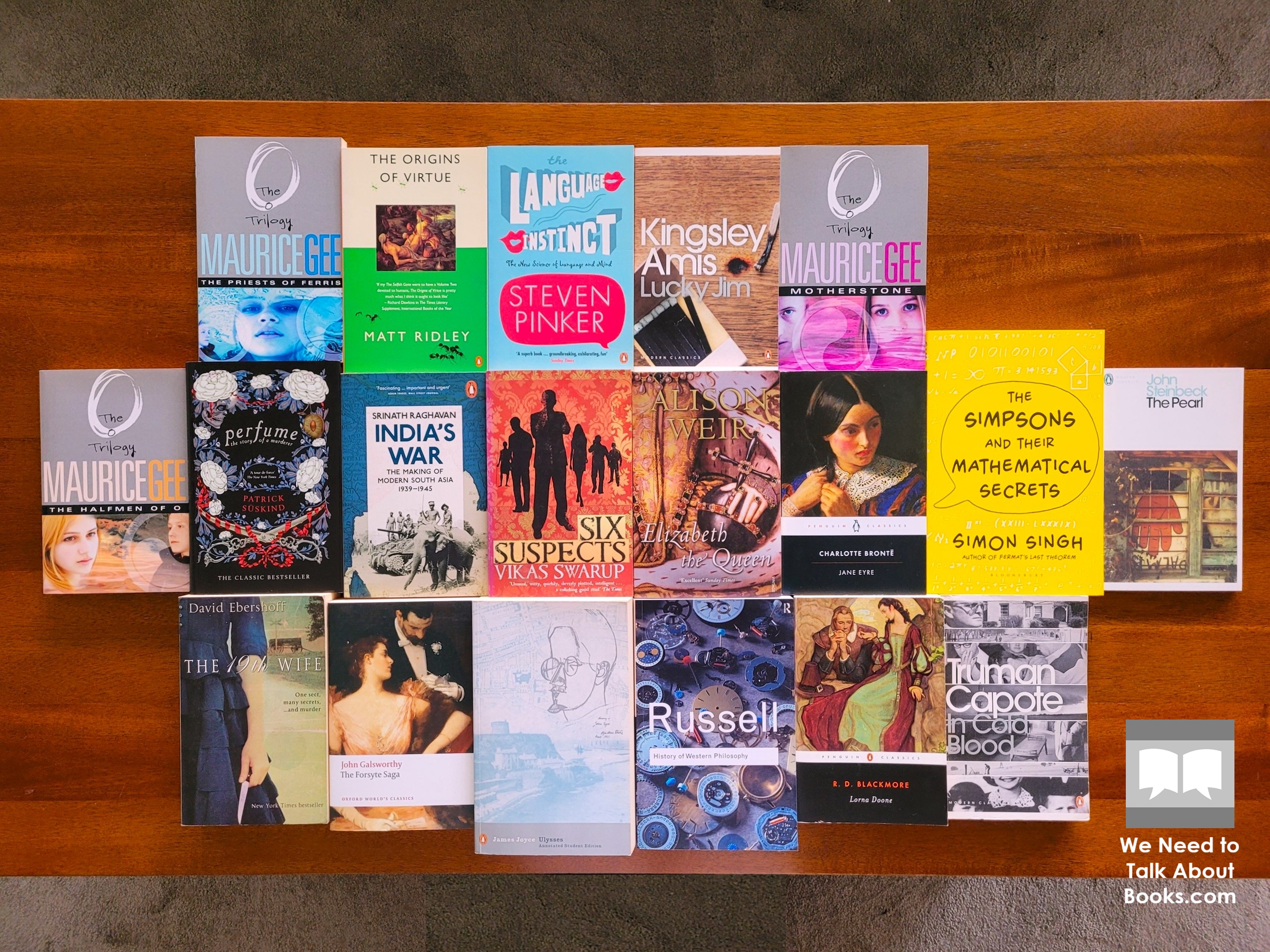
Anyway, first up are novel series. I try to read one each year. In 2026 I will be reading The Forsyte Saga by Nobel laureate John Galsworthy. It is comprised of three novels and two interludes published between 1906 and 1921 which I have in a single volume. They cover an upper-middle-class English family from a period before the First World War to just after. It has been adapted a few times and I several years ago I bought the 2002 television adaptation starring Damien Lewis on DVD – still unopened waiting for me to read the series.
Galsworthy followed The Forsyte Saga with two more series – A Modern Comedy and End of the Chapter – as well as interludes between the main books of these series and prequels. Together they comprise the larger The Forsyte Chronicles – seventeen parts in all. I was not aware of that when I bought The Forsyte Saga. I normally don’t like leaving things incomplete but I will see how I enjoy these five before deciding if I want to read more.
I am also adding a second series to read in 2026 – The O Trilogy by Maurice Gee. A young-adult series, I can’t be sure if it can be categorised as fantasy, science fiction, dystopia or all three. It is part of my effort to read New Zealand books I neglected when I was young. I come up with these annual reading lists years in advance but the recent death of author Maurice Gee makes it a timely addition; a chance to appreciate his work.
My ‘classic’ fiction for 2026 will be Lorna Doone by RD Blackmore. I don’t know much about it other than it sounds like a Romeo and Juliet type story about love across a social divide. At over 700 pages, it surely has more to it than that. I have now read a lot of novels published in a similar Victorian period. It will interesting to place Lorna Doone amongst the rest.
My ‘modern classic’ fiction for the year will be Lucky Jim by Kingsley Amis. Again, I don’t know a great deal about it. I expect some sort of English upper class comedy of manners.
Lucky Jim is a short novel so I am adding a mammoth one. Continuing my reading of James Joyce, I will be reading Ulysses which I have in a huge student edition. Not stopping there I am also continuing my reading of Steinbeck with another of his novellas; The Pearl.
For contemporary literature I am reading Perfume by Patrick Süskind. I saw the 2006 film many years ago so I remember the basics of the plot. But the novel seems to have a cult following which the film did not emulate.
Perfume is also a short novel but I have some more contemporary fiction for other categories on my list. Each year I ask my wife to pick a book for me to read. For 2026 it will be The 19th Wife by David Ebershoff.
Each year I also read fiction by an Indian writer or set in India. My 2026 pick is Six Suspects by Vikas Swarap whose main claim to fame was writing the novel that became the basis for the film Slumdog Millionaire.
Rounding off fiction, I also choose a book to reread each year. Either a past favourite or a book I think deserves a second chance. For 2026 I will reread one of my all-time favourites but one I have only read once – Jane Eyre by Charlotte Brontë.
Moving on to non-fiction, my history book for 2026 will be Elizabeth the Queen by Alison Weir. I have read her books on Henry VIII and Eleanor of Aquitaine and they are decently good history books so I am looking forward to this one.
I am also adding another book. It probably does not count as a ‘history’ book – more of a reportage book or even a non-fiction novel– and that is In Cold Blood by Truman Capote.
For science, I am also reading two books this year. Both cover similar topics – the evolutionary origins of human psychology and behaviour. They are The Language Instinct by Steven Pinker and The Origin of Virtue by Matt Ridley.
I have read a couple of Pinker’s books before. His The Blank Slate I particularly enjoyed and he is one of my favourite public intellectuals, so I am looking forward to this book. Ridley I have not read before but this book has become highly regarded and I think I will read more from him.
My philosophy book this year is a big one. Bertrand Russell’s History of Western Philosophy. I’m hoping to learn a lot and to have my neurons do some heavy lifting with this one.
Just as I read a book of Indian fiction each year, I also read a book of Indian non-fiction. This year it will be India’s War: World War II and the Making of Modern South Asia by Srinath Raghavan. India in fact had the largest volunteer army of the war, fighting both the war in Europe and in Asia. Raghavan argues it played a crucial role in India’s independence movement and emergence as a major power.
Some non-fiction is not easy to categorise. I already mentioned In Cold Blood. Another genre-bending one on my list is Simon Singh’s The Simpsons and their Mathematical Secrets. Singh is one of my favourite non-fiction authors, and being a Simpsons fan, this is an eagerly anticipated book for me.
No coffee-table non-fiction book? I have one earmarked for 2026. But given that I did not read the one on Science from my 2025 List, if I have the time I will read that one first.
All these plus the three books from 2025 will mean I will have to read more in 2026 than I ever have before if I am to stop starting the year with hangovers from the previous year. That’s not counting what new books I get sent to read.
Anyway, I would like to wish my followers all the best for the new year. I am grateful to all of you who still join me here. I would love to hear your thoughts on the books on my list and what your reading plans are for 2026.
 We Need to Talk About Books
I think you might enjoy Rebecca Solnit’s review of Wifedom: https://www.facebook.com/559835551/posts/pfbid0ARFMAGS46aSiEWBUn3qQ99RdVwdfqaimi738pSpycuqaVJeEQ99yZaVExk6uXeRxl/
PS I don’t think you should use the word failure. You read heaps of books and you write interesting reflections about them. How can that be a failure?!
LikeLiked by 1 person
Thanks Lisa for your kind words. Yes, I can be a little harsh with my expectations for myself.
Thanks too for the link. I had not heard of Rebecca Solnit. You are right, I found much to agree with in her piece. She writes beautifully, taking a paintbrush to make an argument I would have used a sledgehammer for.
If I had to pick one part that particularly resonated with me it would be this:
“But while parts of Wifedom are fictionalised, the parts that are not don’t seem to me to meet the obligations of non-fiction.”
LikeLiked by 1 person
Solnit herself has written a lovely book about Orwell called Orwell’s Roses. It made me like him more than ever.
LikeLiked by 1 person