
I have been cautiously curious about postmodernist literature. Often finding myself confused and unaffected by what I have experienced thus far. In Don DeLillo’s White Noise I found an exception. The novel holds up a mirror to modern anxieties. It creates a compelling tension between absurdity and insight using dark humour, anecdotes and suburban surrealism. Behind the postmodern aesthetics is a work of deliberate craft and thematic coherence that, despite seeming aimless, is disturbingly complete.
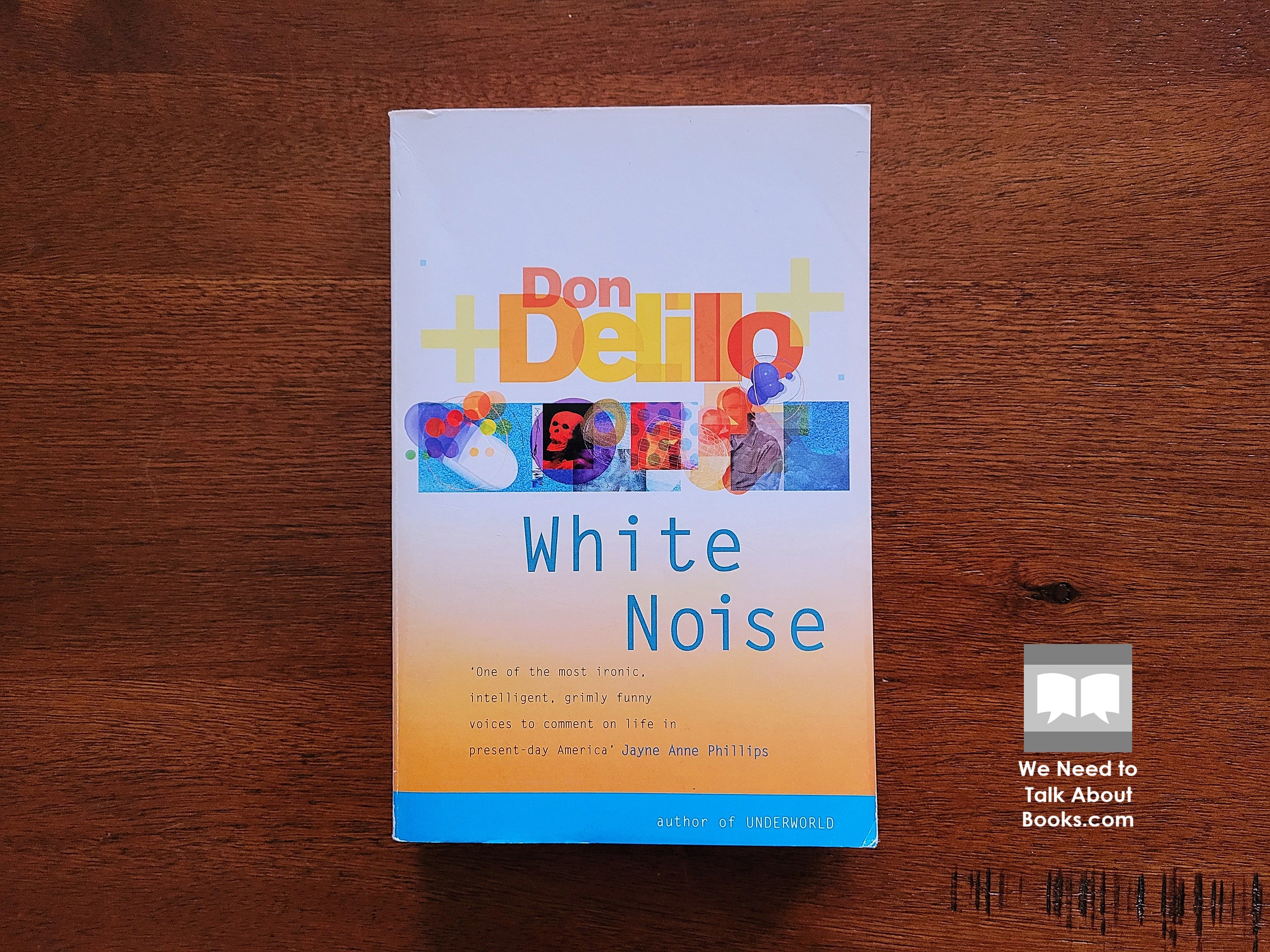
In the small, quiet town of Blacksmith lives Jack Gladney. A professor at the local college, Jack has managed to invent a career for himself. Sixteen years ago, he persuaded his university that it needed a department of Hitler Studies and that he should chair it. Their acquiescence has effectively given Jack a safe job for as long as he wants it.
Yet, Jack is full of anxiety. Despite being the head of Hitler Studies, Jack cannot read or speak German. His ability to produce original academic work from source material is therefore very limited. He has managed to get by this far but feels that he is a fraud who may get exposed at any moment. Even his students know undergrad German.
He lives with his wife Babette and their children from their previous marriages. His marriage to Babette is in fact his fifth. Babette has her own sources of anxiety and their open communication about their vulnerability has become the main component of their intimacy. Their existential angst makes sex untenable as they do not seem to know what they want, what purpose it would serve or how to make it worthwhile.
Family life is similarly unfulfilling. Trips out to see local attractions seem like pointless means to expend spiritual energy. Family TV nights seem more like a subtle form of punishment. Shopping seems to be the only other excursion they manage to force.
Jack’s colleagues don’t inspire any escapism. In contrast to his focus on a person of enormous historical impact, they are more interested in pop culture, consumerism and celebrity influence.
“I understand the music, I understand the movies, I even see how comic books can tell us things. But there are full professors in this place who read nothing but cereal boxes.”
“It’s the only avant-garde we’ve got.”
Even unexpected breaks from the monotony of daily life, such as when one of Jack’s ex-wives makes a visit, seem like more punishment than a reprieve.
All the while, there is the ever-present news flowing out of the TV and radio. It serves only to further frustrate Jack and Babette’s search for meaning, while amplifying the fears of failure, exposure, illness and death that has enveloped their psyches.
While their lives have stalled, their neuroses carry them with increasing momentum. Whatever transpires it will be as tragic as it was unnecessary.
By accident rather than design, I have been dipping my toe into postmodernism lately. But it has been rather hit and miss.
I have started reading James Joyce who straddles modernism and postmodernism. I read Dubliners and A Portrait of the Artist as a Young Man in the past year but I did not write reviews of them mostly because I did not know what to say about them. I will probably read Ulysses next year.
Similarly, I have read Thomas Pynchon’s The Crying of Lot 49 and V. in recent years. Again, I was indifferent. I could not say I liked them or disliked them nor find anything meaningful to say other than being confused by them. That is not going to stop me from reading Gravity’s Rainbow this year.
I think my problem is that, while I am an openminded reader, I can’t help but conclude that there are reasons for conventions in storytelling. One thing that distinguishes postmodernism is the break with convention. A release from covenants of structure, narrative and even plot, coupled with a theory that the reader will still ‘get’ what the author is aiming at.
I often get bored with the formulaic and seek new and different experiences. Yet, if I stray too far, I find myself realising there are reasons why the formulae work. It is not about returning to a safe space. And it is not confined to literature; I have the same feeling towards food, music and film.
I am happy to try the most exotic thing on the menu. But food still needs to have flavour, seasoning, texture, pairings of spicy with creamy, salty with acidic. I don’t like almost all popular music. But when I seek out alternative, underground and hardcore, I find myself wishing for melody and structure.
My happy place is on the fringes between the popular and the alternative. In all I enjoy, I wish there were more Kurt Cobains who can marry The Beatles with The Stooges to create something original, powerful and compelling.
The novel I consider to be my favourite – Catch-22 – is also considered postmodern. Why do I love it above the others I have read? The humour helps a lot. While mostly plot-less, it does the bare minimum to give a sense of forward momentum towards an end. And it leaves little doubt that there is more to the story than anecdotes and the many characters but a thematic message from the author as well.
Which brings me finally to White Noise. To me, White Noise succeeds because it too contains the bare minimum of convention to ground its otherwise postmodern aesthetics. But it has other advantages as well.
Though humour is not a prolifically infused, the novel does contain a certain dark humour and it certainly helps pull the reader along. The anecdotal style also keeps the novel lighter and helps the reader forget their concern over where it is all going.
The reader encounters some weird and mysterious goings on. You want to read on to make sense of it. But you do so with a foreboding that the story might twist into a suburban horror. Then again, I had to ask myself if I was taking the novel too seriously? In doing so, am I failing to appreciate the absurdities for what they might be there to tell me? Should I consider White Noise to be satirical?
“Either I’m taking something and I don’t remember or I’m not taking something and I don’t remember. My life is either/or. Either I chew regular gum or I chew sugarless gum. Either I chew gum or I smoke. Either I smoke or I gain weight. Either I gain weight or I run up the stadium steps.”
“Sounds like a boring life.”
“I hope it lasts forever,” she said.
Another aspect that makes White Noise work is that it is very well-written. It feels deeply considered and expertly crafted before being honed and hewed into its final form. It approaches an asymptote of perfection better than much fiction.
In the morning I walked to the bank. I went to the automated teller machine to check my balance. I inserted my card, entered my secret code, tapped out my request. The figure on the screen roughly corresponded to my independent estimate, feebly arrived at after long searches through documents, tormented arithmetic. Waves of relief and gratitude flowed over me. The system had blessed my life. I felt its support and approval. The system hardware, the mainframe sitting in a locked room in some distant city. What a pleasing interaction. I sensed that something of deep personal value, but not money, not that at all, had been authenticated and confirmed. A deranged person was escorted from the bank by two armed guards. The system was invisible, which made it all the more impressive, all the more disquieting to deal with. But we were in accord, at least for now. The networks, the circuits, the streams, the harmonies.
Though set in the early-mid 1980’s America, White Noise is very much relatable to our current reality a couple of decades into the twenty-first century. If anything, it shows that the antecedents of our contemporary issues go way back. The Gladney’s enjoy a paradise that their ancestors and even the previous generation would happily trade places for. All their basic human needs are amply met. They have no rational reason to expect war, plague or other disasters. Yet Jack and Babette live in constant fear.
Their anxiety is not born of fact. They are educated and professional and even possess an excessive knowledge of self. Yet they live shrouded in middle-class middle-aged malaise. Life barely interests them. They allow things of no importance to dominate they while finding diversion in tasteless unsatisfying activities.
“How strange it is. We have these deep terrible lingering fears about ourselves and the people we love. Yet we walk around, talk to people, eat and drink. We manage to function. The feelings are deep and real. Shouldn’t they paralyse us? How is it we can survive them, at least for a while? We drive a car, we teach a class. How is it no one sees how deeply afraid we were, last night, this morning? Is it something we all hide from each other, by mutual consent? Or do we share the same secret without knowing it? Wear the same disguise.”
“What if death is nothing but sound?”
“Electrical noise.”
“You hear it forever. Sound all around. How awful.”
“Uniform, white.”
Without the struggle for survival, their life has a lightness of being that lacks meaning and is supplanted with unjustifiable anxiety. They obsess over diet, health and particularly fear death. The fear starts to compound as we read on and the characters encounter reminders of the fragility of life and find fuel for their conspiracy theories. The distractions of modern life – pop culture, consumerism, novel technology – fail to distract them from their mortality.
We tend to think that our current age, distinguished by its ever-present connection to almost unlimited information, is one where meaning has become lost. But White Noise shows that this was true even when the oldest Millennials were in preschool. When the access to information is ubiquitous but the ability to discern the factual from the false, the important from the trivial, the meaningful from the superficial, remains a rare skill, the result is unhappiness, lack of fulfilment and even loss of identity.
I am the false character that follows my name around.
But this condition they are suffering from, rather than turning them inert, is drawing them to a precipice where extreme actions, previously unconscionable, become dangerously more likely.
Unlike most of my other encounters with postmodernism, I enjoyed White Noise and found it clever and well written as well. Shortly after finishing it, I read another postmodernist novel set just a few years later in the late 1980’s. It too is darkly comic, largely plotless, satirical, poignant and incisive in an indirect postmodernist way. Together with White Noise, American Psycho, has adjusted my thinking on postmodernism. They live on the fringes. They are compelling without resorting to the overused formulae of narrative.
 We Need to Talk About Books