
In India, cultural practices have survived for centuries unchanged. But, as William Dalrymple reports in Nine Lives, they face new threats from modernity, economic change and an increasingly homogenised culture. But Nine Lives is not a dry academic analysis. It is an eyewitness account of surviving ancient practices and can be read and enjoyed like a collection of short stories.
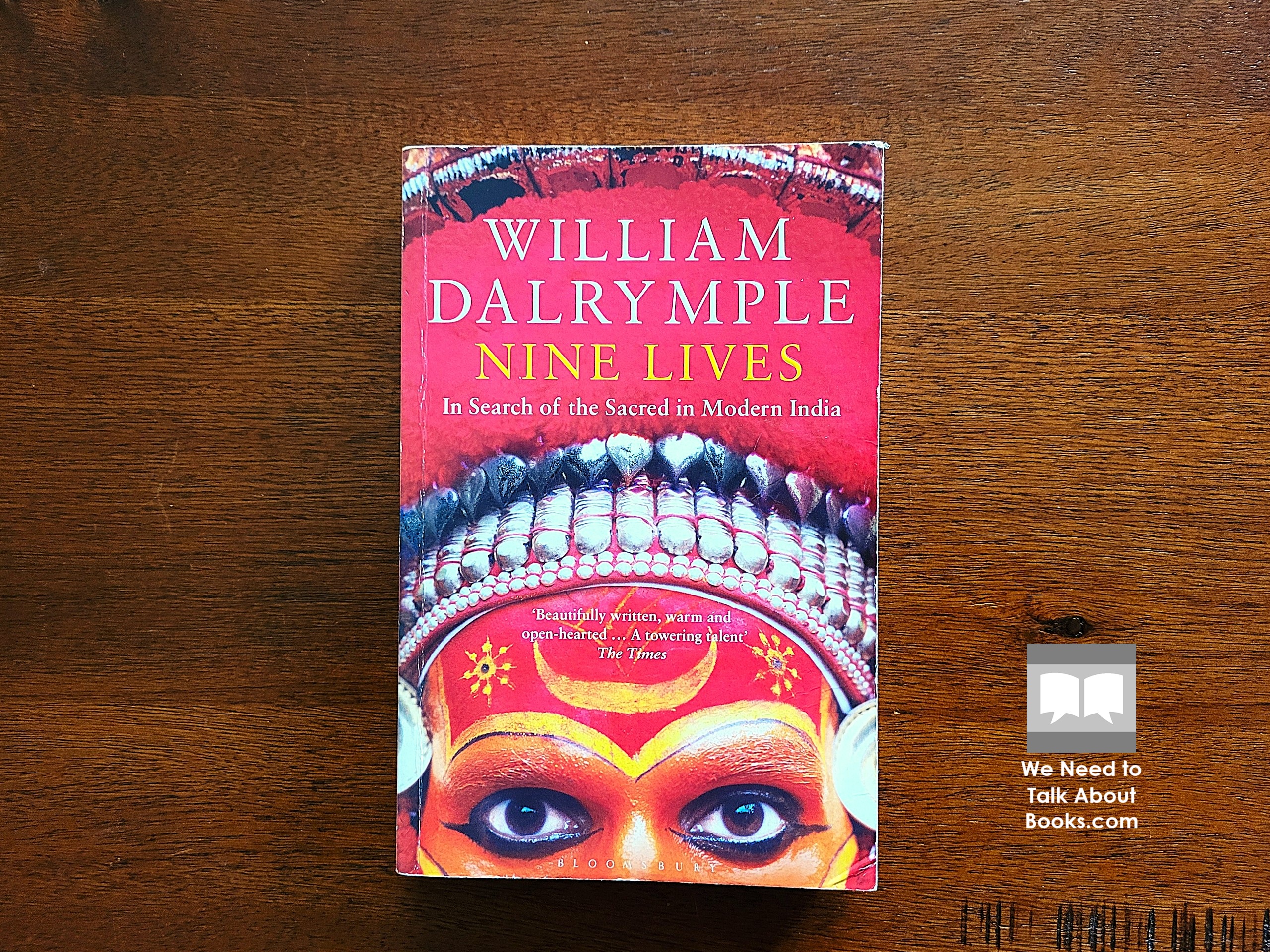
William Dalrymple says he was inspired to embark on the project that became Nine Lives after a couple of interesting encounters. He met a Sanyasi (Wanderer) on a hike to a Hindu pilgrimage site who tells Dalrymple that he once had a successful corporate career. Elsewhere, he met a man reluctant to talk about his skull cleansing ritual for fear it might impact his son’s ophthalmology practice in the US.
Such encounters made Dalrymple contemplate the clash of modernity on India’s ancient religious and spiritual practices. There is no shortage of examples of the impact. Forces for change and resistance to it have often collided in brutal and violent ways. But the responses can also take subtle but no less harmful forms. For example, one common way to fight the threat of extinction is by standardising religious practices. But in doing so, regional diversity is destroyed.
It is exactly these sort of regional variants, and self-contained local cults which are being lost and menaced by the slow homogenisation represented in what the eminent Indian historian Romila Thapar has called the new ‘syndicated Hinduism’ of middle class urban India.
Dalrymple also set his own standards for how he wanted to go about this project. He wanted to keep the focus on the nine lives he has chosen not on his own experiences as narrator. He did not want to delve into politics or economics or to judge the lives he was sharing. There were many subjects he could have chosen but there is no way this project could be a comprehensive study – the potential is impossibly vast. Instead, he has subjectively selected stories that were of interest to him. He also could have chosen subjects that were wilder but was conscious of wanting to humanise not exoticise.
Dalrymple was surprised by the resilience of an older India continuing to fight the old battles – materialism versus spiritualism; action versus contemplation; stability versus the open road; personal devotion versus public religion; textual orthodoxy versus mysticism.
Dalrymple is clever in how he has gone about writing these nine tales. Each follow a basic narrative structure. He usually begins by evoking the location where his subjects live. He is very effective in this and it is one of the things I enjoyed most in the book.
He will then share the experience of witnessing his subject practicing their art, their ritual, their spiritual observance. Where appropriate, he will also outline the basic history of the religion or ritual practice. I enjoyed the tale of the ‘Dancer of Kannur’, which brought back memories of witnessing similar performances on my own travels in India.
Then there is a deeper dive into his subject’s life. He will give a minibiography of them and how they came to be where they are, practising their art.
Lal Peri was the sort of deeply eccentric ascetic that both the Eastern Christians and Sufis have traditionally celebrated as Holy Fools. She was an illiterate, simple and trusting woman, who saw the divine and miraculous everywhere. It was also clear that she had lived an unusually traumatic life, which had left her emotionally raw. She was in fact a triple refugee: first as a Muslim driven out of India into East Pakistan after Hindu-Muslim riots in the late 1960’s; then as a Bihari driven out of East Pakistan at the creation of Bangladesh in 1971; and finally as a single woman taking refuge in the shrines of Sindh while struggling to live the life of a Sufi in the male-dominated and increasingly Talibanised society of Pakistan. The more I heard the details of her story, the more her life seemed to encapsulate the complex relationship of Hinduism with the different forms of South Asian Islam, swerving between hatred and terrible violence, on one hand, and love and extraordinary syncretism on the other.
Although it is supposed to be the inspiration and subject of this book, the clash with modernity might only be a small part by volume of each story. It will be present either as part of telling the history of the practice, the biography of the individual or in an epilogue-like conclusion.
The minibiographies and epilogues can be somewhat dark. They are stories of exploitation, tragedy and poverty. They are also stories of hope and fulfillment found through their spiritualism. Yet, if they have an epilogue, it either points to a disappointment of that hope or an uncertain future for their practice.
Despite their darkness or thwarted hope, the biographies were the highlight of the book. It is the most human aspect and sheds light on diverse lives, experiences, cultures and choices.
‘Look at all the people honouring the gods,’ said Srikanda happily. ‘It is very good for me to leave the workshop occasionally to see such festivals. We get so buried in the daily detail of our work [making idols] that sometimes we forget that idols are the base of our Hindu worship: everything else is built on top of this. Without a murti, there could be no puja, no temples, nowhere for people to come with their prayers and their problems. Really – a devotee can tell an idol secrets they can’t tell even to their wife or children.’
Rather than share basic outlines of the nine lives, I would rather just share one – The Singer of Epics – to give an idea of what this book is about and how Dalrymple has gone about it.
Dalrymple begins by dropping us into his journey to Pabusar with his friend Mohan Bhopa. The Bhopas are bards and shamans, singers of epic poems. Mohan is one of the last hereditary singers of the epic of Pabuji – a great Rajasthani medieval poem that is some six centuries old and four thousand lines long.
Like elsewhere, Dalrymple brings the location to life.
When we finally reached Pabusar, it was nearly sunset. The goats were being led home for the night, and the shadows of the milkweed bushes around the village were lengthening. It was the pruning season, and a few goatherds had climbed up the khejri trees to chop fodder for their goats, camels and cows. On the edge of the village I saw a lone woman in a yellow sari beating a Kikkur tree with a long stick – not some Rajasthani folk ritual, as I had instantly assumed, but, Mohan assured me, merely an elderly goatherd trying to get the seed pods to drop for her hungry, bleating kids.
Dalrymple says he first became aware of the Bhopas when staying in Rajasthan working on a previous book. Like other princely states, Rajasthan preserved the unique aspects of its culture better than those regions that were part of the British Raj. Dalrymple shares some of the history of Rajasthan’s epic oral poetry, the research done on oral epics from Yugoslavia to Greece, and the role and importance of the phad – a long narrative painting on a strip of cloth that is used as the background when Bhopas perform. He also speculates on the relationship between literacy and memory, suggesting the possibility that illiteracy enables the performer’s impressive ability to memorise such large amounts of poetry.
Dalrymple watches and describes Mohan perform. Despite relying entirely on memory for the incredibly long epic, Mohan’s performance is virtually identical to one recorded in the 1980’s. The Bhopas are more than just performers; their religious function includes curing ailments via the god that is believed to inhabit them when they perform.
Then Dalrymple switches to give us a short biography of Mohan. He describes how Mohan came to be a performer following a long line of Bhopas. Mohan describes the talent and skills he needed to demonstrate as a child to show he would be able to carry forward his ancestor’s art. And the importance of the wife – who is the Bhopa’s partner in their performance as well as life.
But there are signs that Mohan’s art is dying and here the clash with modernity comes into the story. The Bhopa’s performances are usually to ordinary folk, not to the upper classes, but they are losing their audience as these folk leave the countryside for city jobs. Even those that stay are seeing their lifestyles change such that they cannot stay up for several nights listening to the stories. Even within the Bhopa’s families there are struggles as their children are literate, they do not seem to have the same abilities for memorisation. The Hindu epics have become huge hits on TV and are available on CD and DVD. But these versions are homogenised and lack the local variations. Even so, the stories are becoming dated and today’s audience struggle to relate to them. But Mohan is still optimistic that there is plenty of work for Bhopas to do.
From the above, you can get a sense of the narrative arc Dalrymple is employing. The Singer of Epics was not necessarily my favourite, although I enjoyed all of them. And it does not contain everything that was common to most. For example, Mohan’s backstory was not the dark and troubled past of most of the stories. Although it does have a dark ending, which I chose not to share, which it has in common with other lives.
By using this narrative arc for these nine stories it can seem a little formulaic. But it is a formula that works very well.
Dalrymple’s background is more in journalism and reportage than academia. I have heard some criticism of his more recent books along the lines that he is wading into academic territory without necessarily making the requisite changes to how it differs from journalistic writing.
But that is not a concern in Nine Lives; a project that is suitable for Dalrymple and shows him in his best form. As he said, he is not trying to present a comprehensive study of the clash of modernity and tradition. Nor is he taking sides, judging, predicting or arguing for an outcome. His nine lives were subjectively chosen for his interest in them and he has deftly employed a trusted narrative technique to make them of interest to us. The result is a fascinating and enjoyable book to read though not without its moments of sadness and heartbreak.
I think Nine Lives would appeal most to those readers who mostly read fiction and perhaps feel a little guilty that they don’t read more non-fiction. Yet are also overwhelmed by the length, complexity and slowness of most history books that they are quickly bored by. Nine Lives is short, readable and affecting. You will feel you have done your non-fiction due diligence with a book containing short stories that you might find yourself enjoying better than a lot of fiction.
 We Need to Talk About Books
I enjoyed this review very much. I’ve read quite a few of Dalrymple’s books, including his latest, The Golden Road; and this is the most memorable for me. I chuckled when I read your description of the type of reader this book would appeal to. I am definitely that reader. I really appreciate his historical works, but I easily get bogged down in the details.
LikeLiked by 2 people