
Cyborg Fever by Laurie Sheck is an hallucinatory novel that feels like you are reading someone’s fever dream. A young orphan boy struck with illness hurtles through space and time, absorbing the most eccentric ideas of the twentieth-century’s greatest minds. Simultaneously, he is confronted with uncomfortable truths about his own life. Searching for meaning in a vast and barren universe, he is also striving to understand what it means to be human in a world where traditional boundaries are vanishing.
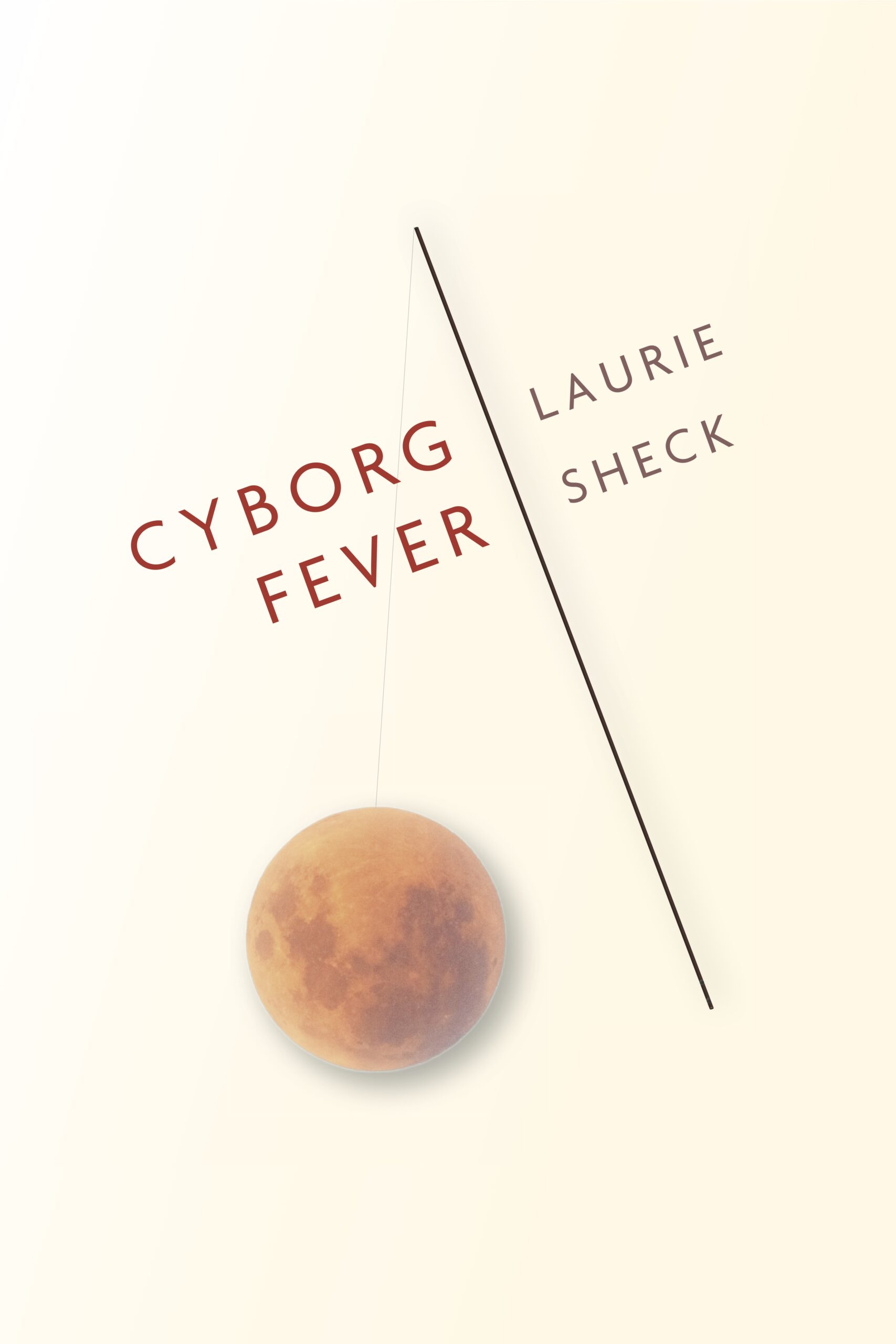
The narrator of Cyborg Fever, who we later learn is named Erwin for Erwin Schrodinger, grew up in an orphanage. Still a child, he has no memory of his life before the orphanage and feels he is unwanted and uncared-for. At one point he meets a couple. He believes they want to adopt him, but they stop visiting and he remains unwanted.
The only person who was ever close to him was the orphanage’s director, Sister Gudrun. She would take him to a locked room filled with books and read stories to Erwin. One in particular has a strong impact upon him.
Funes the Memorious by Argentine writer Jorge Luis Borges describes a young man with a unique and powerful mind. At nineteen-years-old, Funes falls from a horse and is crippled. From them on, Funes spends his days chain-smoking, reading and thinking before dying at age twenty-two from a pulmonary congestion.
It turns out that Funes the Memorious is the last story Sister Gudrun reads to Erwin. His apparent abandonment by her is another mystery of his situation he is unable to solve.
Erwin is soon obsessed with Funes. He wonders about his needs and longings. He wonders if Funes wonders about who he might have become if it were not for his accident and what might now become of him. He wonders how Funes feels to be immobile and alone.
But the Funes Erwin sees differs from the one in Borges’ story. Erwin imagines Funes sitting in bed and spending his days writing on a computer. What he sees Funes writing are facts about various physicists and mathematicians, most from the early-twentieth century.
Funes lay in the white glow of his computer, his neck and back propped on pillows at one end of his cot, the silver, foldable legs of the bed-desk balanced on either side of his hips. The words moved slowly over the screen, as if thinking themselves into being, unsure if they wanted to be seen. Mostly there were facts, though now and then he typed in questions that every time I saw them made me wonder what else he was thinking that I’d never guess—What percentage of reality is visible? What role does the ankle dorsiflexor muscle play in the modulation and control of human walking? If there is a ghost in the machine, what happens to the ghost when the machine is destroyed? And all the while I watched him, I didn’t know where I was, or where he was.
But what Funes writes about is not necessarily the lives of these physicists or their most important and lasting work, but of their more eccentric habits and beliefs.
According to Konstantin Tsiolkovsky, known as the father of modern rocket science, in order for the earth to thrive every atom must be happy.
Funes writes of Boltzmann, Dirac, and Heisenberg. Telsa, Schrodinger and Chandrasekar. Pauli, Cantor and Einstein. And several more.
Meanwhile, Erwin’s narration also tells us of his illness. A six years old, violet flowers appear on his eyes. The ‘flowers’ are a heliotrope rash. Erwin describes his fever and tells the reader of the Greek myth behind the illness’ name.
Soon, Erwin sees Funes writing more about astronomy and early cosmonauts and astronauts. As he does so, Erwin feels himself travelling through space. He is soon beyond the moon and heading towards Sagittarius A* – the black hole at the centre of our galaxy.
I knew I would never understand the violet flowers on my eyelids, or why sunlight hurt them, or my moon-white hair when it came, or why I was an orphan.
But it wasn’t the heliotrope flowers that hurled me from the world to drift through black space. Instead it was a sudden, perplexing silence, starker and more airless than the moon.
Once there he begins hearing the voice of Sister Gudrun. She tells his story from her point of view. How she was drawn towards him. Why she ceased to read to him. Challenging everything he knows about himself. Crucially, she says that scientists began coming to the orphanage looking for children to adopt for experiments.
So why is it so strange that I stopped speaking to you? Why should we grow close when all the universe is filled with an increasing distance? Why should you and I be the exception?
[…]
In any case, everything gives way to entropy in the end, it’s just how it is. Think of melting ice that changes from form to formlessness. I believe you feel this in yourself, how everything inside you moves toward dissolution, the chill of non-existence. You feel it but you don’t want to feel it. You don’t want to believe it is true. Maybe this is why my silence bothered you. Maybe this is why you needed Funes’ heartbeat close to yours. Even as you feel things break apart, you want to believe in coherence. But all over the earth ice fields are melting, chaos blooms slowly, invisibly, then more rapidly than the eye can see. We are governed by such laws and cannot change them. Even your black hole can’t release itself from isolation…Think of the lost places inside us, the many wastelands we carry.
When she has said all she has to say, Erwin hears no more from her and finds himself back on Earth in a white void. It is now that he meets the cyborg who has his own disturbing story to tell.
Cyborg Fever is the new novel from Laurie Sheck, author of A Monster’s Notes (which interacts with Mary Shelley’s Frankenstein) and Island of the Mad (which interacts with Dostoevsky’s The Idiot). It is an exploration of what it means to be human in a world increasingly impacted by AI and on the verge of introducing transhumanism. As well as the Jorge Luis Borges story, Cyborg Fever also draws on the RW Fassbinder film In a Year of 13 Moons.
The novel has a great opening, discussing the life and work of the Austrian physicist Ludwig Boltzmann. Boltzmann’s main contribution to science was his expansion of the understanding of the second law of thermodynamics and entropy. His mental health issues (he was possibly bipolar), the mainstream rejection of his work and the feeling of futility from his understanding of entropy culminated in a death by suicide.
For a reader like me, it is a big bang of an opening. Already, one detects several potential themes the novel will explore. As we meet our narrator, Erwin, and the other characters, with each of their perspectives the themes of the novel only compounds. The need for meaning and purpose in life. The meaning of empathy and its role in making us human. The suffocating loneliness of an increasingly connected world.
Though, in the early parts we witness Funes’ obsession with twentieth century physicists, and the latter parts hint at technology not yet with us; references to Bitcoin, Steve Bannon and the X-Men place it near the present day. The motive to create a cyborg – that we must transcend the limitations of human biology – sounds like something that is both a source for contemporary science-fiction and echoes the words of certain tech entrepreneurs as well.
This was followed by a series of key points:
- The cyborg does not have to be problematic. It does not have to be monstrous or deformed.
- Pure humanity has always been an illusion. The cyborg collapses conventional binary terms of difference.
- The end goal is a highly capable, unfrightening hybrid being.
[…]
Gradually the eerie feeling crept into me that my existence signaled a new world where the boundary between human and machine, animate and inanimate, owner and thing, even between passive and active, was quickly coming to an end. I was a kind of death-knell. But maybe I was also a kind of new beginning—I couldn’t decide if this was true.
But the strangeness of the story makes the reader question what they are reading. Erwin’s observing of Funes seems hallucinatory. His journey through space where the voice of his only teacher, Sister Gudrun, reaches him between black holes, is bizarre. Learning of Erwin’s illness, we can’t help but wonder if what we are reading is his fever dream. Meeting the cyborg and the other characters in the rest of the novel only makes us wonder more.
The novel consists almost entirely of one-sided conversations and interactions where one character speaks and the other is only able to listen. Erwin watches Funes. Sister Gudrun tells her story to Erwin. The Cyborg tells his story to Erwin. And so on. The novel does not have a plot and there is very little distinguishing the voice of each character, furthering the idea that what we are really reading is a dream of one of them.
The more I listened to the Cyborg, it seemed he and Laika and Funes were almost the same lonely being—the only being I had ever loved.
Parts of Cyborg Fever reminded me of Never Let Me Go, the novel by Kazuo Ishiguro about a group of cloned children being raised to be organ donors. It has a similar sense of characters faced with having to accept an unwelcome fate. Of higher powers determining their purpose for them.
To this day I don’t know if the things I looked up were really of my choosing, or if I was being guided, but without my knowledge. I didn’t realize algorithms can lead you from one topic to another without your suspecting you’re being lead—you just think you’re making choices. If I paused three seconds longer at one site, did the algorithm use that information to reconfigure the search engine, leading me to where the lab wanted me to go? After all, even here in the outside world, there’s almost no privacy left anymore. The idea of free choice is muddled, obsolete, corrupted. So why should I have had it there? Still, in those hours I felt almost free. Though I was afraid of what the sensors attached to my head might reveal of me without my knowing.
Its dreamlike quality and lack of a plot may remind some readers of post-modern works in particular. It is written in short pieces, many pages contain only a paragraph, some only a sentence. It can be read quickly, but that would make you feel like you are avoiding the depth behind the words.
Likewise, its philosophical themes and almost stream-of-consciousness style might remind readers of Virginia Woolf, James Joyce or Albert Camus.
In Sheck’s list of sources for this novel are also several books and writers that readers of popular science books like myself will be familiar with – Brian Greene, Carlo Rovelli, Michio Kaku, James Gleick and others.
Did I enjoy Cyborg Fever? It is a difficult question to answer. It is not that sort of novel – one to be entertained by. Finishing it does feel like exiting a disturbing dream. Where Cyborg Fever does succeed is in making you feel that, as you leave the dream, you are returning to a present that is possibly more disturbing. Full of threatening new technology, potential mind control, a breakdown of ethics and human rights, in pursuit of a future that is not everyone’s choice.
Cyborg Fever will be released on June 1 2025. We Need to Talk About Books was provided with an advanced copy in return for an independent review.
 We Need to Talk About Books
Good review. 🙂
LikeLiked by 1 person
Thanks! 🙂
LikeLiked by 1 person