
I think it is safe to say that when it comes to books, I am allergic to hype.
If there is something others are raving about, it makes me want to run away. The reverse is also true. If I hear about some forgotten, overlooked masterpiece; if I come across something while browsing that I have never heard of before but that sounds amazing, I will want to get it straight away (reading it straight away is a separate issue).
There are exceptions to this. I am not immune to fear of missing out. Some items and experiences are only available for a limited time. A film that is best seen on a big screen for example. A Lego set that would go great with my others. But this is rarely the case for books.
A more common exception for books would be if there was an overlap between the much-hyped book and another reading interest of mine that would persuade me to read it soon without feeling like I was succumbing to the excitement but doing it for my own reasons.
In the case of Harry Potter, I comfortably ignored the interest, feeling assured I would come to it in my own time on my own terms.
But the hype never really went away. Seven books and eight films. The author made a billionaire and the actors made celebrities. Endless promotions, toys and new editions of the books. I say this not to sound like a curmudgeon. I think it is great that a series of books have had this impact on children. Much better than the TV-show-toy-manufacturer collaborations of my childhood.
But it did make it difficult for me to feel I could find a quiet place for me to enjoy them in peace.
I told myself I would get to them when my then-unborn children did. That came sooner than expected – they grow up fast and my daughter is a very keen reader. But it also came slower than expected – she had to be somewhat cajoled into picking up Harry Potter.
Once she became an independent reader she went through the Usborne Young Readers series of Fairy Ponies and Fairy Unicorns. Roald Dahl of course. Then came books by Isla Fisher and Sophie Kinsella. Some David Walliams but lots of Ella Diaries and Babysitter Clubs. And she was far keener on Jeff Kinney’s Diary of a Wimpy Kid series and Jacqueline Harvey’s Alice-Miranda series.
But with encouragement from her parents she did eventually come to Harry Potter. She enjoyed it enough that when her school’s dress up day for book characters came around she was adamant that she would go as Hermione. I asked her to count how many Hermiones there were at her school that day and she came to twenty-seven. There is also a haunted girl’s toilet at her school but she insists that is a coincidence.
And so my time came.
I began feeling certain I would not post about Harry Potter here. What could I possible say that has not already been said? And what about the risk of being corrected on every trivial detail by every superfan? Yet, I was barely into the second book before feeling I would share something. I don’t pretend I have anything original to say here and the following is full of spoilers. I definitely will not be consulting the superfans or pore through the huge amount of online resources for verification. This is very much a newbie’s take. Also, it is something of a ‘live’ response. I won’t be revising my first impressions to be consistent with my conclusions. Instead, I am updating regularly and sticking with what I thought at the time. So, here goes.
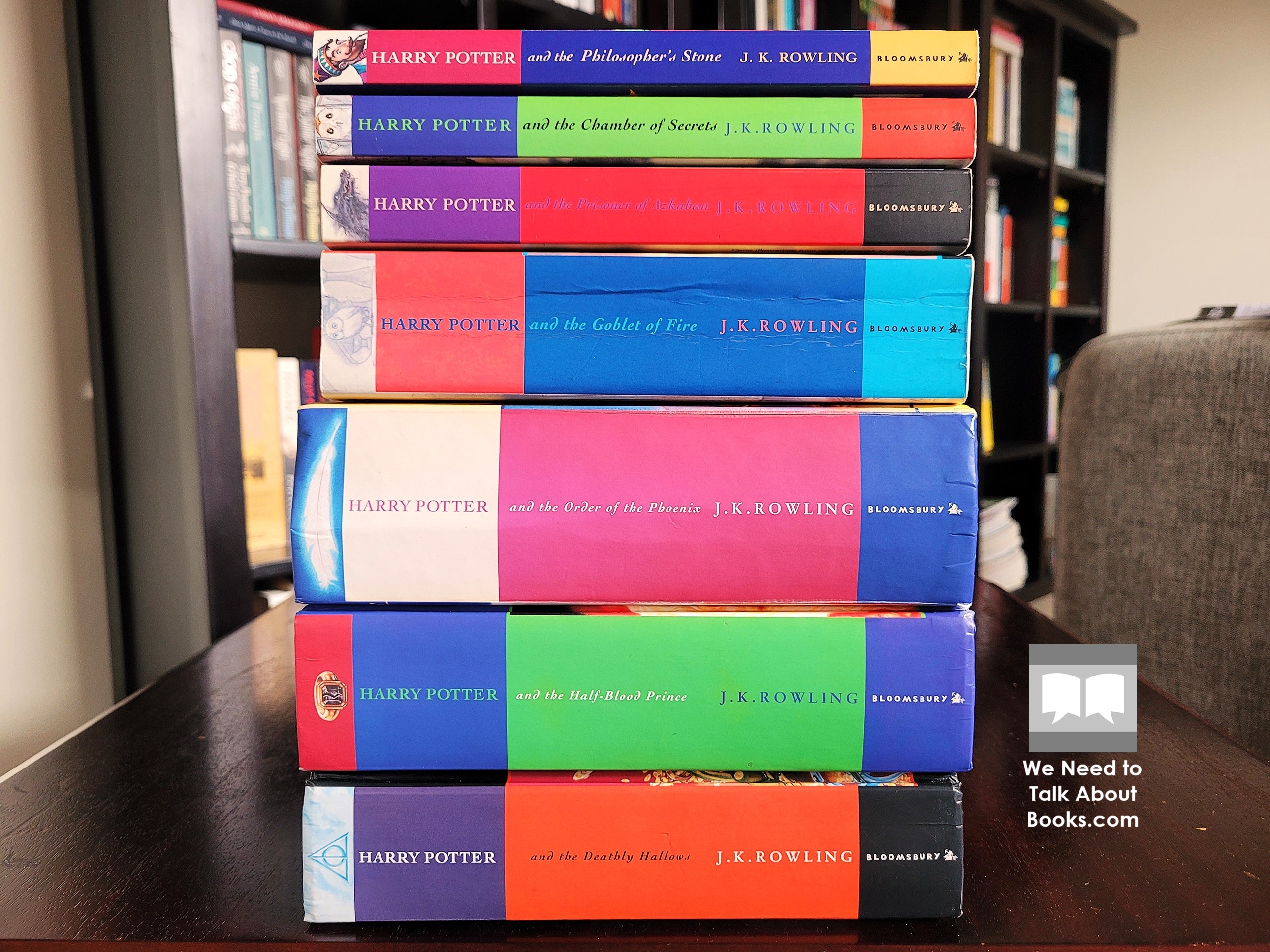
Harry Potter and the Philosopher’s Stone
The set up for the first book is very familiar. The orphan boy with magical powers, parents killed by a dark wizard, raised by his uncle and aunt who will not tell him the truth about his past or his powers, the future seems as bleak as it is boring until an unlikely intervention. From this, a whole new world opens up. So far, so very Star Wars (which has its own derivations).
The world-building is a key strength of the novel. The dual-realities, the owls, Diagon Alley, Hogwarts, Quidditch, and much more. As well as the usual requirement of other characters and their motivations, the location and the plot – all are wonderfully imagined.
I was not fond of the ending. Firstly, of the way Harry Potter gets the philosopher’s stone. But after thinking about it a bit and reliving the moment again shortly after by watching the film, I think I am satisfied enough.
I am less satisfied with the ‘saved by his mother’s love’ explanation for Harry’s survival of the novel’s climax. It sounded too much like the endings of so many stories of my early childhood. Where the un-foreshadowed last minute saving miracle is procured from some emotional or supernatural cause. Rather like the ‘Deeper Magic’ from The Lion, the Witch and the Wardrobe. It read too closely to those examples and I think for readers close to Harry’s own age (eleven years old in this novel) it might have sounded a bit juvenile too.
The writing is very good and the novel well-crafted. As you would expect for a children’s book, there is no room for the deeper characterisation, tone, mood and themes that would be required for a mature novel. It is very concise, precise and pragmatic with no tolerance for the superfluous. The best indicator of this is the fact that it is a short novel, the shortest of the series, and yet the two-and-a-half-hour film can’t contain all of the elements of the story.
Harry Potter and the Chamber of Secrets
Back again, and though it is only the second book, it feels like a formula is being worked – the oppression of the Dursleys, letter by owl, escape to Diagon Alley. Although it is not being utilised the same way, it feels like the formula that Bond novels and films exploited best – the prospect of confrontation with an ill-defined great evil on the horizon, but first a trip to the armoury! Where some weird, seemingly innocuous device or piece of knowledge will probably have a pivotal role in the story. Very much in keeping with the Overcoming the Monster plot type.
Again, the writing and crafting is very good. Clearly, Rowling is writing to a plan created before the first book of a great story arc. I especially liked how she worked the disaster made by Dobby the house elf at the Dursley house. It was very effective in creating the feelings of injustice and entrapment that all older children feel.
But the plotting already has to jump through more hoops in this second novel. We have all read or watched fantasy or science fiction where some amazing and versatile power or technology turns the plot in unexpected ways. The problem is that it either becomes overused or you need to explain why it isn’t being used. Invisibility is one of those powers and in the first half of the book the children were slow to remember its potential to help them.
A bigger issue is the children’s secrecy and the role of Dumbledore. They know Dumbledore is wise. They know he is good. Yet they won’t tell him what is really going on. Of course, if they did, we may not have a story! Alternatively, Dumbledore is the head of a school and maybe he is allowing Harry, Ron and Hermione to proceed as they do to aid their development in reaching greatness. Maybe he knows everything that is going on and will intervene if he has to. It feels like a bit of a stretch though.
Again, I was unsatisfied with the climax of the story. Traditionally, evil powers are coldly rational and intelligent. Their great physical or supernatural powers are matched by their great knowledge and intellect. The strength of the good powers are their greater moral clarity and positive emotions. So, the fact that Tom Riddle/Lord Voldemort was ignorant of the fact that Phoenix tears have healing powers, to me, significantly diminished his standing as a great evil and a power to be feared.
The film was not great. Again, it is impossible for the film to contain all of the elements of the story. But even in omitting many, the film felt far too rushed. It felt like they may have filmed all of the story and then edited it back to fit a reasonable length. There was no pause or slowing of the action to allow the audience to appreciate the lapse of time, the growing fear, the mounting tension, the difficulties and dead-ends.
I liked the addition of Moaning Myrtle and Professor Lockhart in the book but did not like their portrayals in the film. Lockhart in the novel is pompous, annoying and, to the reader, an obvious fraud. Myrtle allowed us to think beyond the book to things the main characters may not experience but will be familiar to readers – bullying, depression, suicidal thoughts. But in the film both are very one-dimensional.
The verbal confrontations in the film, whether with Draco Malfoy, his father or Tom Riddle are cringingly melodramatic.
One thing I did like about the ending was how it was explained. It was foreshadowed this time and so felt less miraculously convenient. They were the result of loyalty shown and choices made. I liked that and it made me feel a bit better of the ‘mother’s love’ explanation of the first novel.
I also liked that we are seeing greater complexity in the main characters. Harry is not some angelic figure. He has a certain disregard for the rules as it is put. And this prompts his own anxiety of how much he has in common with his adversaries. As Dumbledore wisely puts it, they share several strengths and their differences are few but are significant. In particular, the difference in their choices.
This too is a classic storytelling trope and I liked its employment here. It does feel a little Return of the Jedi-y though. I wonder if we will find out that Harry and Hermione are somehow related, Ron and Hermione will get together, and Voldemort will display some characteristics of an absent father-figure?
Harry Potter and the Prisoner of Azkaban
I was more than two-thirds through the third Harry Potter book and beginning to wonder how it could possibly all end. Mystery was piling on mystery and we are fast running out of pages for the plot to collapse to a satisfying ending.
And, it does not really. When I finished the novel I felt it was my least favourite of the first three. But, as a couple of weeks of dwelling on it passed, my feelings turned around significantly. It may not be the most enjoyable or satisfying of the first three or of the whole series as it turns out, but it may prove to be the pivotal one.
First, there is a clear break from the first two novels in plot type. A long time ago, a murder is committed. The suspect is a man no one would have previously suspected. His crime is therefore also a gross betrayal. He is quickly found guilty and imprisoned but maintains his innocence. Conveniently, the method used means there is no corpse of the victim.
This is not an Overcoming the Monster story but more akin to a spy novel. Less James Bond and more George Smiley now. The challenge for the protagonists is not so much defeating the enemy but uncovering the enemy. There is much intrigue and mystery. Agents may be caught holding secrets but for reasons other than any guilt for any crime. Clearly a betrayal has occurred but who is the real double-agent?
Second, there is also a clear break from the first two novels in terms of the greater story arc. The first two novels were very episodic in nature; self-enclosed stories with only small hints of a larger plan in the author’s mind. Now, with The Prisoner of Azkaban that door is blown wide open. The innocent man has escaped again and is still presumed guilty and hunted. The guilty man has also escaped again and is presumed dead. The ending is unresolved and we must read on.
Also much blown up is the world of Harry Potter. There are new abilities such as the Patronus Charm. There are new magical artifacts such as the Time-Turner, the Marauder’s Map, the Sneakoscope (time travel, like invisibility is a story-telling pandora’s box that once opened is difficult to avoid over-utilising or under-utilising). There is new history, particularly of Harry’s parent’s generation when they were students at Hogwarts, which has parallels with Harry’s generation.
Most of all, there are the new characters who leave Harry’s story in the end but whose own stories are unresolved and we therefore expect to return at some crucial moment in the future – Remus Lupin, Peter Pettigrew and Sirius Black.
I cannot say I read a lot of young adult fiction when I was a young adult. But from what I recall, characterisation was very pre-modern. Characters were mostly all-good or all-bad and lacked any complexity. That is definitely not true in this series. Harry and his friends can be irrational, emotional, proud, arrogant, insubordinate and with an inflated sense that they know best. I do not know when this transition occurred in the history of young adult fiction but due to my limited reading it feels new.
Again, I did not like the film and I am beginning to wonder who the films were really for? Not for those hoping to substitute it for reading the book. The pace is still far too fast and with too many omissions for it to be easy to follow without already being familiar with the plot. For fans of the book it may be great to see the characters and scenes brought to life. Alan Rickman as Neville’s Boggart may have been worth seeing the film for. But the film still leaves so much out. Do those who appreciate the book feel it is an adequate adaptation?
In 2020, Time Magazine assembled a panel comprising N.K. Jemisin, Neil Gaiman, Sabaa Tahir, Tomi Adeyemi, Diana Gabaldon, George R.R. Martin, Cassandra Clare and Marlon James to select the 100 best fantasy novels of all time. The panel put Harry Potter and the Prisoner of Azkaban second only to Tolkien’s The Fellowship of the Ring!
Harry Potter and the Goblet of Fire
The fourth Harry Potter novel underlines my sense that the third would prove pivotal. The first two feel more like prequels now. We are far away from the episodic Overcoming the Monster stories. Instead, we have more left unresolved and open-ended for us to read on for the conclusion.
There is a lot to like in Harry Potter and the Goblet of Fire. There are the aspects which made The Prisoner of Azkaban enjoyable too. There is considerable expansion of the Harry Potter universe. Partly from a new appreciation of the global reach of the magical world but more so from learning details of the history of events such as the trials of the Death Eaters. There are the new magical abilities and artifacts. There are the imperfections and hence realism of the main characters.
There is also a lot that The Goblet of Fire does better than the earlier novels. The humour is better and there is more of it. I especially liked the new characters and deliberately avoided looking up who plays them in the film in the hope I would be pleasantly surprised. I liked how seemingly minor things we learned early in the story – portkeys, the Summoning Charm – returned to play a key role in the big moments. Mad Eye Moody was a great source of pleasure for me. The discovery that the character I loved was not who I thought he was, was inevitably bittersweet.
One thing I had not mentioned previously but had been brewing was the fact that Harry Potter is relatively wealthy while he best friend Ron was not. In the earlier novels I had to wonder why Harry would not do anything to help his friend, even a minor source of aid or comfort. It is clearly on the author’s mind because several times in the Goblet of Fire it is explained why Harry does not do more, what he does do and we have moments of friction between the characters over money. Again, it aids the realism of the characters. I will wait and see what becomes of Hermione’s campaign for the House Elves.
I am still a bit underwhelmed by Voldemort as a great villain. So far, he has been thwarted by a riddle a first year Hogwarts student figured out. He has lacked knowledge whether on Phoenix tears or what occurred between his and Harry’s wands when duelling. Even if there is too much magic to know, which can be used with great versatility, for anyone to effectively counter every eventuality, Voldemort relative to Dumbledore is far weaker. And he has been undone by simple spells. When he finally had Harry in his clutches, and ordered the murder of the extra, he did not think to destroy Harry’s only means of escape.
The forces for good must surely triumph. Not only do they have the benefits of moral clarity and knowledge, but their adversary is ignorant and incompetent.
The film of The Goblet of Fire was not bad. Naturally, it can only contain a slim majority of the book’s story. Most of the omissions were understandable to save time such as cutting the house elf characters and Hermione’s passion project to emancipate them. The cutting of the match play of the quidditch world cup was somewhat abrupt though.
The bigger faults of omission for me were of the first and third challenges for the Triwizard Tournament. I don’t think the idea to use the conjuring spell in the first challenge was given its due to make its use in the conclusion satisfying. And the third challenge was mostly running the maze. Omitting the solving of the riddle of the sphinx was disappointing.
I was looking forward to seeing Mad Eye Moody brought to life on screen. For some reason I pictured someone who might look at home in the Rogues Gallery of Batman the Animated Series. Brendan Gleeson is a fine actor but I don’t think he is scary or creepy enough to be Moody. David Bradley may have been good if he was not already cast as Filch. Even the eye was disappointing. Far too sanitised.
Harry Potter and the Order of the Phoenix
So far, I have been toying with comparisons between these books and spy novels. But The Order of the Phoenix if anything made such feelings more certain. In the same way that the Star Wars films are fantasy stories in a science fiction setting, or Firefly is a western in a science fiction setting; I increasingly feel like Harry Potter is a series of spy novels in a fantasy setting.
Having compared the first couple of novels to James Bond-ish overcoming the monster stories and the subsequent ones to more traditional spy stories of uncovering double-agents and doppelgangers; now in this fifth novel I again feel like I am even more so in John le Carré territory.
In The Order of the Phoenix, the Ministry of Magic feels like an espionage agency akin to MI6 or the CIA. The leadership of this bureaucracy is refusing to admit the possibility of a great threat emerging. In this case it is not the theft of a nuclear warhead, the development of a WMD or an engineered pathogen but the return of Lord Voldemort and his operation to steal secret information hidden at the heart of the Ministry.
The motives behind the Ministry position are not uniform. For some it may be a fear-based rejection of an inconvenient truth. Some are prejudiced against the proponents of this theory and would oppose anything they affirmed. Some may be taking their positions out of personal ambition and following a chain of command. It is even possible some within the Ministry are actively working to aid Voldemort’s return to power.
Consequently, those who acknowledge the real dangers are taking matters into their own hands. The Order of the Phoenix is a mixed bag of Ministry agents, blacklisted agents, retirees returning to assist and outcasts. They have to keep their activities secret on two fronts from both the Ministry and from Voldemort.
Not to be thwarted, the Ministry expands its reach to arenas normally beyond their purview. Namely, into Hogwarts. Here too, those who seek to undermine the Ministry’s shortsightedness to the growing dangers will form a secret agency from within. As always, the danger is that they might be betrayed by one of their own. To be uncovered, captured and shut down like criminals by the Ministry might be just the opportunity Voldemort is waiting for.
Politics has always been a factor in the novels. Examples would be ideological divisions about pure-bloods, half-bloods and muggles, the separation of and diplomacy between the magical and non-magical worlds, and Hermione’s House Elf campaign. But from the early chapters in The Order of the Phoenix, where the need for the Order and the role of the media in influencing opinion becomes manifest, politics has now become a serious force in the novels.
Harry continues to grow. He is not really changing but with more confidence his individuality is becoming more pronounced. He is, if anything, more short-tempered, more arrogant, more petulant, more entitled, more self-important. Though he does have periods of reflection and introspection it is yet to come to his aid in the moment. Instead, he yields to dangerous temptations too easily. As yet, he lacks the maturity to know how to process his mistakes and failures with humility and acceptance. More likely he will take out his guilt on others. Is it endearing? Far from it. Is this realistic for a fifteen-year-old character? Absolutely. Is it at least relatable? That would depend on the reader.
The Order of the Phoenix is the longest of the Harry Potter novels. Unlike the short first two novels, which employed great economy in its writing, The Order of the Phoenix is quite bloated and full of the superfluous. This is not a criticism. I said The Philosopher’s Stone did not have the aspects of a mature novel such as deeper characterisation and themes. In a noticeable change from the earlier novels, that is no longer the case and I enjoyed all the extra material.
All the novels employ a slow build up of the plot followed by a sudden collapse towards the end (often followed by an explanatory session with Dumbledore). In The Order of the Phoenix this is even more extreme. The build-up is far longer and slower. The collapse far more thrilling and action-packed. Like an extended Cold War Tom Clancy novel, it succeeds in making the reader forget the time and effort it took to reach the exciting ending.
And if anything, it feels far less resolved. The universe is still expanding; mysteries compounding; the list of characters of significance increasing.
Even more so than when I finished The Goblet of Fire, I feel the first two novels are like prequels and it is the five subsequent novels that contain the great story arc. That would make The Order of the Phoenix the middle story of the series. With the dark powers in the ascendency, the young hero rushing headlong into danger, much needless risk and destruction and the potential demise of a character, The Order of the Phoenix feels like The Empire Strikes Back of the series.
I thought the film was the best of the series so far. I think the fact that the novel consisted mostly of a long slow build up aided the film because it cured the biggest flaw of all the earlier films – the overly fast pace. I thought Imelda Staunton was a great choice to play Umbridge and I enjoyed her performance immensely.
Again, like any adaptation, compromises are made with the source material. For the most part these were understandable, but there were two I did not like. I was surprised to see Harry give up the prophecy to Lucius Malfoy. Even if it was to create a diversion it is not in keeping with the facts or the spirit of the book. Also not in keeping was Harry apologising to Dumbledore at the end. As mentioned, the immature Harry of the novel struggles to process his guilt, apologise or accept responsibility.
It seems to be a conscious effort to make the Harry of the films more likeable than the Harry of the novels. Ditto for Ron and Hermione who maintain harmony and cordiality with each other throughout. A far cry from their acrimonious relationship of the novels.
Harry Potter and the Half-Blood Prince
If you are still with me, you will have noted the tone in my writing that could be mistaken for cynicism. I don’t think I am being cynical. Instead, this is the other side of the coin to what I said at the beginning about not being influenced by hype. While it may be true that I am not inclined to join bandwagons, I may be guilty of being a harsher critic of them.
I think the more popular something is, the harder it has to work to impress me before I decide to join the party. I think it is fair to take that approach. When you read something ignored or unpopular it does not have to do much to make you conclude that it may be unfair that it is overlooked. Alternatively, if it fails to reach that low bar you might say you can see why it is not more popular.
When something has been as enormously popular as Harry Potter has, I think it is justified to have high expectations and to be unwilling to count yourself as a fan unless it meets those expectations. As long as you don’t dismiss it as poor just because it fails to justify its popularity – it might still be very good but its popularity is questionable.
With all that said, I feel that in reading The Half-Blood Prince a Rubicon has been crossed. I will now count myself a fan of what I think is an excellent series.
Before I share why, let me say that being late to the party does mean that some spoilers were not possible for me to avoid. I knew even before beginning the series that a certain main character would meet their death and by whose hand it would come (though I did not know in which book it would occur).
The Half-Blood Prince contains two of my favourite scenes of the series so far. The first was the ‘House of Gaunt’ chapter where Harry witnesses an episode in the life of Voldemort’s grandfather, mother and uncle. The second was ‘The Cave’ where Harry and Dumbledore work to retrieve one of Voldemort’s horcruxes. Both are powerfully evoked in the novel and came to life in my mind’s eye full of the haunted darkness and trepidation they deserved.
Then there is the incredible ending. Being dropped into the midst of battle. A thrilling chase. And most of all, the double revelation that all may have been for nought compounded with a tantalising new mystery. Things are left not necessarily more dire than at the end of The Order of the Phoenix. Instead, we are simultaneously much closer to both ultimate victory and ultimate defeat. A great place to leave the reader.
It should also be mentioned that The Half-Blood Prince contains a chapter that is probably crucial to the entire series – of Dumbledore and Harry discussing the Horcruxes.
Finally, my little piece on the character of Harry at the end of The Order of the Phoenix turns out to not just be unendearing realism but has an important role for the plot. In The Half-Blood Prince, Hermione, Ron and others are justifiably reluctant to go along with Harry’s suspicions. This would not have been the case if he was right in The Order of the Phoenix or if at least he took being wrong with humility. As throughout the series, we might still wonder why Harry did not question Dumbledore on some things when he did on others, but that would have prevented the story from proceeding the way it did. Instead, like so much of the series, even the parts that make me dislike Harry are purposeful.
[slow clap, chef’s kiss] Well played JK.
I thought after reading The Goblet of Fire that it might be the Empire Strikes Back of the series. But I have to revise that now that I have read The Half-Blood Prince. Here we have an even darker ending that The Goblet of Fire. Snape even has a Darth Vader moment. His ‘I am the half-blood prince’ being analogous the Vader’s ‘I am your father’.
Halfway through the film of The Half-Blood Prince, I was thinking it was doing pretty well. The pacing issue that plagued the earlier films was largely resolved. The dialogue and acting was less melodramatic. The film is still portraying Harry as far more likeable than the novels do. But once I finished the film I had to conclude that it was an absolutely awful adaptation and the worst of the lot so far.
The film skips the House of Gaunt. It does ok with The Cave but not great. But the exhilarating final chapters of the novel are a damp rag in the film. Harry and Dumbledore are not dropped into the heat of battle on their return to Hogwarts. Harry is not a frozen witness to the death of Dumbledore. The chase of Draco and Snape to the Hogwart’s boundary was anything but exciting. Viewers not familiar with the novel would be excused for not noticing one of the main points of the novel – Harry’s affinity for the Half-Blood Prince – as it was barely acknowledged.
The flaws that weren’t even necessary probably irritated me the most. Like allowing Dumbledore to apparate from within Hogwarts.
For the first time I hopped online just to see if I am in a minority on this assessment. And I found that was not the case. There does seem to be many, perhaps even a majority, who agree the films are poor and The Half-Blood Prince is the worst of them.
Harry Potter and the Deathly Hallows
Despite the time that has passed since the novels were first published, I think when I came to The Deathly Hallows I had the same first impression that other readers had when it was first released. How can this novel, which is shorter than the previous three, possibly contain everything that it needs to?
Given how things were left at the end of The Half-Blood Prince, there is an enormous task before the main characters and, apparently, very little time to achieve it.
Halfway through the book the situation is even more dire. Harry is on the run, owl and wand-less, estranged from his best friend and getting sidetracked by an alternative way this could all end.
I still felt a strong vibe of the spy novel in a fantasy universe in The Deathly Hallows. Between long periods of build-up, there are shorter episodes full of action, often involving penetrating the impenetrable – the Ministry, Gringotts, the new Hogwarts – often with the use of Polyjuice potion disguises, invisibility, undisclosed secret access ways. This time we are less in the world of Fleming or le Carré and more within a Tom Cruise Mission Impossible film following the small team acting independently of the major institutions.
Of course, any final episode has to do more than just conclude the basic plot satisfactorily. It also needs to resolve all outstanding issues. For example, one of which was Dumbledore’s apparently hands-off approach to guiding Harry through everything he knew Harry would have to face. I think my theory that Dumbledore was allowing Harry to learn by experience, to suffer both success and failure which he must own, which conveniently also allows for better storytelling, was largely the case and reason for this was given in the final novel.
Was everything resolved in the end? Far from it. There is plenty left for fans to argue and speculate over. I am not going to dive in.
I enjoyed the fact that Snape was restored and vindicated in the end. I never doubted that he was in fact a force for good even if I was not sure if he knew it. My theory as I read the series was that Dumbledore knew of a role for Snape in the downfall of Voldemort via a prophecy. Dumbledore therefore defended Snape against accusations while Snape was largely unaware of what role he might play. That theory did not pan out but the real explanation was much better.
I joked earlier about comparing the roles of Star Wars characters to Potter characters. I was wrong in wondering if Voldemort might compare to Darth Vader. Clearly, if there is a Vader in Potter it is Snape. He had a Vader moment in The Half-Blood Prince and he has another one here. One of the tragedies of Harry Potter is how much Snape and Harry could have meant to each other if circumstances were different. Harry needing a father figure but can’t see past his dislike for Snape. Snape mourning Harry’s mother but unable to lower his guard lest he neglect his duty to defeat Voldemort.
I was a little disappointed with the epilogue. After all this, the adult Harry Potter is just an ordinary citizen?
The brevity of the book is to the credit of the writing. In lesser hands the length could have easily exploded given all that could have happened, all that needed a conclusion. Instead, the last novel was as well-controlled as the first.
The two films for The Deathly Hallows were not good but for different reasons to the earlier films. Being spread over two films, the story was not compressed or rushed like the earlier films. Yet, there is still something missing. The novel is full of doubts, dead ends, setbacks. Halfway through we are further from resolution than when we started. But the way the films tell the story of The Deathly Hallows was just far too linear, far too easy. The struggles and doubts of the main characters do not really come through. The films lack emotional depth.
Although, the emotional side comes through better in the second half of the second film, it is still a bit underwhelming and overall the films remain subpar.
Having now seen all of the films what was most annoying was not all that was left out for the sake of time restraints. Nor was it the acting that was hammy at times. The worst was all the unforced errors. Moments that diverted from the books for no good reason. Dumbledore apparating from within Hogwarts was an obvious example but there are some in every film.
Conclusions
Harry Potter is the fourteenth novel series I have read. Seventeenth if you count The Lord of the Rings and a couple of two-novel series.
Having started from a very sceptical place I am now inclined to say that it may be my favourite novel series as far as its entertainment and enjoyability value is concerned. Is it my favourite overall? Here its main competition comes from The Lord of the Rings and my current overall favourite, The Ibis Trilogy by Amitav Ghosh.
Not too sound too snobbish but inevitably I have to ask if the series is literary? Is it just entertaining or does it have a message?
I think valid arguments can be made on several fronts. Many times the novels address how we ought to treat people who are different to ourselves. There are concerns over worker’s rights. There is the segregation of the wizarding world into groups with differing privileges. Gender role issues make some appearances. Much of this can be interpreted as analogous to racial and sexual prejudices. The power, advantages and dangers of bureaucracy. The corrupting desire for power is ever-present and we find it in places we did not suspect it too. Politics and the power of the media for good or for ill.
The series has its flaws too. I was expecting to find an instance where the enormous powers available – invisibility, time-travel, duplication, etc – went forgotten. But Rowling was fairly reasonable in their use and offered limitations to prevent their overuse. Some of these it could be argues were fairly convenient. Otherwise, the series was pretty good at hiding its flaws. It takes some thinking on the part of the reader to discover them. An example would be how the wizarding world was considerably expanded and internationalised for The Goblet of Fire yet shrunk considerably when a revolution of the wizarding world unfolded in The Deathly Hallows.
For me, the complexity of the characters was a very noticeable feature. Harry, Dumbledore, Sirius, Snape and others are all flawed. Even some of the villainous characters have more to them than might appear. Far more so than I would have expected in children’s and young-adult fiction, though my experience is admittedly very limited. It is a feature that added a lot to my enjoyment and, apart from the clever plotting, it was the complexity of the characters that diffused my scepticism the greatest.
It is a feature that also extended to Voldemort but perhaps not in a good way. I did not find him to be a great villain. His clear ignorance and incompetence meant he was always vulnerable and never seemed indefatigable.
Rather than defeating Voldemort, the greater challenge was defeating the magical safeguards protecting him. Some of which Voldemort was not aware of. The even greater challenges were the permutations of magic itself. Some of which went beyond not just the knowledge of Voldemort but even of Dumbledore. An agonising stalemate or unending warfare seemed more likely than either defeat or victory against Voldemort. You could say this is true even from Voldemort’s point of view.
That makes for a good ending – both sides must risk failure in order to secure victory. But it still diminishes Voldemort as a villain and antagonist.
The greatest disappointment of this experience was undoubtedly the films. Made in a rush to overlap with the book buzz and with a mostly excellent adult cast the films succeeded in cashing in on the excitement but failed to deliver something worthy or durable for fans.
The filming of a TV series based on the Harry Potter novels begins this year. I said at the start that the reason for the timing of my Harry Potter reading was that my daughter finished the series. My son is about a year away from being old enough to start. Maybe when he gets into it we can watch the series together. Though, a series a year for seven or more years, is not a timetable for children reading the books for the first time. It is more for fans who have already been there.
Will the series be a success? It is difficult to see how it could fail. As long as it improves on the films, which may not be difficult, and makes fewer compromises that dissatisfy fans it should do well. As I said, since Harry Potter first arrived it has never left us.
 We Need to Talk About Books
Gosh, what an heroic effort!
When I was a school librarian, I felt I ought to read HP, but I only made it half way through the second one before deciding that it wasn’t worth my time. Kids who were going to read it were going to do it anyway, and I was better off reading other children’s novels that I could recommend to others who were not such keen readers.
In the end I had to read No 7 because it was said that it was more ‘mature’ so I didn’t want to risk complaints from parents that it wasn’t suitable. It was ok, but reading that ‘brick’ was a really boring way to spend my weekend.
Maybe I’m being parochial, but I think the worst thing about these books is that they export the British culture of boarding schools and an all-white cast to the world, pretending to be universal. I wanted my students to read Australian stories, set in our cities and towns, and to tackle the kinds of issues that matter here.
LikeLike
Thanks, I had not thought of that. You are right, the HP world is very limited. It is of a time that is not very contemporary and a setting that is not very diverse. Even when that world is expanded in Goblet of Fire, it is still only to northern and eastern Europe. We never even hit the Mediterranean. Never mind the diversity within a modern UK. The middle books do touch on personal issues for teens and a sense of mission for righting social wrongs, but these are just dead-end side plots. The HP series I think will live on in popularity as an entertaining diversion, but won’t be sort the books that really impact young adults.
LikeLike
They wouldn’t have had the success they’ve had without the marketing.
LikeLiked by 1 person