
Tortilla Flat was John Steinbeck’s first major success. Though not without its issues for the modern reader, it is supremely well-crafted and stands as a landmark work in the career of a writer on a path to even greater success.
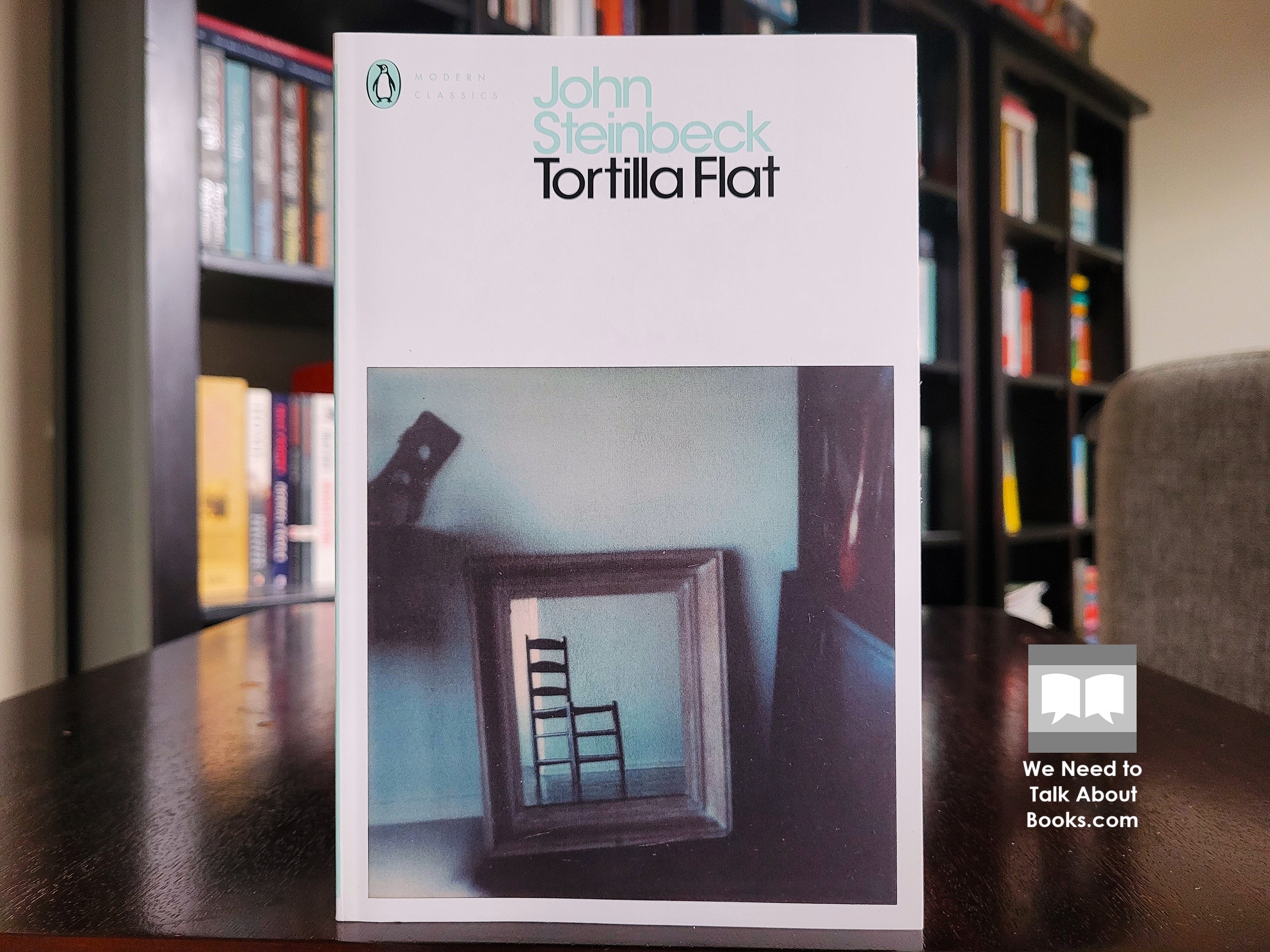
Monterey is an old town on the California coast. At the bottom is a bay and the lower part of the town is occupied by Americans and Italians who work in the town’s main industry – catching and canning fish. Behind the town are hills topped with pine trees. The upper part of the town is called Tortilla Flat and is occupied by Paisanos.
What is a paisano? He is a mixture of Spanish, Indian, Mexican and assorted Caucasian bloods. His ancestors have lived in California for a hundred or two years. He speaks English with a paisano accent and Spanish with a paisano accent. When questioned concerning his race, he indignantly claims pure Spanish blood and rolls up his sleeve to show that the soft inside of his arm is nearly white. His colour, like that of a well-browned meerschaum pipe, he ascribes to sunburn. He is a paisano, and he lives in that uphill district above the town of Monterey called Tortilla Flat, although it isn’t a flat at all.
Tortilla Flat is a tale of Danny, one of the Paisanos of Tortilla Flat, Danny’s friends and Danny’s house. When America declares war on Germany and enters the First World War, Danny and his friends get drunk and enlist.
Separated from his friends for the duration of the war, when Danny leaves the army and returns to Monterey he finds he has inherited two houses from his wealthy, respected grandfather. The sudden wealth and responsibility is too much for Danny to handle. He gets drunk, vandalises, gets into fights and spends time in jail.
His friend, Pilon, is sure Danny will forget all about his friends now that he is rich. Danny insists he will not. Together they come up with the idea to let one of the houses. Pilon will be Danny’s tenant though he does not know how he will afford the rent.
Pilon sat silent and absorbed. His face grew mournful. He threw a handful of pine needles on the fire, watched the flames climb frantically among them and die. For a long time he looked into Danny’s face with deep anxiety, and then Pilon sighed noisily, and again he sighed. “Now it is over,” he said sadly. “Now the great times are done. Thy friends will mourn, but nothing will come of their mourning.”
Danny put down the bottle, and Pilon picked it up and set it in his own lap.
“Now what is over?” Danny demanded. “What do you mean?”
“It is not the first time,” Pilon went on. “When one is poor, one thinks, ‘if I had money I would share it with my good friends.’ But let that money come and charity flies away. So it is with thee, my once-friend. Thou art lifted above thy friends. Thou art a man of property. Thou wilt forget thy friends who shared everything with thee, even their Brandy.”
His words upset Danny. “Not I,” he cried. “I will never forget thee, Pilon.”
“So you think now,” said Pilon coldly. “But when you have two houses to sleep in, then you will see. Pilon will be a poor paisano, while you eat with the mayor.”
Danny arose unsteadily and held himself upright against a tree. “Pilon, I swear, what I have is thine. While I have a house, thou hast a house. Give me a drink.”
Sometimes Pilon comes across a little money, finds some paid work, but he spends it all on wine instead of rent. Though he does share his wine with Danny. Pilon finds a solution to his debt to Danny when he runs into Pablo. Recently released from jail, Pablo agrees to sublet from Pilon though both know Pablo can’t afford rent either. Soon they rope another friend, Jesus Maria, into subletting the house though he too can hardly pay any rent.
After another night drunk on wine, the friends leave a candle burning and accidentally burn down the house. Pilon advises them to avoid Danny for a while. Danny shows an appropriate amount of anger towards his friends but is actually relieved to lose the house and the burden of responsibility that comes with it.
They all move into Danny’s remaining house and are soon joined by two more friends. Though it was not planned, Danny, his friends and his house are now bound together. Together, they scheme for ways to get money, food and especially wine. Sometimes that includes plotting against each other. They pursue love and become embroiled in the domestic lives of others on Tortilla Flat. And several times events cross their paths that arouse their sense of justice and they find themselves acting to make things right.
Jesus Maria Corcoran was a pathway for the humanities. Suffering he tried to relieve; sorrow he tried to assuage; happiness he shared. No hard nor haunted Jesus Maria existed. His heart was free for the use of any one who had a use for it. His resources and wits were at the disposal of any one who had less of either than had Jesus Maria.
[…]
Together with his capacity for doing good, Jesus Maria had a gift for coming in contact with situations where good wanted doing.
And yet, Danny remains weighed down by the responsibility of his property and longing for the irresponsible freedom he has lost. His friends watch with concern as Danny self-destructs.
Having read Of Mice and Men, The Grapes of Wrath and East of Eden, I tagged John Steinbeck as the closest I had to a favourite author. From just the preface of Tortilla Flat I felt myself already hooked. The writing is spare and precise and seems to possess magical qualities.
In the early novel there is a sameness to the characters of Tortilla Flat. But as the novel progresses their individuality comes out. Pilon is a schemer who seems one step ahead of the others. The Pirate is more trusting of others and has a certain moral clarity. Big Joe Portagee is simple-minded and instinctual and therefore not to be trusted. But he is not malicious so his failings are easily forgiven. While Jesus Maria has the greatest sense of humanity.
Though today it is not as well known or read as the novels listed above, Tortilla Flat was Steinbeck’s first success and was made into a film. For readers during the Depression, the adventures of Danny and his friends, who live by their own rules, apart from respectable society, with few wants besides enough food, a warm place to sleep and alcohol, offered an escape from daily troubles. Novels like Tortilla Flat romanticised the Depression as a time when friendships meant more than material comforts.
“But after all,” [Pilon] said philosophically, “maybe if we had found gold, it might not have been good for Danny. He has always been a poor man. Riches might make him crazy.”
Big Joe nodded solemnly. The wine went down and down in the bottle.
“Happiness is better than riches,” said Pilon. “If we try to make Danny happy, it will be a better thing than to give him money.”
This might put the novel’s idea of how to pursue happiness and fulfilment at odds with the American Dream. Also, contrasting with convention are the character’s ideas of morality. Though they break the law in various minor ways and spend time in jail, they have their own code of honour that conflicts with social norms. Other themes in Tortilla Flat might include the loyalty of friends, the daily navigation of poverty and the escapism offered by alcohol.
A short novel with short chapters, Tortilla Flat blurs the line between the novel and a short story collection. It also seems to echo narrative styles that predate the novel such as medieval romance, folklore and allegory. Steinbeck today is known for his Biblical allegories contained in his more famous novels. Tortilla Flat is instead understood as a reworking of Arthurian legend. The symbolism of certain episodes, such as a hunt for buried treasure, seem to make the connection clear. It is also in the language Steinbeck uses for the character’s dialogue. Analysts have found a long list of parallels between Tortilla Flat and the Arthurian legend as chronicled by Sir Thomas Mallory. The adventures of Danny and his friends are tragicomic; blending situational comedy and the tragedy of poverty with touching moments of humanity.
[…] When you speak of Danny’s house you are understood to mean a unit of which the parts are men, from which came sweetness and joy, philanthropy and, in the end, a mystic sorrow. For Danny’s house was not unlike the Round Table, and Danny’s friends were not unlike the knights of it. And this is the story of how that group came into being, of how it flourished and grew to be an organisation beautiful and wise. This story deals with the adventuring of Danny’s friends, with the good they did, with their thoughts and their endeavours. In the end, this story tells how the talisman was lost and how the group disintegrated.
Modern readers might find Tortilla Flat to be dated at best and offensive at worst. Steinbeck was a white middle-class man from Salinas. Naturally, the authenticity of Tortilla Flat has been questioned. Steinbeck sourced the material he used for the Tortilla Flat from Monterey natives, particularly via Susan Gregory. But is an accurate portrayal of how Paisano’s of Monterey lived? Would they recognise themselves in the novel? Did the novel contribute to a negative Mexican-American stereotype?
Gregory’s real love, however, centred on a group of fascinating people known as paisano’s, who inhabited shanties and shacks on a forested hillside overlooking Monterey. These olive skinned men and women were the descendants of the original Spanish settlers who had come to Monterey in 1770. Through years of haphazard intermarriage between the Spanish, Indians, Mexicans and various other groups, the paisanos had evolved. As a group, they went without formal education and were either unemployable or given the most menial labour to perform. A good paisano, however, cared little for work. Their cultural values remained almost unfathomable to nearly everyone except another paisano and few outsiders such as Gregory who had taken the time to understand. It was Gregory who introduced Steinbeck to the vagaries of the paisanos and the section of Monterey where they lived, which was commonly called Tortilla Flat.
From A History of Steinbeck’s Cannery Row by Tom Mengelsdorf, 1986.
The history of criticism of Tortilla Flat shows that this is not a 21st century concern but was first voiced in the early 1970’s. Steinbeck is said to have been saddened that readers took the Paisanos to be bums and did not view them with the same generosity he did.
For myself, I can understand why Tortilla Flat might be an awkward and problematic read for modern readers. That being said, I don’t read something like Tortilla Flat and take Danny and his friends to be representative of Paisanos. Rather, I see Steinbeck as having taken anecdotes he had found in his research and moulded them to fit the Arthurian allegory he was constructing alongside his own agenda to show a slice of American life as it was with neither judgement nor the creation of a patronising utopia.
Reading Tortilla Flat I was not immune or indifferent to the awkwardness. It may belong to the list of novels that needn’t be entirely discarded, that were of a time and place, but have not aged well. The craft and narrative control of the writing remains excellent. And it shows us a period in the career of the future recipient of the Nobel Prize for Literature where he is coming into his own.
Note – I am indebted to Thomas Fensch, writer of the Introduction to the Penguin Modern Classics edition of Tortilla Flat that I read for some of the points in the above analysis.
 We Need to Talk About Books
One of Steinbeck’s that I haven’t read, and I need to rectify that. Thanks for a good, balanced review. 🙂
LikeLiked by 2 people
Thanks! I hope you enjoy it.
LikeLiked by 1 person
I can’t remember if I’ve read this one or not. Which makes me think that maybe I haven’t because I really like Steinbeck and I remember other ones really well.
People are sensitive about their ‘group portrayal’ these days…
LikeLiked by 1 person