
Trick or Treatment? Alternative Medicine on Trial by Simon Singh and Edzard Ernst will no doubt be considered controversial to practitioners and believers of Alternative Medicine. But the curious, the openminded and those who wish to avoid misplacing their trust, will find it to a definitive and useful resource.
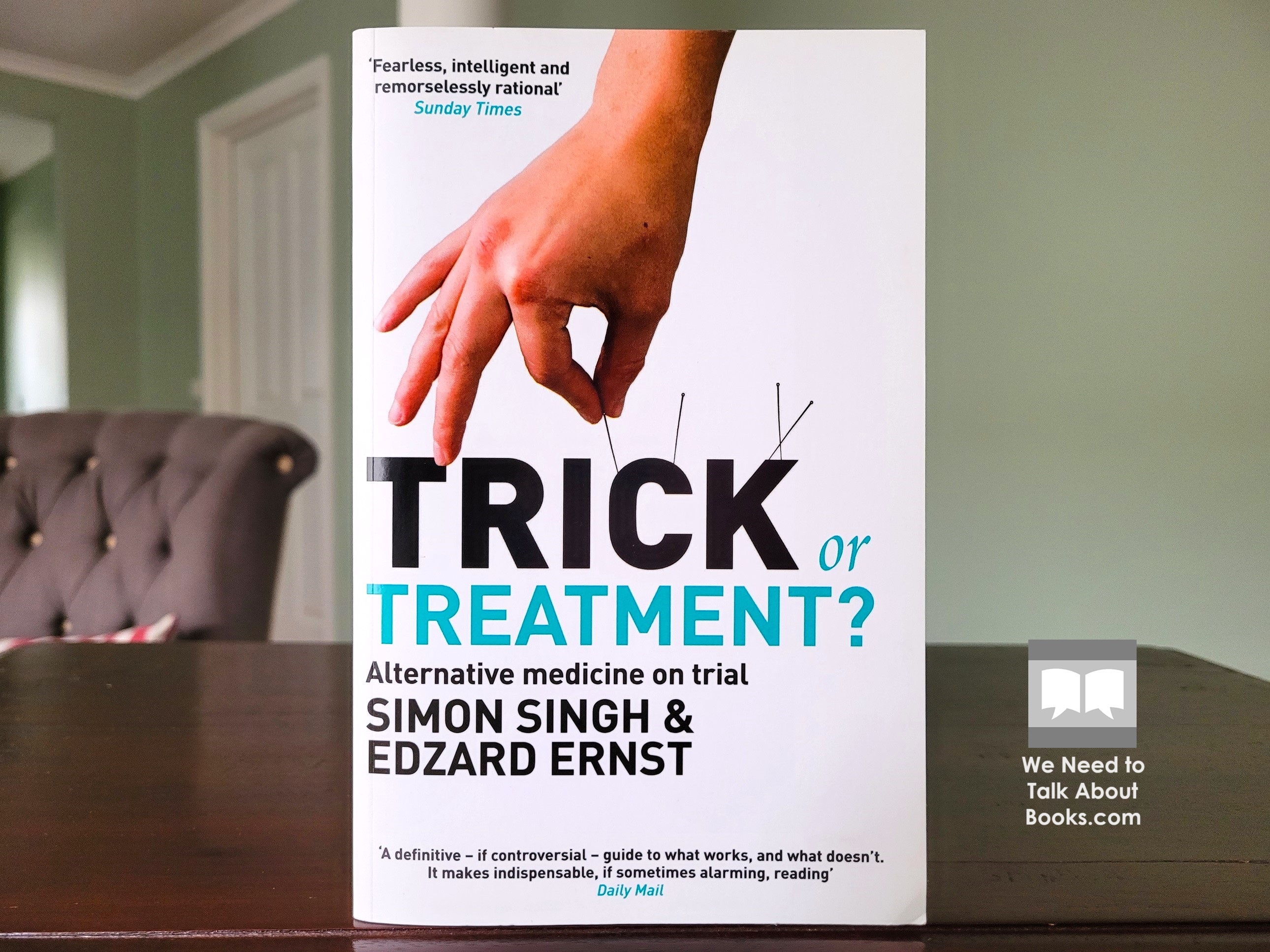
Alternative Medicine (AM) is a huge industry but the lingering question has always been – does it actually work? The goal of authors Simon Singh and Edzard Ernst is to provide a useful guide answering that question and more. Simon Singh is one of my favourite non-fiction writers and this is the third book of his that I have read. But medicine is not his speciality. So, he has teamed up with Ernst, who is a trained clinical doctor but who previously studied and practiced AM and is in fact the world’s first professor of AM. Both are trained scientists but neither has worked for the pharmaceutical industry nor profited from AM.
Trick or Treatment consists of six chapters. The first introduces the scientific method as it applies to medical science. In the next four chapters the authors investigate four of the most popular AM’s in turn – acupuncture, homeopathy, chiropractic and herbal medicine. The final chapter deals with remaining issues and plots the way forward. In addition, there is an appendix which contains one-page summaries of 36 more AM’s including aromatherapy, Ayurvedic therapy, meditation, naturopathy and more.
Teaching the History
It may be unfair of me to attribute too much of this book to Simon Singh but I am more familiar with his writing. One of the things I like about him is that he teaches science like history. He shows the origin of ideas and how they have evolved over time. The authors use the first chapter to show the early steps in the development of evidence-based medicine.
Evidence-based medicine seems obvious to us now but it did not really take hold until the mid-twentieth century and was not even properly defined until 1992. It is also easy to forget how bad conventional medicine (CM) was not that long ago.
‘Heroic medicine’ was a term invented in the twentieth century to describe the aggressive practices that dominated healthcare up to the mid-nineteenth century. Patients had to endure bloodletting, intestinal purging, vomiting, sweating and blistering, which generally stressed an already weakened body. On top of this, patients would receive large doses of medications, such as mercury and arsenic, which scientists now know to be highly toxic. The extreme bloodletting suffered by George Washington, as described in Chapter 1, is a prime example of heroic medicine and its harmful impact on a patient. The label ‘heroic medicine’ reflected the role played by the supposedly heroic doctor, but anyone who survived the treatment was the real hero.
The authors begin by sharing in parallel the history of the demise of an established treatment – bloodletting – and the rise of a new treatment – vitamin C. In the former, it was the work of Alexander Hamilton and Pierre Louis and in the latter it was the work of James Lind and Gilbert Blaine. Other examples include Florence Nightingale’s use of statistics and Hill and Doll’s work on the link between smoking and lung cancer.
Important lessons from this chapter include the importance of publishing your findings, independent replication, designing trials to randomise and remove other factors and keeping an open mind. There is also the difficulty in overcoming scepticism and entrenched ideas.
When Hill and Doll first published their research in the British Medical Journal, an accompanying editorial recounted a very telling anecdote: ‘it is said that the reader of an American magazine was so disturbed by an article on the subject of smoking and cancer that he decided to give up reading.’
But the authors know not to overwhelm the reader with the scientific method from the start at the cost of delaying progress onto the books core topics. So, instead they move on to cover the four popular AM’s while routinely returning to the key developments in evidence-based medicine.
In the acupuncture chapter, they introduce one of the key issues in any assessment of AM or CM – the placebo effect. As well as telling the history of the discovery of the placebo effect and theories of its cause, they also share the history of how it has been mitigated in research – namely, the development of the blinded clinical trial.
Also included in the acupuncture chapter is an assessment of the 2003 World Health Organisation (WHO) report on acupuncture leading to a discussion on another key development – systematic review. While the homeopathy chapter discusses a type of systematic review – the meta-analysis. The chiropractic and herbal medicine chapters are used to discuss the issues of risk and safety concerns.
Is there a connection between Alternative Medicine and Authoritarianism?
As well as telling the history of evidence-based medicine, the authors also begin each of the four AM chapters to share the history of each of them. They share the origins of each of these practices, the philosophy or theories they are based on and how they have evolved over time.
One lesson I learned from this book is of how AM has been exploited by authoritarian regimes who use AM as a part of their nationalist and anti-foreign agenda. Acupuncture, for example, has ancient origins both in the West and the East but had largely fallen out of use. The Chinese Communist Party initially banned its practice but later reversed course and revived it as part of a promotion of Chinese culture and a rejection of foreign influence. Acupuncture then travelled westward as China reopened itself following the Nixon regime.
Similarly, homeopathy was practically dead in the face of advancements in medicine but was reintroduced by the Nazis as a German invention and a way of keeping their promise of delivering cheap healthcare. Despite the demise of the Third Reich, homeopathy survived thanks to its endorsement by British Royalty and US politicians.
In recent years the Indian government is similarly encouraging Ayurvedic medicine as a patriotic alternative to CM in collaboration with the WHO.
Counterarguments from Alternative Medicine
Naturally, AM practitioners have made arguments against the use of scientific techniques to scrutinise their methods. For example, a common argument is that science is biased against AM. But as the authors point out with examples, science is open both to the possibility that bizarre treatments might work and to question established practices. The authors tackle these questions and other push back from the AM industry and practitioners.
Not surprisingly, modern science struggles to accept homoeopathy. After all, there is no logical reason why like should be guaranteed to cure like; there is no known mechanism that would allow such ultra-weak dilutions (devoid of any ingredient) to impact on our body; and there is no evidence whatsoever to support the existence of a vital force. However, the sheer oddity of homoeopathy philosophy and practise does not necessarily mean that this approach to medicine should be rejected, because the critical test is not how bizarre it is, but whether or not it is effective. This can best be decided via the ordeal of the clinical trial, that tried and trusted tool of evidence-based medicine, which is capable of separating genuine medicine from quackery.
One point I thought was important to remember is that once an AM is proven effective it is no longer considered an AM! Vitamin C, fish oil, St John’s Wort (for some conditions and not without risks) and Osteopathy have each made the transition to CM. Potentially this leaves AM’s as a collection of the unproven and the disproven.
Why Not Indulge Alternative Medicine?
Another thing I have found Singh does well from reading his other books is explaining complex ideas and evidence. He has hardly needed to flex his muscles here – the concepts in this book are pretty basic even for the non-science reader. That being said, the information in this book tends to provoke more questions that need to be addressed.
For example, if the placebo effect is real, why not exploit it for non-serious conditions? Also, since the common problems with AM’s are not serious and the serious problems are not common, why not indulge it? The authors give well-reasoned explanations for why these are bad ideas.
The main point of the investigation into the homoeopathic treatment of malaria was to demonstrate without doubt that even the most benign alternative medicine can become dangerous if the therapist who administers it advises a patient not to follow an effective conventional medical treatment.
Among the bad actors in the promotion of disproven and unproven medicine, the authors list some you might expect but also some you might not – medical researchers, doctors, the WHO.
The Question of All Questions
So far this century we’ve had to endure a resurgence of old ideas and an emergence of new ones we may have naively hoped was an aspect of our less-informed past. Religious extremism, anti-vaccination proponents, climate change denialism, flat Eartherism, creationism and an abundance of misinformation, disinformation and conspiracy theories. Easy explanations for these often come up short. Inevitably, the authors of this book have to answer the question of all questions: why do otherwise smart people choose to believe in the demonstrably false?
In the case of AM, their answer is that AM cleverly exploits several fallacies – the natural fallacy, the traditional fallacy, the holistic fallacy. They also use fallacies to try and discredit science – ‘science cannot test AM’, ‘science does not understand AM’, ‘science is biased against AM’. They also exploit fallacies to legitimise their practices – the scientific explanation fallacy, the scientific gadget fallacy, the scientific clinical trial fallacy. Why do people think AM is helping them when the evidence says otherwise? Confusing correlation with causation, statistical coincidence, confirmation bias and the placebo effect are possible explanations.
We believe that there is an important message here: alternative medicine is not so much about the treatments we discuss in this book, but about the therapeutic relationship. Many alternative practitioners develop an excellent relationship with their patients, which helps to maximise the placebo effect of an otherwise useless treatment.
The message for mainstream medicine is clear: doctors need to spend more time with patients in order to develop better doctor-patient relationships.
Singh and Enrst dedicated this book to the then Prince of Wales, Prince Charles. This might seem tongue-in-cheek but they point out Charles has said the right things about AM’s – that he would like to see their effectiveness scientifically proven. Unfortunately, his actions and other statements put the lie to those sentiments. As one of the highest profile promoters of AM’s they urge him to take more responsibility.
It is difficult to imagine a better book on alternative medicine than Trick or Treatment. It is as patient, sensible, sensitive and openminded an assessment of alternative medicine as can be made. But the authors warn in their introduction that while they will take claims of alternative medicine seriously they will be blunt in their conclusions and how these are received will depend on the openmindedness of the reader. It is difficult to conclude that any reader who fails to agree with the authors has failed this test.
The Scottish distiller Thomas Dewar once said: ‘Minds are like parachutes. They only function when open.’ On the other hand, the New York Times publisher Arthur Hays Sulzberger stated: ‘I believe in an open mind, but not so open that your brains fall out.’
[…] Throughout this book we have tried to strike a balance by being open to all forms of alternative medicine and all their respective claims, while submitting each one to the ordeal of testing.
[…] Having sought to be both open-minded and sceptical, and having relied on all the best available evidence, our broad conclusion is fairly straightforward.
PS – This review was written before King Charles III’s recent cancer diagnosis. Naturally, the humane response to hearing such news about anyone is to wish them a full recovery with as little suffering as possible. Nevertheless, it will interesting to hear what course of treatment the King chooses and the subsequent response from both conventional medicine and alternative medicine communities.
 We Need to Talk About Books
Thank you for sharing your thoughts about this book.
If all the money that’s wasted on AM were spent on public health care instead, everybody would be a lot better off.
LikeLiked by 1 person
It was a joy to read and write about!
I suppose part of being in a free society means individuals are free to believe what they want, spend their money how they want and make their own healthcare choices.
But it’s the governments and institutions, who probably think they are doing the right thing, being neutral and allowing free choice, who might need to reconsider if they are acting in the public’s best interest.
The authors don’t have much to say much about what should be done. Conventional medicine has to go through a lot before it is released to the public, maybe alternative medicine should go through the same. Some that have dangerous effects should come with warning labels.
LikeLiked by 1 person
But that’s the interesting thing.
In a democracy we get to choose, and theoretically we could choose policies that put the public interest first.
But mostly, people don’t do that. Or they think some other kind of public interest is more important, like blocking immigration or not paying much tax…
LikeLike
Yup. The normal debate seems to be around whether to expand government services or cull them, usually to fund a tax cut. But an option to make public services more efficient and effective never seems to be on the table. Maybe it is something voters need to demand but it can be difficult to articulate. It would better if a party wanting voter support put together a policy to show voters what reform would look like and how it would benefit them.
LikeLike
People don’t seem to understand that there are things they can’t access as individuals and need governments to provide them because private enterprise doesn’t.
And they also don’t seem to understand that a whole society is better off if everyone gets a good education. We wouldn’t need to support unemployable people (or have them begging on the streets or robbing us) if they all had the skills they need to contribute to society.
LikeLiked by 1 person