
What happens when the story of a child and her summer holiday adventure become twisted into the mythology of a brutal new religion with herself as the messiah? In this review of The Priests of Ferris, I explore how Maurice Gee transforms a seemingly simple young adult fantasy into a dark, subversive tale about power, belief, and the dangers of organised religion.
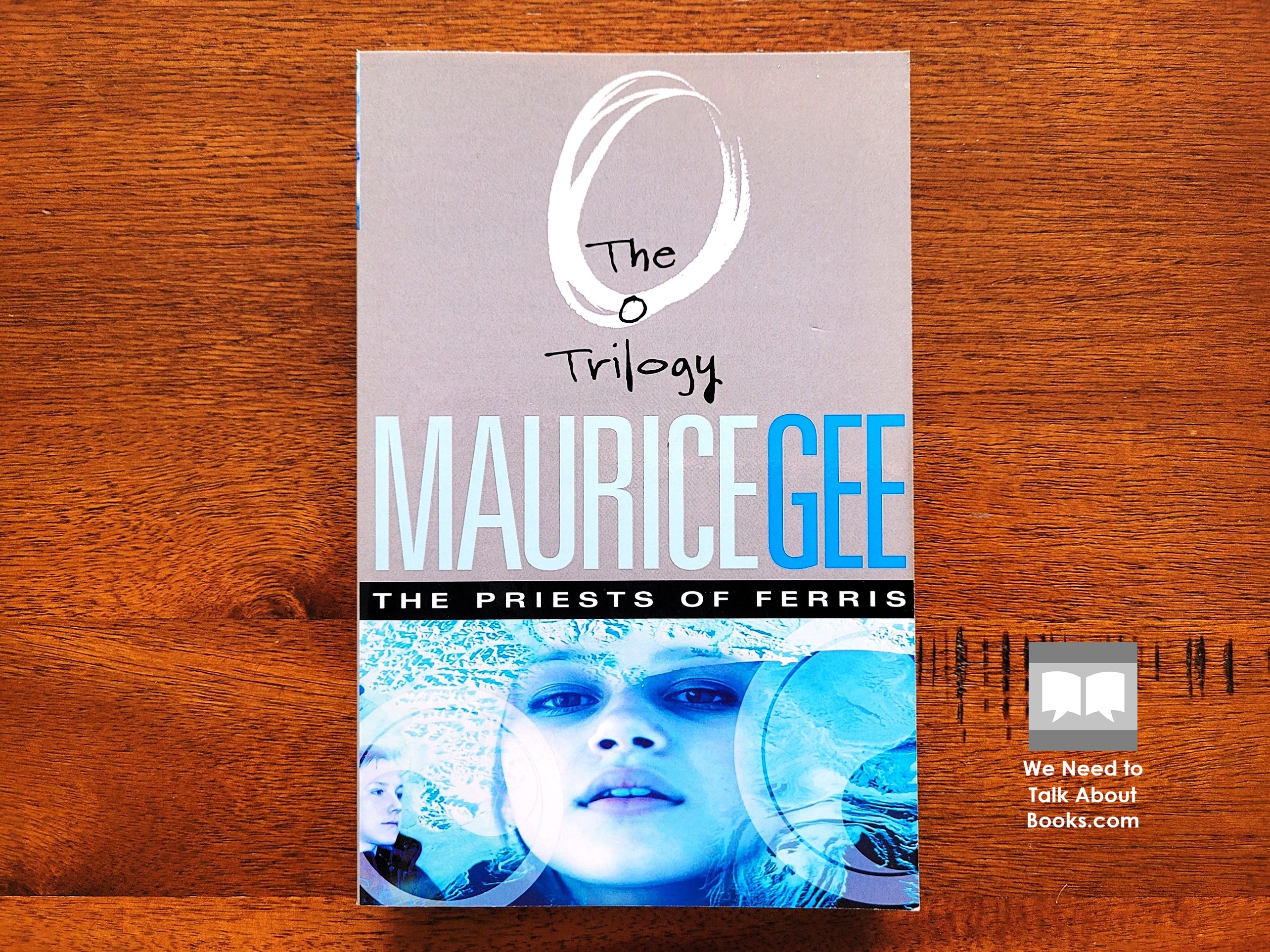
The Priests of Ferris Review: Introduction
I found Maurice Gee’s novel to be far better than I expected. It is an unexpectedly subversive young adult novel, showing great creativity from Maurice Gee and surprises the reader with its characters, world building and turns of plot. It thoroughly deserves to be discovered by new readers and rediscovered by those who may have only experienced it in childhood.
This review explores this second novel of the O Trilogy, including its plot, themes and its take on religion. New readers are advised that since The Priests of Ferris is the second novel in a trilogy, this review contains spoilers with regards to the first novel, The Halfmen of O.
The Priests of Ferris Review: Plot Overview
A year has passed since Nick and Susan travelled from Earth to the world of O, where Susan reunited the halves of the Motherstone, defeating the Halfmen and making the humans of that world whole again. Once again it is the summer holidays and Nick has come with his parents to Ferris Farm. Nick and Susan would like nothing more than a normal summer as preteens, engaging in adventures in their world and of the mind.
But when Susan spots a wet footprint on a rock near the creek, she knows someone from the world of O has crossed to Earth. They soon find a boy with a deformed foot who says he is called Limpy. His story, the reason he has come to Earth does not make any sense to Nick and Susan. It is clear enough that Susan and Nick need to return to O with Limpy and help him if they can.
Arriving in O, Susan and Nick learn that almost a hundred years have passed since they left. Everyone they knew previously must be long dead, including Jimmy Jaspers who chose to stay behind. Soon they hear tracking dogs chasing them and they must flee. They cross a creek, climb hills, fight off dogs before reaching a cave where they are cornered.
Their pursuers are the Priests of Ferris. As difficult as it is for Nick and Susan to imagine, their escapades in O a century earlier have passed into legend and from there an organised religion took shape and now dominates O.
And she told them how the Temple had begun. It was as Nick had guessed. There was a time of lawlessness after the Halves were in balance. Men seemed lost, they seemed to be waiting for someone to rule them. But some left the lowlands and settled in the forest, and others travelled north and south and set up villages on the coast and lived from fishing. They were the lucky ones. In the cities people starved and preyed on one another, and everywhere cults and superstitions grew up. Then one grew stronger than the others – the cult of Susan. It made a holy book, it set up rites and doctrines and invented enemies, and people flocked to it, and soon it ruled.
Her reforming of the Motherstone is called ‘The Mending’. The events of their adventure are hailed as miracles. And Susan is nothing less than a messiah. The priests have skin painted white and wear robes of white leather during the day, switching to black at night. They look unblinking and speak in a monotone voice. Around their necks they wear necklaces of human bones – the bones of heretics such as the ones they must turn over to the temple if they are to be accepted as priests. The punishment for heretics is to be thrown from the cliff at Deven’s Leap to see if they can fly as they believe Susan did.
Susan wants to confront the priests that have trapped them in the cave but Limpy won’t allow it. Plenty of girls have claimed to be Susan, even burning her mark on themselves. It won’t work.
Limpy tells them of his family and community, how his leg became deformed and especially of his younger sister, Soona. A gifted young girl, she was selected for the priesthood. They say she is a chosen one to be tested on the centenary of the Mending. Her test will be to perform Susan’s miracle of flight or to die in the attempt.
But Soona had a prophetic dream and tells Limpy to seek out Susan on Earth.
A familiar voice from the back of the cave comes to them. It is Seeker, one of the Stonefolk and he can rescue them.
Soon Susan and Nick hear more prophecies and even find a letter left for them by Jimmy Jaspers. Their mission begins to take shape and will again involve help from the Stonefolk, Birdfolk and Woodlanders as well as others new to them.
And she thought of Watcher’s prophecy that she would end the Lie, and that became the real part, that was what she must do. Face the High Priest. Face him alone. That was why she was back on O. To end the religion grown up in her name. To stand before this man who sat like a spider in its web, and tell him all his teaching was a lie. It terrified her. She thought of Otis Claw. She had done at once and it seemed unfair that she should have to do it all again.
But even if rescuing Soona is possible, how can they defeat an organised religion? Especially one as dominant and totalitarian as the Priests of Ferris? It is never as simple as exposing the false beliefs of the religion, something Susan discovers during her unforgettable encounter with the High Priest.
[Soona] shook her head sadly. ‘You don’t understand. It really has nothing to do with you. This isn’t a religion, it’s a government. The High Priest is a king. He is not interested in Ferris bones and religious rites. He’s interested in staying on his throne, staying in power. He does it through the temple, that’s all, through superstition and cruelty.’
[…]
‘Now do you understand? You cannot change things by talking. It’s not an argument about what is true or false.’
A Brilliant Idea to Continue the O Trilogy
In The Halfmen of O, the first novel of Maurice Gee’s O Trilogy, once I was beyond the introductory scenes and Susan’s mission became clear, I assumed the trilogy was about the fulfillment of that mission. Instead, Susan, with help from Nick and others, completed the mission and reformed the Motherstone in that first part of the trilogy.
Naturally, I assumed that meant that this was a trilogy that was more episodic in nature and less about parts in an overall quest. Very little was left open at the end of The Halfmen of O which made me wonder what this second part could be about. I was therefore not prepared for what lay in store.
I found the idea that Susan and Nick’s exploits from the first novel have resulted in the creation of an organised religion in Susan’s name to be brilliant. Maurice Gee expands the world of O and with it the reader’s intrigue. The short young adult novel is full of mystery, surprises and escalating tension that made for a great entertaining read.
The Destruction of a Religion – A Subversive Topic for a YA Novel
As well as being a great idea for the book and the continuation of the series, we cannot escape the fact that a story about two young people on a mission to take down an organised religion is a very subversive topic.
There are religions in our present world based around messianic figures including religions which expect their messiah to one day return. But there are critics of these religions, including followers of the religion, whose main criticism is how far the organised religion has strayed from the teachings of their messianic founder. A common refrain is to ask what the messiah would think if they were to return.
Susan found an image of her, with eagle wings outspread and a look of foolish holiness on her face. It made her shiver and she threw it overboard with the rest. But she kept a little book of her ‘sayings’. ‘Listen, Nick. “Those who believe in me shall fly in Earth, but the unbeliever shall fall and a breaking of bones shall be his punishment.”’
‘When are you supposed to have said that?’
She turned back to the beginning and read quickly.
‘Let me guess,’ Nick said. ‘You appeared in a vision to the first High Priest and he wrote it all down.’
‘That’s it. That’s it exactly.’
‘He must have been a pretty smart operator.’
Well, in The Priests of Ferris, the return of the messiah is literally what takes place. A messiah who, like some real-life examples, never intended to found a religion, For Maurice Gee to satisfactorily show how this might play out within a short young adult novel is quite an achievement.
Gee also grapples with the complexity of Susan’s mission from the point of view of the religion’s followers. Some, no doubt, are earnest believers. Others like Limpy and Soona’s family are unbelievers but must keep up appearances or fear deathly consequences. For them to seek out Susan to save them is therefore complicated by their resentment for all she has come to represent.
In our house we did not practice the rites. No one knew of it. The priest did not know. We did not thank Susan for our food. We did not pray at dawn and at dusk, unless someone was with us. Then we prayed. We went to the Temple, we had to do that. But at home we were unbelievers. We did not speak of it, we kept very quiet. If he had known the priest would have sent us for trial. And my sister Soona, she hated Susan most of all.
The reader might also ask what it means. How much of a religion is to do with a spiritual worldview, ethical guidance and mental wellbeing and how much is to do with temporal power? Again, there is a lot here for a young adult novel.
Also, there are aspects of O that might be considered magical if they were present on Earth. There are a range of intelligent creatures of very different forms. There are prophetic dreams and substances with incredible properties. Though it is not explicitly explored, a reader might wonder about the contrast between the power wielded by the false organised religion while extraordinary real events and abilities are considered normal and not representative of something deeper.
Did The Priests of Ferris Influence His Dark Materials?
I said in my review of The Halfmen of O, that parts of it reminded me of Star Wars and The Lord of the Rings. I also said that this probably reflected my lack of experience with the fantasy genre. Reading The Priests of Ferris, where two preteens battle with a totalitarian institution of religion, I naturally thought of Philip Pullman’s His Dark Materials. Again, I thought this was showing a lack of knowledge on my part.
Except for one thing. Some of the characters in The Priests of Ferris are polar bears!
Technically, they are not like Earth’s polar bears but are intelligent polar-bear-like creatures and somewhat martial ones. In other words, they appear to have a lot in common with the armoured bears of His Dark Materials. There is also Jimmy Jaspers who, while not being much like Lee Scoresby from His Dark Materials, has managed to secure an unprecedented human-bear partnership. Combined with the plot, this seemed too fantastic a coincidence to dismiss.
The known literary influences on Philip Pullman’s His Dark Materials include Milton’s Paradise Lost and Lewis’ Chronicles of Narnia. Is it possible that The Priests of Ferris was also an influence? I am given to understand that the fantasy and science fiction genres are party to a lot of ‘borrowing’. Is this another such instance?
Even the cover art on early editions of The Priests of Ferris look like they could have equally been made for His Dark Materials’ first novel Northern Lights (aka The Golden Compass).
Fans of His Dark Materials may find much to their interest and enjoyment in The Priests of Ferris and the O Trilogy.
Final Verdict: Is The Priests of Ferris Worth Reading?
I enjoyed the first novel of this series more than I expected. I found this second novel, The Priests of Ferris, to be even better. Like the first, it packs a lot of punch in a short book that can be quickly read. I think it could have easily been turned into a novel three times its size if written for adults without losing any of its impact. With potentially much deeper meaning, it deserves to be rediscovered and widely read.
 We Need to Talk About Books