
Introduction
Maurice Gee’s The Halfmen of O begins in an ordinary corner of rural New Zealand before unfolding into a darker and far stranger other world. Set on a remote farm near Golden Bay, the mutual dislike of cousins Susan and Nick is interrupted by a disturbing encounter with a mysterious old man and a cryptic symbol carved into a stone. From this unsettling beginning, the novel rapidly expands into a fantasy quest that carries its young protagonists beyond their familiar landscape and into the bleak realm of O, where the balance between good and evil has been shattered. Blending a local New Zealand setting with an imaginative secondary world, Gee crafts a fast-moving adventure that explores the consequences of a universe in which humanity has been split into its moral extremes.
Book Review Summary
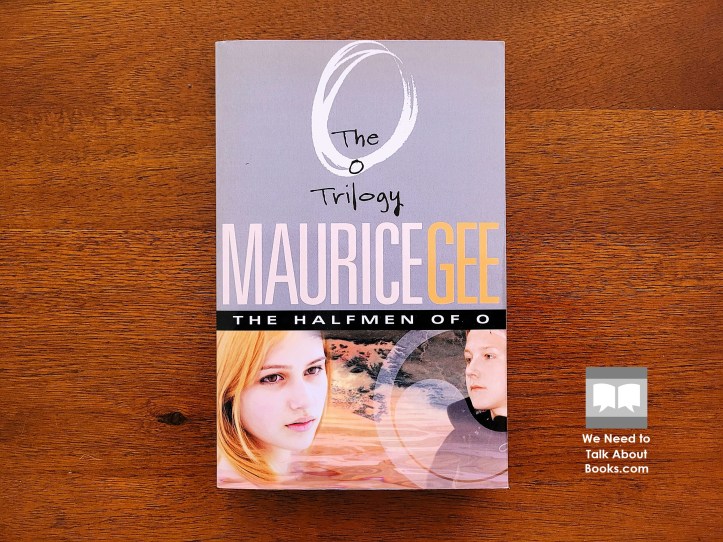
The Halfmen of O is the first novel in Maurice Gee’s O Trilogy, a memorable work of New Zealand young adult fantasy by one of its favourite writers. Published in 1982, the story could easily have been made into a book three times its size. Instead, it is only 186 pages so the pace is fast and full of action. I had some minor criticisms of some parts of the plot which stretched credulity. But I otherwise found The Halfmen of O to be terrifically enjoyable with great imagination, an exciting plot and engaging themes.
Plot Summary of The Halfmen of O
Ferris Farm lies near the Golden Bay region in the north-west of New Zealand’s South Island. Ted and Pattie Ferris live on the farm with their daughter Susan. Each summer, Susan’s uncle and aunt and her cousin Nick visit the farm. The two preteens pretend to get along for their parent’s sake but the truth is that they cannot stand each other.
After antagonising each other, Nick goes off on his own. He rock climbs and goes down a gorge and hears the sound of a two-stroke engine. He spots an old man dredging a creek. The old man grabs Nick, questions him roughly before pulling a knife. He cuts a symbol, like a yin-yang, onto a pebble and tells Nick to deliver this message to Susan.
A disturbed Nick returns to an apologetic Susan and delivers the message. Susan implores Nick to keep his encounter secret and Nick reluctantly obliges.
That evening, Nick overhears the adults talking about Susan. Her parents admit she is distant, quiet, often strange. They recount the disturbing story of her birth. The flood that prevented them from reaching a doctor; the intruder they chased from the baby’s room; the birthmark on Susan’s wrist; the intruder later found dead from a fall near a gold mine with the same mark on his wrist.
The next morning, when Nick wakes Susan is already gone. He goes after her and spots her talking to the old man – Jimmy Jaspers – who gave him the message. She wants to meet the man who gave her the mark, but Jimmy confirms he is long dead. Nick watches as Jimmy opens a small bottle from which a yellow smoke snakes around Susan and appears to send her into a trance. She walks mechanically away.
Nick follows and tries to wake her but she is under something else’s power. He watches her go down an old mine shaft, walk to the end, appear to turn transparent and travel through the rock wall. Soon after he spots Jimmy Jaspers inhale the smoke himself and travel through the rock as well. Jimmy though leaves the bottle behind.
On the other side, Susan enters another realm.
The creek was gone, the bush was gone, the tailing mounds were gone. And everything was grey: a huge grey cloudless sky, grey land, grey hills rolling endlessly down until they were lost in a haze, ashy stunted trees, twisted unnaturally, grass the colour of tin. But worst of all, most hideous of all, burning without colour overhead, a huge black sun, set up there like an iron hot-plate in the sky.
Susan screamed. She looked at herself. Her skin was grey, her nails gleamed like chips of polished stone. She grabbed a handful of hair and pulled it round. It was grey and dead as an old woman’s hair. She cried out with horror and disbelief. She pushed her hands away from her, throwing them away. They were not part of her. Her hair was no part. She refused them. And this grey world in front of her was an evil dream.
Then she meets Odo Cling and his Deathguards.
A voice spoke to her with a scratchy softness. ‘Good! Good! Hee! Your pain is most amusing.’
Susan screamed. The man in front of her had come like a ghost. She stared at him without any understanding. He was no taller than her, and a good deal thinner. He dressed all in leather and black iron, like a Roman soldier. An iron cap was close about his skull. He was grey, like her; except his eyes. They were red. She was almost glad to see the sign of colour, even though his eyes were bright and cruel.
‘Who,’ she managed to say, ‘who are you?’
‘I am Odo Cling. His voice had the sound of a nail scratching tin. ‘I am a Great One. I am Executive Officer. I am Doer of Deeds for the One Who Rules, Otis Claw, Darksoul, Ruler of O, where pain is truth. I am Second. One day I shall rule.’ His eyes grew a deeper red. ‘I shall bring you to the Pit. I shall be the one. Otis Claw shall make room for me.’ He drew himself up taller. He showed his teeth.
Odo Cling’s men test her mark. Touching the dark half appears to give them pleasure. But touching the light half makes them squirm before an explosion sends them flying away. Susan is the real thing. Jimmy arrives soon after expecting a promised bag of gold for delivering Susan. Instead, Odo Cling orders his Deathguards to kill Jimmy. They have no more use for him.
Susan, Odo Cling explains, is now in the land of O, home of the Halfmen. She is to be taken to Darksoul, to the Pit, and there to be killed. It is five days march to reach there. Susan is to be bound and forced along.
One night, while the Halfmen camp near a forest, hooded figures emerge from the trees and drug the guards. They free Susan, but Odo Cling seizes her at knifepoint. Susan presses the mark on her wrist against him, blasting him away and allowing her rescuers to escape with her. Among them is Nick.
They are Woodlanders who take the cousins to the Wildwood to meet Marna, the widow of Freeman Wells, the man who placed the mark on Susan before his death. Marna explains that the world of O was once balanced when Freeman Wells created the Motherstone, placing within it the forces of light and dark. But his disciple Otis Claw shattered that balance, splitting humanity into “Halfmen” who are either wholly good or wholly evil.
Before he died, Freeman Wells hid the two halves of the Motherstone with the Stonefolk and Birdfolk and built a portal to Earth, hoping to recruit ordinary humans—still capable of both good and evil—to restore the balance. Susan is the only Earthling he managed to mark. Her task is clear: recover the two halves, reach the fortress of Darksoul, and return them to the Motherstone to make the Halfmen fully human again.
How it Compares to Maurice Gee’s Under the Mountain
Admittedly, ‘young adult’ and ‘fantasy’ are not genres I have much familiarity with (although I have begun to work my way through some classics of fantasy). Reading Maurice Gee is part of an effort on my part to read some New Zealand fiction – books I probably should have read as a young adult in New Zealand myself.
Having read Gee’s Under the Mountain, I expected something similar. There are some familiar elements. A rural New Zealand setting. A boy-girl pair of young adults. Older characters, marking an absence of anyone around their parent’s age. A quest to save a dying people from annihilation.
But aside from that, The Halfmen of O is a significant step up from Under the Mountain. Perhaps aimed at a slightly older audience, the story is more compelling; the plot unfolds with much action and unexpected turns; the alternative world is wonderfully imagined. I found myself enjoying it far more that I ever expected to.
Comparisons to Star Wars and The Lord of the Rings
Once Marna has explained the nature of Susan’s quest, I could not help feeling an affinity for Star Wars. The good and evil Halfmen are like the Jedi and Sith. Otis Claw is like the disfigured Darth Vader. The fallen Freeman Wells like an Obi-Wan.
Likewise, the nature of the quest gives strong Lord of the Rings vibes. Susan (like a Luke Skywalker or Frodo) is the chosen one for whom the burden to defeat the forces of darkness lie with her alone. Nick (like Samwise) will assist but will prove more pivotal to their chances than even he expects. Together, they journey across realms, encountering other folk, whose trust of humans and others has been damaged. And the nature of their mission means that rather than avoiding the forces of evil or directly confronting it in battle, they must journey to the heart of it by stealth.
Such associations, I am well aware, probably reflect my limited experience with the genre.
Key Theme
The book could be said to have interesting things to say about the nature of good and evil. Portraying normal humans as possessing both to various extents but capable of changing. While showing the unnatural extremes of the Halfmen to be unsustainable.
Final Verdict: Is The Halfmen of O Worth Reading?
The Halfmen of O has a well-considered plot and the world of O shows great creativity, imagination and originality whatever similarities it may have with familiar stories. Maurice Gee contrasts a boring family summer holiday for young adults with an exciting and dangerous fantasy quest narrative. While clearly aimed at a younger audience, the novel’s themes of good, evil and balance will engage adults as well. It is a book that deserves to be read more. I found it surprising and enjoyable and found myself wishing the author had made it into a larger work.
Book Details:
Title: The Halfmen of O
Author: Maurice Gee
Genre: Young Adult Fantasy
First Published: 1982 by Oxford University Press
Review Edition: 2005 by Puffin Books
 We Need to Talk About Books
Considering my blog is supposed to be about NZ books, there’s not enough about Maurice Gee there, and what there is, is his adult fiction. I’ve got a couple more on the TBR, I should read them!
LikeLiked by 1 person
I’m glad I did. O is a really good series, I hope more people discover it.
LikeLiked by 1 person
I enjoyed reading your review.
LikeLiked by 1 person
Thanks!
LikeLike