
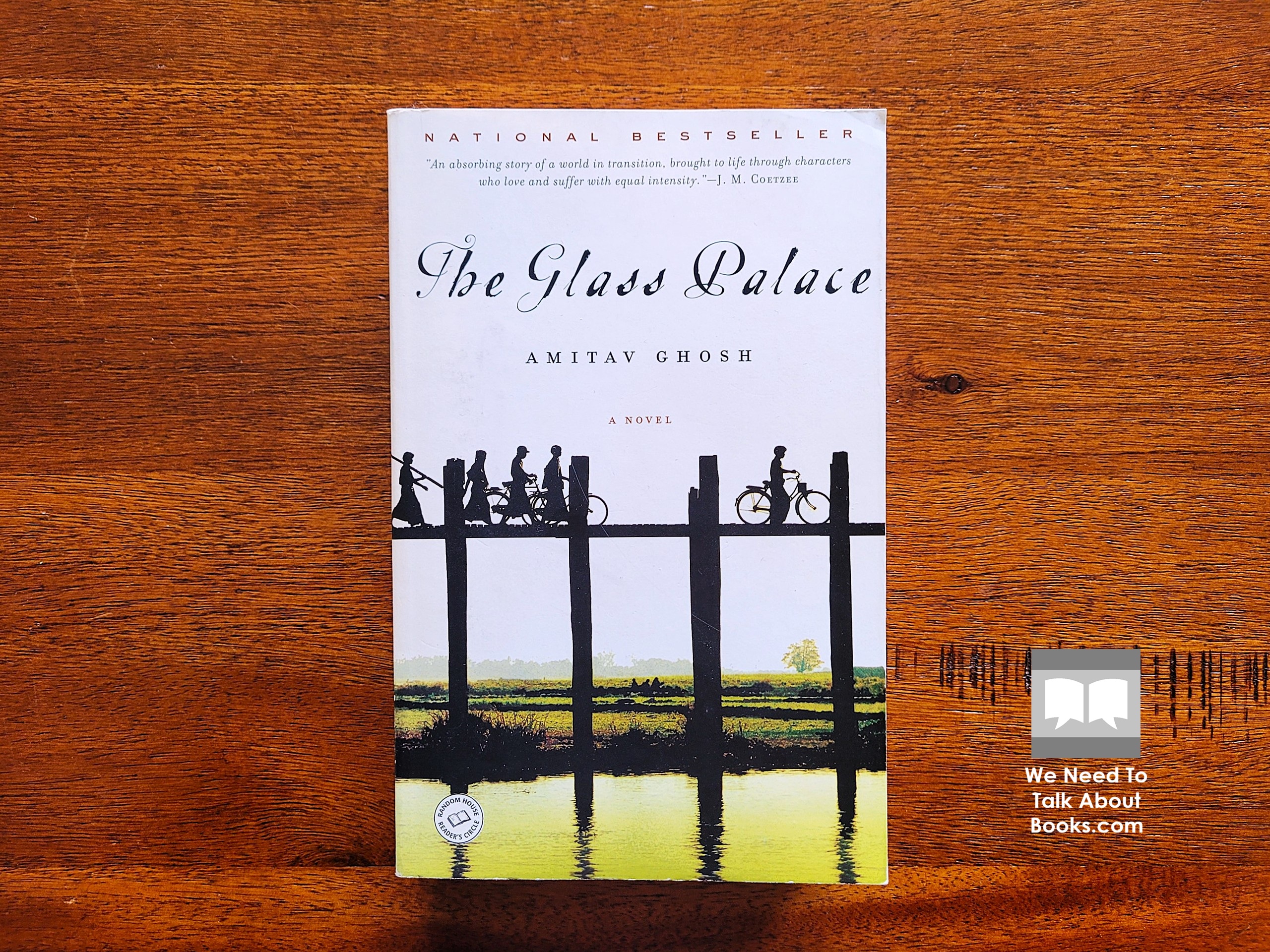
Amitav Ghosh’s The Glass Palace is an ambitious historical novel that traces the human consequences of colonialism in Burma, India and beyond. Moving from the fall of the Burmese royal court to the Second World War, Ghosh weaves personal lives into the vast machinery of imperial ambition. The novel asks how individuals – kings and queens, servants and soldiers, migrants and merchants – are shaped, displaced, and compromised by forces far larger than themselves, while never losing sight of their intimate desires, loyalties, and moral uncertainties.
The lunchtime crowd in Mandalay, Burma (now Myanmar) is interrupted by a strange sound they do not recognise. Rajkumar, an Indian serving boy explains it to them. “English cannon”, he says.
Raj is acquainted with people with more knowledge of what is unfolding than the customers he is serving. He is told the British plan to invade to secure the lucrative teak trade. Raj thinks this is ridiculous but it turns out to be true.
Nearby is the Burmese royal palace, whose inner hall is known as the ‘Glass Palace’. The palace issues a proclamation announcing their intention to fight the British followed by a second proclamation declaring an early victory.
Thebaw, the current King never expected to be a monarch. He had studied to become a Buddhist monk. But his mother-in-law created a path for him over forty-six other princes before his wife, for whom he has a powerful mutual love, had rival princes eliminated and her mother removed from influence.
Queen Supayalat is eight months pregnant and has two young daughters. She too is disturbed by the sound of heavy guns after being told the war was going well. Invasion seems extreme for a minor dispute over the teak trade.
But the generals are lying to the royal couple in the hope they will be rewarded by the British for handing them and the country over with little cost. The war lasts only fourteen days as the Burmese are overwhelmed by the superior technology, firepower and battle-hardened Indian sepoy soldiers.
When locals loot the palace, prising jewels out of the walls and doors the furious queen is powerless to stop them. Rajkumar is there watching on. He sees Dolly, one of the royal family’s attendants and is held fast by the most beautiful person he has ever seen. He introduces himself but when soldiers arrive to clear the looters he must flee.
The King and Queen journey to exile in India. It is a forlorn existence. They have no income but cannot get a fair deal for the sale of their possessions. Their servants are free to leave and most do but the local replacements can’t follow protocols. They can only watch as the king of Siam, whose ancestors were defeated in war by Thebaw’s ancestors, goes on a royal tour of Europe. The Queen predicts the British will rob Burma of its natural resources and leave the country with nothing.
The Queen greeted them with her proud, thin-lipped smile. Yes, look around you, look at how we live. Yes, we who ruled the richest land in Asia and now reduced to this. This is what they have done to us, this is what they will do to all of Burma. They took our Kingdom, promising roads and railways and ports, but mark my words, this is how it will end. In a few decades the wealth will be gone – all the gems, the timber and the oil – and then they too will leave. In our golden Burma, where no one ever went hungry and no one was too poor to write and read, all that will remain is destitution and ignorance, famine and despair. We were the first to be imprisoned in the name of their progress; millions more will follow. This is what awaits us all; this is how we will all end – as prisoners, in shantytowns born of the plague. A hundred years hence you will read the indictment of Europe’s greed in the difference between the Kingdom of Siam and the state of our own enslaved realm.
Meanwhile Rajkumar in Mandalay does not know what to do with himself. An orphaned Indian immigrant, he is out of work as the food stall he was working for has closed down. He does not want to go back to India or the fishing boat that brought him to Burma. But his ambition and curiosity is fired by the fact that the British would go to war and invade an entire country for wood.
With the help of friends and investors who advise him and become his business partners as well as his own insight, Rajkumar looks to make the most of the opportunities in Burma. He travels to India to hire indentured labour and soon has his own timberyard. With all the construction the British are engaging in Burma there is no shortage of demand. And he is keen to diversify as Burma also has oil and a great climate for growing rubber.
He is not solely motivated by the challenges and rewards of business success. Once he becomes sufficiently wealthy he plans to visit the Burmese royal house in Indian exile and be introduced to his dream girl, Dolly. Whether she welcomes the attention of a man who was there when the palace was looted, who wants to take her away from the family she has supported back to a country no longer ruled by their people, by a man many would see was part of the occupying invaders, is a perspective Rajkumar has not considered.
As the decades go by, families grow and younger generations have their own ambitions. But everything turns to turmoil as a Japanese army approaches. Native Burmese sense the opportunity to rid themselves of their Western masters for an Eastern one. Indians, whether wealthy industrialists, poor labourers or British soldiers find themselves the targets of nationalist sentiment as much as the British.
The Congressmen had bitter memories of their confrontations with Indian soldiers and policemen. They began to berate Arjun for serving in an army of occupation.
Arjun recalled that it was his sister’s wedding and he managed to keep his temper. “We aren’t occupying the country,” Arjun said, as lightly as he could. “We are here to defend you.”
“From whom are you defending us? From ourselves? From other Indians? It’s your masters from whom the country needs to be defended.”
“Look,” said Arjun, “it’s a job and I’m trying to do it as best I can…”
One of the Burmese students gave him a grim smile: “do you know what we say in Burma when we see Indian soldiers? We say: there goes the army of slaves – marching off to catch some more slaves for their masters.”
It was with a great effort that Arjun succeeded in keeping control of himself; instead of getting into a fight, he turned round and marched away. Later, he went to complain to Uma and found her wholly unsympathetic. “They were just telling you what most people in the country think, Arjun,” Uma said bluntly. “If you’re strong enough to face enemy bullets, you should be strong enough to hear them out.”
Meanwhile, Indian soldiers serving with the British, away from home and against the Japanese, while an Independence movement is at its peak in India, begin to question their loyalties.
Was this how a mutiny was sparked? In a moment of heedlessness, so that one became a stranger to the person one had been a moment before? Or was it the other way around? That this was when one recognised the stranger that one had always been to oneself; That all one’s loyalties an beliefs had been misplaced?
The Glass Palace is the fifth novel I have read by Amitav Ghosh and I think it is safe to say he is one of my favourite writers. In The Glass Palace we see the traits that make him so good. The setting is something of a cultural melting pot – something Ghosh excels in writing about. As well as the main plot, he writes with a lot of asides, anecdotes and mini-stories. Instead of being distractions, they are purposeful while being as enjoyable a journey as the main story.
And, as always, the book is extensively researched. The descriptive pieces are excellent, yet he never makes you feel like you are having to do homework while reading. The research is completely entwined with the story and never feels additional or attritional.
Once, while sheltering beside a dying and girdled trunk of teak, Saya John gave Rajkumar a mint leaf to hold in one hand and a fallen leaf from the tree in the other. Feel them, he said rub them between your fingers.
Teak is a relative of mint, Tectona grandis, born of the same genus of flowering plant but of a distaff branch, presided over by that most soothing of herbs, verbena. It counts among its close skin many other fragrant and familiar herbs – sage, savory, thyme, lavender, rosemary and most remarkably Holy Basil, with its many descendants, green and purple, smooth-leaved and coarse, pungent and fragrant, bitter and sweet.
There was a teak tree in Pegu once with a trunk that measured one hundred and six feet from the ground to its first branch. Imagine what a mint’s leaf would be like if it were to grow upon plant that rose more than one hundred feet into the air, straight up from the ground, without tapering or deviation, its stem as straight as a plum-line, its first leaves appearing almost at the top, clustered close together and outspread like the hands of a surfacing diver.
The mint leaf was the size of Rajkumar’s thumb, while the other would have covered an elephant’s footprint; one was a weed that served to flavour soup, while the other came from a tree that had felled dynasties, caused invasions, created fortunes, brought a new way of life into being. Yet even Rajkumar, who was in no way inclined to indulge the far-fetched or the fanciful, had to admit there between the faint hairiness of the one and the bristling, coarse-textured fur of the other, there was an unmistakable kinship, a palpably familial link.
Also, as always, his characters and plots are there to empower his themes. Like his other works, these are of colonialism, racism, displaced people, and environmental damage. But the relationship works both ways. His characters are not mere tools for his themes, nor can his themes be reduced to sermons. Instead, his characters humanise and show a complexity behind the issues that thwart any attempt to simplify.
All that being said, I don’t think The Glass Palace was as strong as the other Ghosh novels I have read. My main issue is that I found it quite uneven. The first third of the novel is very compelling. Reading a bit like an historical romance, it seems to reach a full conclusion without any threads to continue with.
But the majority of the book is yet to come and the reader is pulled along for much of it. I felt his other books unfolded their plots effortlessly, while The Glass Palace has to ask the reader to keep going somewhat.
It is not without purpose however. The conclusion of the novel, as the Second World War makes its impact, is exciting and horrific. Is it worth the wait? I would say that it is. The ending, and the complicated positions it puts the characters in, is clearly what Ghosh designed the novel to build to, and he is too good a writer to let the reader down.
This encounter with Arjun left Dinu profoundly shaken: now, for the first time, he began to understand the irreducible reality of the decision that Arjun had made; he saw why so many others whom he’d known – men such as Aung San – had made the same choices. He began to doubt his own absolute condemnation of them. How does one judge a person who claims to act on behalf of a subordinated people, a country? On what grounds can the truth of such a claim be established or refuted? Who can judge a person’s patriotism except those in whose name he claims to act – his compatriots? If the people of India chose to regard Arjun as a hero; if Burma saw Aung San as her saviour – was it possible for someone such as him, Dinu, to assume that there was a greater reality, a sweep of history, that could be invoked to refute these beliefs? He could no longer be confident that this was so.
Of the five novels of Ghosh’s that I have read, The Glass Palace (2000) is the earliest published. Perhaps it represents a stage in Ghosh’s career prior to him being able to produce the novels I found to be more accomplished and which I enjoyed more such as his Ibis Trilogy. But for fans of his work like me, The Glass Palace is worth experiencing. For it still contains many of the elements and much of the skill that have lead us to enjoy his work.
 We Need to Talk About Books
I think Ghosh is at his best when writing about colonialism, he does it in such an interesting way without that overbearing moralising that can be rather tedious. I loved The Ibis Trilogy too, but was not so keen on The Hungry Tide.
His latest work seems to be nonfiction, which is a pity. I want another novel!
LikeLiked by 1 person
I want another novel too! But I did buy one of his non-fictions – Smoke and Ashes – which I hope will be a nice complement to Ibis.
LikeLiked by 1 person
An absolute fan of Ghosh’s work. Especially how the latest book brings The Glass Palace, Hungry Tide and Gun Island together.
LikeLiked by 1 person
Thanks for visiting and sharing!
LikeLike