
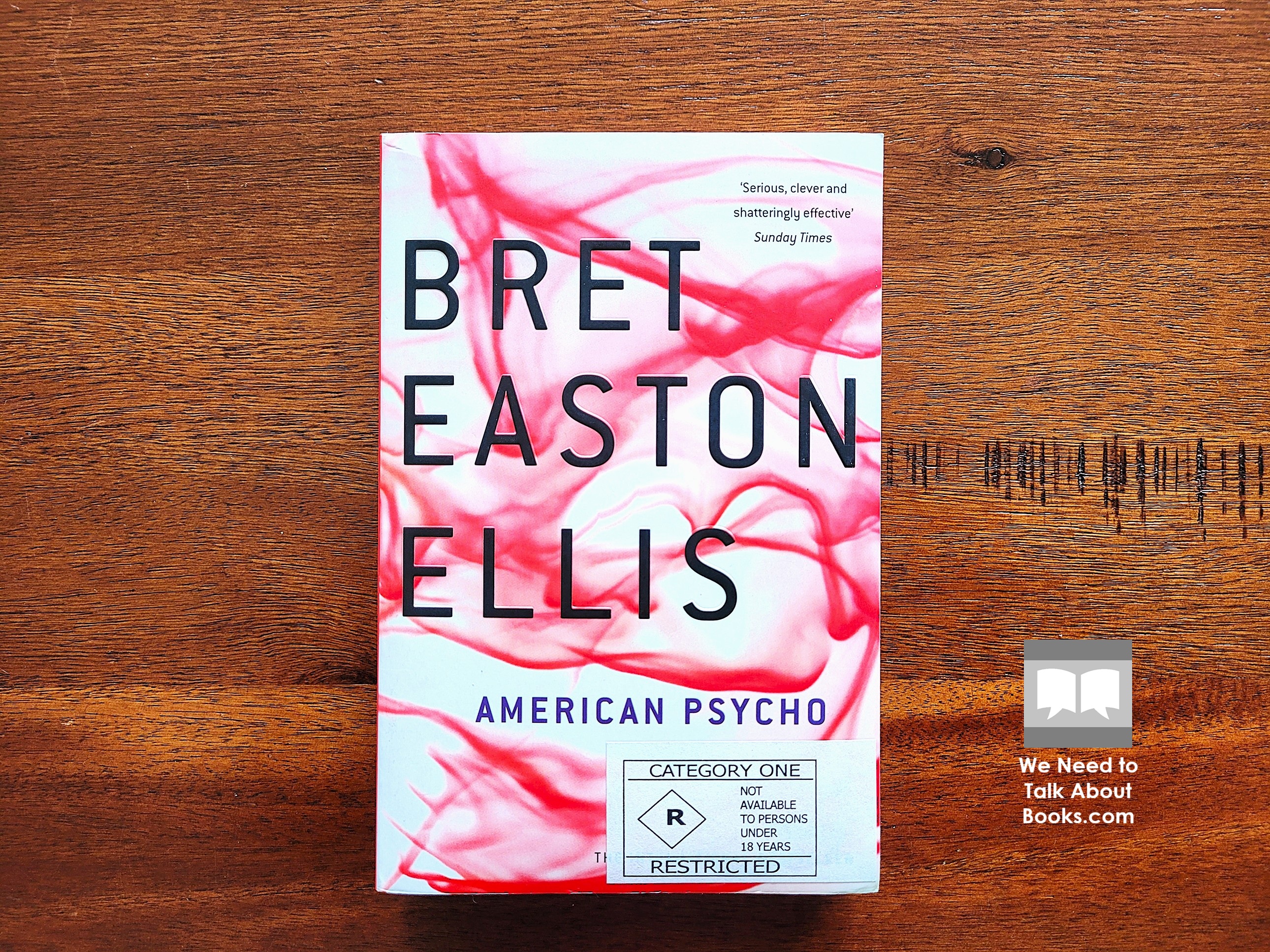
Bret Easton Ellis’s American Psycho is one of the most controversial and polarising novels of the late 20th century. First published in 1991, it shocked readers with its blatant sexism and graphic violence including sexual violence. Later chapters get even more extreme. Told through the detached narration of Patrick Bateman, the novel immerses us in a world of superficial charm, empty status symbols, and moral decay. Bateman’s life, carefully curated with luxury brands and hollow routines, is a portrait of a society obsessed with appearance over substance and pleasure over empathy. Bateman invites the reader into his mind, forcing us to confront his psychopathy. But it is no secret, he confesses it openly. American Psycho therefore also forces the reader to question the values of the culture that enables Bateman.
Patrick Bateman begins his day with an elaborate morning routine in his luxury New York apartment.
In bed I’m wearing Ralph Lauren silk pyjamas and when I get up I slip on a paisley ancient madder robe and walk to the bathroom. I urinate while trying to make out the puffiness of my reflection in the glass that encases a baseball poster hung over the toilet. After I changed into Ralph Lauren monogrammed boxer shorts and a Fair Isle sweater and slide into silk polka-dot Enrico Hidolin slippers I tie a plastic ice pack around my face and commence with the morning’s stretching exercises. Afterwards I stand in front of a chrome and acrylic wash mobile bathroom sink – with soap dish, cup holder, and railings that serve as towel bars, which I bought at Hastings Tile to use while the marble sinks I ordered from Finland are being sanded – and stare at my reflection with the ice pack still on. I pour some Plax anti-plaque formula into a stainless-steel tumbler and swish it around my mouth for thirty seconds. Then I squeeze Rembrandt into a faux-tortoiseshell toothbrush and start brushing my teeth (too hungover to floss properly – but maybe I flossed before bed last night?) and rinse with Listerine. Then I inspect my hands and use a nail-brush. I take the ice-pack mask off and use a deep-pore cleanser lotion, then an herb-mint facial mask which I leave on for 10 minutes while I check my toenails. Then I use the Probright tooth polisher and next the Interplak tooth polisher (this in addition to the toothbrush) which has a speed of 4200 RPM and reverses direction forty-six times per second; the larger tufts clean between teeth and massage the gums while the short ones scrub the tooth surfaces. I rinse again, with Cēpacol.
Then he heads for Wall Street.
At his office Bateman does very little work. Today he preoccupies himself by rearranging his office. His secretary, Jean, who is probably in love with him, organises everything and covers for him.
After work, most days he meets his friends at a bar. Like him, they are obsessed with clothes and appearances, gossip and connections. They banter with playful insults, boast about sexual exploits and make derogatory jokes. They seem to have no opinions of their own but rely on reviews, celebrity endorsements and luxury brands. Bateman proudly shows off his new business cards but is dismayed to see his friends all have new ones too and theirs are more impressive than his.
When they finally agree on where to get dinner, they are able to use their connections to get entry ahead of the large crowd of diners with reservations. A bottle of champagne is brought to their table but they do not open it as it is not vintage and was bought for them by someone they disklike. So, they snub him and it.
I have a knife with a serrated blade in the pocket of my Valentino jacket and I’m tempted to gut McDermott with it right here in the entranceway, maybe slice his face open, sever his spine; but Price finally waves us in and the temptation to kill McDermott is replaced by the strange anticipation to have a good time, drink some champagne, flirt with a hardbody, find some blow, maybe even dance to some oldies or that new Janet Jackson song I like.
Later they go to a club. They score some cocaine but it is low quality. The club is loud and packed and they can’t seem to enjoy themselves. So, they call it a night. Like so many nights, they wanted to have a big one but everything seems to disappoint.
The rest of Bateman’s lifestyle routines consists of more pleasure-seeking, self-indulgence and complaining. He describes his workouts and gets himself facials and mani-pedis. He buys lifestyle magazines and rents violent movies and porn. Though it is the violent movie scenes he masturbates to. And he is getting fed up with his drycleaner who can’t seem to get the blood stains out of his clothes.
He goes on dates but tends to suffer through them. He finds the conversation painful and goes to his happy place thinking about his expensive possessions, his sexual fantasies and his body and his looks. His own dates can’t stand him when he forces them out of their plans and towards something he would rather do, even if he can’t deliver on what he promised. And the sex is unfulfilling if it just becomes an argument over condoms and spermicide.
He regularly openly confesses his violent dark thoughts but no one seems to listen.
“My life is a living hell,” I mention off the cuff, while casually moving leeks around on my plate, which by the way is a porcelain triangle. “And there are many more people I, uh, want to … want to, well, I guess murder.” I say this emphasising the last word, staring straight into Armstrong’s face.
One night, he leaves a black-tie event early. The champagne and canapes were poor and he was bored to death. He finds a sleeping homeless man and wakes him up. After some small talk, he stabs the man and leaves, finds a McDonalds and gets himself a thickshake.
From its impressive early chapters, American Psycho makes a strong impact. The reader is plunged headfirst into the life and mind of Patrick Bateman. His first-person narration is a presentation of his life, the high level of detail owing to his excessive interest in himself. That he is part of a tribe of similar men is made clear to us from the first chapter.
“Lunch?” I ask them, yawning. “Tomorrow?”
“Can’t,” McDermott says. “Haircut at the Pierre.”
“What about breakfast?” I suggest.
“Nope,” Van Patten says. “Gios. Manicure.”
“That reminds me,” I say, inspecting a hand. “I need one too.”
“How about dinner?” McDermott asks me.
“I’ve got a date,” I say. “Shit.”
“What about you?” McDermott asks Van Patten.
“No can do,” van Patten says. “I’ve got to go to Sunmakers. Then private workout.”
This was the resurgent New York of the 1980’s. Think Reaganomics, young Donald Trump, films like Oliver Stone’s Wall Street and novels like Tom Wolfe’s The Bonfire of the Vanities. Bateman and his tribe embody the elitism, entitlement and superiority of a certain section of society with their obsession over looks, status and brand names; with diet, lifestyle and bodies. Importantly, it is an elitism that has grown from no competencies and carries no consequences.
The fact that Bateman regularly confesses his psychopathic thoughts to others and is ignored is a symptom of the culture he is but one member of. What he does – in his job, his murders, his sexual assaults – are of little value or interest to others. Only how he appears attracts attention and acknowledgement.
His friends may not be psychopaths, but the pervasive moral vacuum leaves them unable to respond humanely to things that don’t directly affect them. And despite their hanging out, their dates and relationships, like Bateman they are profoundly alienated and alone with no one who knows and understands them.
Later, we are lying on opposite sides of the bed. I touch her shoulder.
“I think you should go home,” I say.
She opens her eyes, scratches her neck.
“I think I might … hurt you,” I tell her. “I don’t think I can’t control myself.”
She looks over at me and shrugs. “Okay. Sure.” Then she starts to get dressed. “I don’t want to get too involved anyway,” she says.
“I think something bad is going to happen,” I tell her.
She pulls her panties on, then checks her hair in the Nabowev mirror and nods. “I understand.”
After she’s dressed and a minute of pure, hard silence have passed, I say, not unhopefully, “You don’t want to get hurt, do you?”
She buttons up the top of her dress and sighs, without looking over at me. “That’s why I’m leaving.”
I say, “I think I’m losing it.”
Their obsessions are highly contagious, however. In American Psycho, through Bateman and his tribe, we can see a showcasing of the expensive lifestyles of the New York elite we would later see in television shows like Sex and the City and Gossip Girl. Both stepping stones to the vapid influencer culture we are currently steeped in.
Another way that American Psycho was a forerunner of cultural trends is that the character of Bateman can be seen as an early exemplar of the antihero that would enjoy a dominant period in television from the late 1990s. Tony Soprano (The Sopranos), Walter White (Breaking Bad) and Don Draper (Mad Men) being some of the most famous iterations. Author Bret Easton Ellis is also probably the most high-profile member of what was termed the ‘literary brat pack’.
It needs to be said that there are two incompatible ways of interpreting American Psycho. One is to say that Patick Bateman is really carrying out these violent attacks and murders. The alternative is that Patrick is imagining them. As the novel progresses, they move from being fantasies he is in control of to complete hallucinations. By the end he can no longer tell what is real and what was a hallucination.
There are opportunities in the story for Bateman to get caught. His confessions are sometimes made in the attempt to confirm his memories really happened. These instances are ambiguous enough to keep both interpretations in play. Either his confrontations with reality fail because there is nothing to confront – his murders never happened, and they are a symptom of the phoniness of his culture. Or they fail because of the jilted morality of his culture which would rather permit his violence than confront it. This is the interpretation I made and I think is the more interesting one.
In my recent review of Don Delilo’s White Noise, I mentioned my unplanned journey through twentieth century postmodernism, largely unfulfilling. Like some other examples, American Psycho barely contains a plot. While linear, it is somewhat fragmented. Its playfulness and humour makes an upsetting combination with its narrator’s disturbing sexual and homicidal exploits. And that first-person narration puts the reader in the awkward position of asking us to read on while rejecting Bateman’s worldview.
But like White Noise and Joseph Heller’s Catch-22, I found American Psycho to be more readable than some others, Thomas Pynchon for example. Like those others, it does enough to avoid confusion while still diverting from traditional storytelling methods.
Though it does not employ a conventional arc, the action in the story consistently escalates. This means that the reader’s awkward position I mentioned, becomes more difficult as the story goes on. And while I say I found it ‘readable’, I mean I did not suffer confusion as I have with other postmodernists. I don’t mean it from the point of taste. On that score, I did reach my limit late in the book where Bateman’s exploits became too sick for me. At that point I felt I had to break the contract between reader and book of entry and acceptance into the world of the book and retreat into the safety of my own world and continue reading at arm’s length. It is one of the purposes and achievements of the book to test where that point is for the reader.
The main arc is broken up with Bateman regaling the reader with his thoughts on the pop music of the 1980’s that he loves. His feelings here come across as very sincere. They do have the effect of somewhat softening and humanising his otherwise deplorable character. They also serve to break up the escalation of his violence and juxtapose the man who commits those sexual and violent acts with the one who loves Whitney Houston. I had to chuckle at the comic timing of it.
The 2000 film follows the novel fairly closely. Though too much is probably made of the extreme violence from the novel that was omitted in the film. It is more due to making allowances for length and ratings that the format requires rather than necessarily sanitising the material. It is a good film, featuring several actors before they were big names and succeeds in bringing the satirical and comedic elements to the fore.
The film also reminds us of another way that American Psycho has divided interpretations. Feminists were critical of the novel for the sexism of the main characters and the graphic violence towards women, notably Gloria Steinham. But screenwriter Guinevere Turner and director Mary Harron seem to have seen an opportunity to create a feminist statement by depicting the toxic masculinity, the frailty and superficiality of the elite men and their inability to connect with women on any meaningful level. This has largely been how the film has been interpreted, though to be fair I felt there were elements of this in the novel as well.
Being the age we live in (or are hostage to) we cannot leave without examining the fact that Bateman’s idol is Donald Trump.
Initially, I thought this was another sign of Bateman’s incompetency and superficiality. Isn’t it true that New Yorkers were wise to Donald Trump? That they could see behind the façade to the conman who, if he was not born into wealth, would be more at home selling Rolexes on the street? Therefore, isn’t Bateman’s admiration of him either mistaken or more evidence of his lack of seriousness?
Then I ask, suspiciously, “Why wasn’t Donald Trump invited to your party?”
“Not Donald Trump again,” Evelyn moans. “Oh God. Is that why you were acting like such a buffoon? This obsession has got to end!” she practically shouts. “That’s why you were acting like such an ass!”
But we must remember the timing of the novel. Reagan is still president in American Psycho. Whereas Donald Trump’s fall from esteem did not occur until the 1990’s after his casinos failed and he was resorting to selling steaks by television. So, perhaps Bateman’s admiration for Trump is valid?
Yet, apart from the musicians Bateman is a fan of, other celebrities are barely mentioned, no other businessmen that I can recall, while Trump is brought up many times. So, I think my initial impression is correct. There are many businesspeople and celebrities for Bateman to admire. His choice of Trump to the exclusion of others is illuminating. Though I doubt it is a case of foresight that can be attributed to Ellis, we may look back and see Bateman’s love for Trump is an instance of one sociopath admiring another.
American Psycho is a brutal, relentless satire of consumer culture, toxic masculinity, and moral apathy, told through the disquieting lens of a narrator who is both product and symptom of his environment. Patrick Bateman is not merely a psychopathic killer – he is a mirror held up to a culture obsessed with image and status anxiety, where real human connection is not only absent but irrelevant. Ellis’s novel challenges the reader to navigate the space between horror and humour, sincerity and detachment, fantasy and reality, often blurring the lines so completely that one becomes indistinguishable from the other. Whether Bateman’s crimes are real or imagined, the emptiness he inhabits—and embodies—is all too real. That emptiness, beneath all the polish, brand names, and late-1980’s glam, is what makes American Psycho disturbing, compelling, and enduringly relevant.
 We Need to Talk About Books