
Like many artists who break through and achieve great success, John Steinbeck chose not to rest on his laurels but to keep searching and experimenting. Whether Cannery Row is a successful experiment is debatable. Nevertheless, it still contains recognisably great writing. Far from a sign of decline, it is one more milestone in a career that had more great work to come.
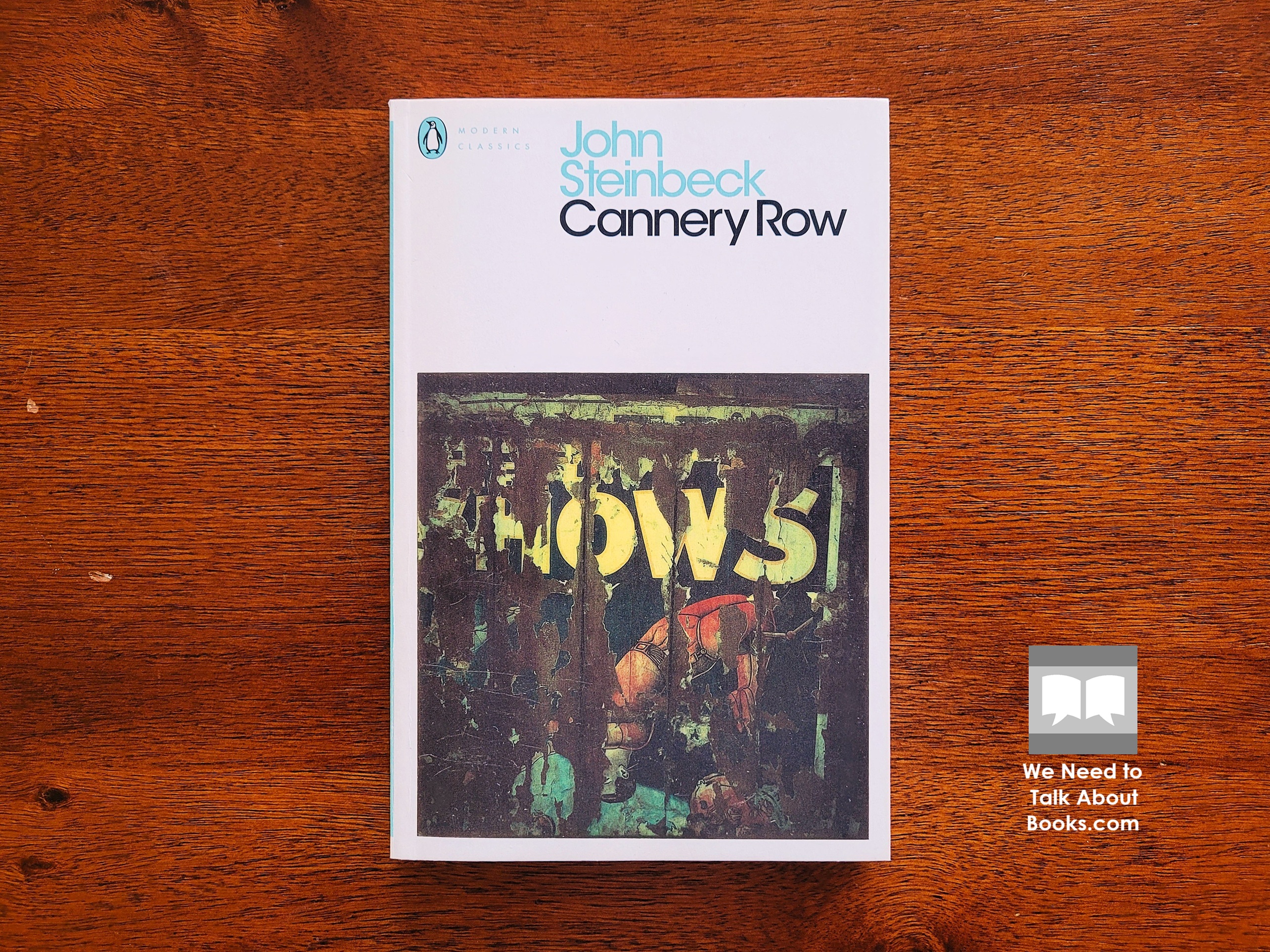
Cannery Row in Monterey in California is a poem, a stink, a grating noise, a quality of light, a tone, a habit, a nostalgia, a dream. Cannery Row is the gathered and scattered, tin and iron and rust and splintered wood, chipped pavement and weedy lots and junk heaps, sardine canneries of corrugated iron, honky tonks, restaurants and whore houses and little crowded groceries, and laboratories and flop houses. Its inhabitants are, as the man once said, “whores, pimps, gamblers, and sons of bitches,” by which he meant Everybody. Had the man looked through another peephole he might have said, “Saints and angels and martyrs and holy men,” and he would have meant the same thing.
John Steinbeck’s 1945 novel Cannery Row, set in the industrial fishing town of Monterey features an assorted cast of characters.
There is Lee Chong, a Chinese-American who owns and runs a grocery store that stocks everything you may need. A shrewd businessman, Lee is open to hearing offers of a deal and everyone in town seems to owe him money.
One such deal has just come along. Horace Abbeville approaches Lee to sell a building he owns in return for clearing his grocery debt. But new assets come with new problems like how to protect it.
That is when Mack approaches Lee with another new deal. Mack is the leader of a group of men with no families, no money and no ambition. Mack offers to protect the building for Lee in return for allowing Mack’s crew to live there.
Lee understands he is cornered. Mack’s men are the kind his building would need protection from. If Lee does not take the deal, they are likely to vandalise his new building until he does. So, Lee takes the deal. Even though he knows he will see no rent from Mack, it is still worth it. Mack’s men will protect the building, it gives Lee some goons to call on if there is any trouble and gives them a reason to not shoplift from his store.
Also in town is Western Biological, owned and operated by Doc. A marine biologist, Doc collects samples of starfish, octopi and various other marine life. Some he keeps for his own laboratory, but most which he preserves and dispatches to universities for their labs.
Doc lives very independently and contently and shows great patience in the company of others. Though he is mostly solitary, it is known that women visit his home. He will enjoy a beer with a companion and will take on assistants for his work. But Doc does not seem to be aware of the great affection the town has for him as they see him as their fountain of philosophy, science and art.
One who does appreciate Doc is Mack. Dwelling on Doc’s uncelebrated status, Mack resolves to throw Doc a surprise birthday party. He has a lot of helpers he can call on. As well as Lee, there is Dora Flood, who has been madam of the local brothel for fifty years. And Eddie, an understudy barman who supplies Mack and his men with alcohol from the patron’s leftovers. Doc’s party gives Mack and his men the worthy goal their lives have been lacking.
Cannery Row was not what I had expected. Given its title and what I knew of Steinbeck, particularly from The Grapes of Wrath, Of Mice and Men and Tortilla Flat, I had expected a story of the workers of the town of Monterey. A story of the fishermen who venture into the ocean to make their catch, and the workers of the canning factories who process it. It was not like that at all.
Dismissed by many reviewers as frothy and sentimental, it certainly was not the novel expected from a writer who had grappled with California’s labour problems, and not the sort lauded in the midst of a World War. […] Indeed, Steinbeck himself was later apt to dismiss it as “a nostalgic thing, written for a group of soldiers who had said to me, ‘Write something funny that isn’t about the war’. […] And told his editor, Pascal Covici, that “No critic has as yet stumbled on the design of the book.” Steinbeck’s own remarks are as baffling as the critics divided opinions’ on the book’s merit. Perhaps the safest course to steer in reading this seemingly disjointed text is to consider it first as “difficult” as the life it mimics.
From the Introduction.
In 1957, some twelve years after the book was published, the town of Monterey changed the name of the main road the factories sit on to ‘Cannery Row’ in honour of the book. Yet, the fishermen and the factory workers make no appearance at all in the book.
Then there is the fact that there is almost no story. Again, from what I know of Steinbeck from his other work, there is always a grand vision. Biblical allusions, semi-autobiography, reworking of classical themes are common driving forces behind the plots in his famous books. But it was difficult to discern much here.
The closest thing to a plot here is Mack’s quest to throw Doc a party. Though it sounds a lot like the quests of Danny and his friends in Tortilla Flat, it is a smaller part of the book here.
Then there are the strange interchapters. Often featuring characters who appear for that chapter only, they are like short story digressions embedded in the larger book. I found them to be the most enjoyable part of the book and they were often humorous.
There is also a clear focus on nature, the environment and animals. Animal characters feature in the book including one of the interchapters which is devoted to the difficulties faced by a particular gopher.
But there are also the aspects that are familiar to fans of Steinbeck. The writing is amazing at times. When Mack, on his quest for Doc, goes on a journey out of Monterey with his friends, Steinbeck is able to immediately conjure all the romance of the road trip, the peace of being reunited with nature and the beauty of the locations they find as if it was the easiest thing for him to do.
The Carmel is a lovely little river. It isn’t very long but in its course it has everything a river should have. It rises in the mountains, and tumbles down a while, runs through shallows, is dammed to make a lake, spills over the dam, crackles among round boulders, wanders lazily under sycamores, spills into pools where trout live, drops in against banks where crayfish live. In the winter it becomes a torrent, a mean little fierce river, and in the summer it is a place for children to wade in and for fishermen to wander in. Frogs blink from its banks and the deep ferns grow beside it. Deer and foxes come to drink from it, secretly in the morning and evening, and now and then a mountain lion crouched flat laps its water. The farms of the rich little valley back up to the river and take its water for the orchards and the vegetables. The quail call beside it and the wild doves come whistling in at dusk. Raccoons pace its edges looking for frogs. It’s everything a river should be.
It just shows how beautiful Steinbeck’s natural writing is and makes you wonder why he diverted from it for much of this novel.
So, how to explain the rest? Here Susan Shillinglaw, who was Director of the Centre for Steinbeck Studies at San Jose State University, and who wrote the Introduction to this Penguin Modern Classics edition of Cannery Row came to my aid. While covering a lot in her Introduction, some of it also helped illuminate the uncertainties I had with this book.
Cannery Row was written after a difficult period in Steinbeck’s life. After the fallout of his controversial bestseller, The Grapes of Wrath (1939), and a divorce from his first wife, Steinbeck looked for an exit from the road he was taking. He worked as a war correspondent. He dabbled with filmmaking. He investigated studying to become a marine biologist and became close friends with Edward F Rickets whom several of his characters have been based on, none more so than Doc in Cannery Row.
How can the poem and the stink and the grating noise – the quality of light, the tone, the habit and the dream – be set down alive? When you collect marine animals there are certain flat worms so delicate that they are almost impossible to capture whole, for they break and tatter under the touch. You must let them ooze and crawl of their own will onto a knife blade and then lift them gently into your bottle of sea water. And perhaps that might be the way to write this book – to open the page and let the stories crawl in by themselves.
When he did think about writing, Steinbeck felt he had taken the novel form as far as he could. Instead, he wanted to experiment with fictional forms, write for fun and avoid politics.
Shillinglaw confirms the book lacks a clear plot or resolution. It is not working to a purpose. And it is not about the canneries or who worked there but about Cannery Row after hours and about marginalised characters.
The difficulty in reading this novel is that it includes so much that is essentially Steinbeck: scientific detachment and ecological awareness; empathy toward the lonely and dispossessed that occasionally verges on sentimentality; awareness of the potential cruelty of group man; and, at the darkest level in the book, the terror of isolation and nothingness, existential despair that was his own demon as well as the legacy of war. And, of course, humour. It’s probably Steinbeck’s funniest novel.
In its very complexity, cannery row contains the centrifugal energies of the previous five years.
From the Introduction.
Given the information in Shillinglaw’s Introduction, the largest influence on Cannery Row is probably Steinbeck’s friend Rickets. As well as being the basis for Doc, Rickets and Steinbeck agreed in rejecting a human-centred view of the universe and stressed the interconnectivity of humans and nature. It is from this concept we see in the novel the connections between characters, between characters and the environment and the use of animal characters. Shillinglaw also stresses the Darwinian aspect of the novel – some characters die while others survive by being the fittest using different strategies to do so.
But what to make of the interchapters? Here Shillinglaw points to Steinbeck’s love of Melville’s Moby Dick. This was a facepalm moment for me for I had read Moby Dick only recently and knew Steinbeck was a fan of it. But I did not make the connection that he was emulating its effect here.
In Melville’s novels, notes Richard Brodhead, “plot gives place to a vision which takes us outside of plot and allows us to look back on it in its entire outline… lead us from narrative to theme… and from a temporal to an atemporal vision.” This is precisely the function of Steinbecks interchapters and of these perplexing moments in the text.
[…]
If the book is written on four levels, as Steinbeck insisted, then the deepest level is this reality beyond the sheer physical presence of the Row. The ecological and artistic elements of the novel come together most insistently in this parting of the veil. Biological multiplicity of forms and artistic fragmentation are resolved in those visionary moments that connect the individual to the whole. And like Melville, Steinbeck was convinced that any transcendent vision was necessarily momentary. Only in the patterns of art can one retain remnants of that truth or marshall the holistic vision that contains them.
From the Introduction.
Like many artists who reached great heights of success, Steinbeck indulged other interests, searched unlikely places for new inspiration and turned his hand towards experimentation. Cannery Row is one of the high marks of this phase of Steinbeck’s career.
I’m not against experimentation. But I tend to be one of those readers who believes in there being a few necessary fundamentals to good writing. One of which, is the need for a story to drive the narrative. The lack of a driving force in Cannery Row I believe hurts it.
But the style and quality of the writing remains exquisite. And maybe it is the fault of the reader to not be able to let go of the need of story and just enjoy what is. And though Cannery Row may be emblematic of a stage in Steinbeck’s career, it is in no way a sign of a decline after the highs of Tortilla Flat, Of Mice and Men and The Grapes of Wrath – his great East of Eden was just a few years away.
 We Need to Talk About Books
It’s nice that someone appreciates the writers my generation grew up with – us old-timers who didn’t know what a TV was until we were 5 or 6, let alone a computer, a chat or social media….as obviously the then-writers knew not, either.
LikeLiked by 1 person
Thanks. I can’t say I read many writers of ‘my generation’. Not even sure who they would be. I tend to prefer ‘classics’ and ‘modern classics’. They have stood the test of time for good reason.
LikeLike
Interesting analysis. Whatever it might seem to lack, I love ‘Cannery Row’ just as it is. 🙂
LikeLiked by 1 person
You’ve convinced me, I should re-read this book because I was disappointed in it when I read it back in 1998.
BTW I have read Steinbeck’s war reporting in Once There was a War. It is magnificent. The first article, when he is on a troop ship, destination unknown but guessable, is unforgettable.
LikeLike
I can’t say I loved it but it has its interesting parts and enjoyable parts. I had not thought about reading his non-fiction. I was just thinking that I had not read any of Orwell’s non-fiction either. I think it is worth checking out.
LikeLiked by 1 person