
Under the Mountain is a classic of New Zealand young-adult fiction. A short novel a child can read in a weekend, it is a perilous story of creepy neighbours, alien invaders and saving the world. All amongst Auckland City’s dormant volcanoes.
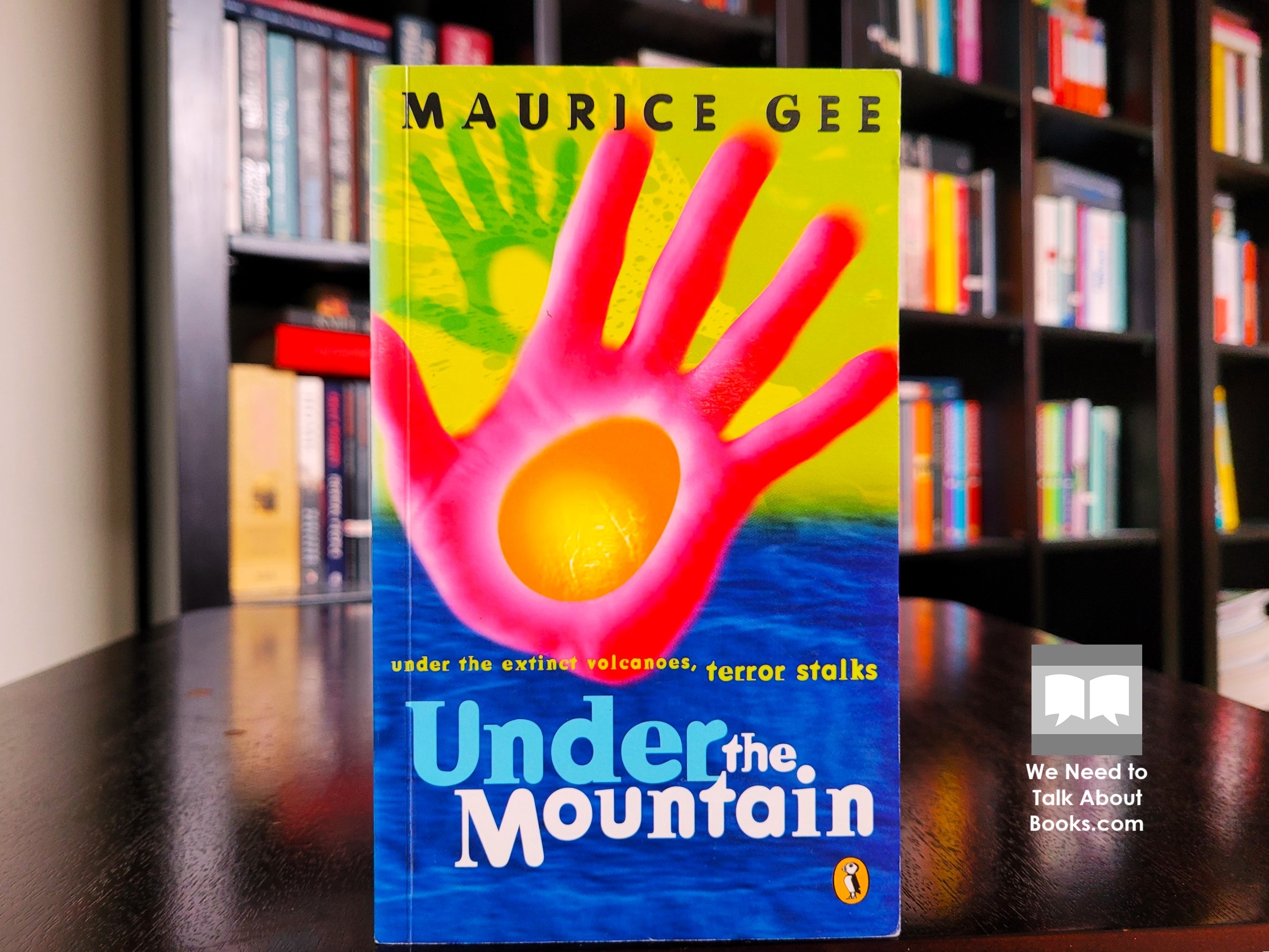
There were signs even from their birth that the Matheson twins, Rachel and Theo, were different. Their shock of bright red hair stood in great contrast to the rest of their family.
When they were three years old, they wandered off from their family farm in rural New Zealand. A large search party was quickly organised, but they could not be found. With the overnight temperatures at that time of year dropping below freezing, it was feared the children would not survive the night.
A stranger in town hearing this news grows alarmed. He quickly finds the twins. Before alerting the others, he tells the twins they are special, and he will call on them in ten year’s time.
Years later, the twin’s journey to spend the summer with their aunt, uncle and cousin Ricky. They have a house by Lake Pupuke near the city of Auckland.
‘I’ve been exploring and I found this book. It’s about Auckland’s volcanoes. And listen to what it says about the lake. “Lake Pupuke is an explosion crater, containing a freshwater lake. The name for basins of this sort is maar. The lake itself is of extraordinary depth. It lies some 200 metres from the sea and twenty metres above it. An underground drainage system extends through the lava and fresh water can sometimes be seen bubbling through the rocks at Thornes Bay north of Takapuna beach.”’
‘But it’s flat here,’ Rachel said.
‘Well, evidently you can have flat volcanoes. And we’re sitting right on the edge of one. Doesn’t it make you feel funny?’
Immediately the twins notice things that perhaps the locals have become accustomed to. Weird smells, weird noises and weird neighbours. One of those neighbours is Mr Jones, the old man who rescued them from the bush all those years ago.
He walked through the streets of the town and came to a little house behind a high hedge. In the kitchen he crossed to the window, where two white objects lay on the sill. They were not what they seemed. Only he knew what they were. He laid his hands on them, felt their warmth.
‘I must get you ready,’ he whispered. ‘The ones who can use you have come.’
Jones is not of this world but is a member of an alien race. He has been in human form for so long it has begun to feel natural to him. His species has been locked in a centuries long war with another alien species. His enemy is a parasitic alien that travels from habitable planet to planet, consuming all of its resources and turning them into uninhabitable wastelands. They too can take human form though not as convincingly as Jones can.
Each side in this war has come close to eliminating the other. As far as he knows, Jones is the last of his species. Meanwhile, the enemy is gaining strength here on the outskirts of Auckland. The region’s collection of extinct, dormant and active volcanoes and volcanic lakes makes it an ideal location for them.
Defeating the enemy requires working in pairs. Jones’ partner was killed a long time ago and ever since he has been looking for an ideal human pair to go into battle. Despite finding Rachel and Theo and despite the rising threat of the enemy, Jones has misgivings. Ideally, he needs identical twins to make an effective pair in battle. Rachel and Theo have the gifts to use the remaining weapons he has but he is not sure that will be enough. Jones is also haunted by what happened to the last pair of humans he selected.
For their part, Rachel and Theo accept Jones story and can see they do in fact possess gifts other humans do not, but they have they own concerns. Having been raised in New Zealand, they question whether it is right to eliminate a species, even a parasitic world-ending one like the ones they face.
Rachel was less happy. She stared at the shape of Rangitoto. It was so black, so threatening. A pale light was growing over its southern flank. The moon would soon be up. That did not make it seem any more friendly. She dreaded going there. She was troubled too by the thought that she was going to kill. The Wilberforces were the last of their kind. It was a crime.
Maurice Gee is considered one of New Zealand’s finest writers and is one of those uncommon writers who has had success with both adult and children’s fiction. His Under the Mountain has long been considered a classic of New Zealand children’s literature. Though I think I skipped it when I was a child in New Zealand, I picked up a copy on a trip back there in 2016 along with a number of other local books.
Written when Gee would have been in his mid-late forties, and at the height of his career, Under the Mountain has a very natural feel. It reads like something children would make up about weird or creepy neighbours; inventing backstories filled with mystery to justify their fear or animosity towards them, turning it into a game of exciting action.
The short novel is fast-paced with plenty of mystery and tension in the beginning. It is easy to keep turning the pages and uses some creative imagination. Later chapters can be quite exciting with narrow escapes and chases. Yet there is also much that is left obscure and unexplained at the end. You could easily read it again and wonder at what has been left unsaid. Rachel and Theo are not credulous either. They have doubts about the story they are being fed by Mr Jones and have their own ideas about how to proceed.
It is the sort of short children’s novel an eight-year-old could easily read in a weekend. Once I was deep into the novel some things began to feel familiar and I began to wonder if I really had passed it by as a child or whether I had forgotten I had read it. An inescapable fact is that part of my enjoyment of it comes from my own familiarity with New Zealand. I am sure that reading a story set in familiar locations, something kids would not have experienced in most of the fiction they read, was a key reason this became a favourite in New Zealand. And though it was written much before my childhood, there is also a familiarity of the experiences of my own generation. The era of teenage house parties for example.
Despite the nostalgia in addition to the story’s other strong points, it is a little difficult for a man my age to really enjoy. It all felt bit juvenile. I suspect this is not just me but most children of today would agree. Despite the pacing, tension and mystery, the novel doesn’t really have any depth. There aren’t any themes to speak of and the characterisation and plot is all very surface-level. It is not that sort of book. Rather it is light weekend reading for the aforementioned eight-year-old.
That being said, I am currently reading it to my six-year-old son. Despite it being a book without pictures, from a different era and lacking some of the zaniness and humour of Andy Griffiths’ and Tery Denton’s Treehouse Series or the novels of David Walliams (two of my son’s favourites), he is genuinely engrossed by the story and disappointed when we have to end each evening’s reading time.
A TV miniseries was produced in 1981 and a film in 2009. Normally I always check out an adaptation after reading a book. But in this case I just could not muster the enthusiasm. Even though the 2009 film stars Sam Neill, the plot is so basic and the film so poorly received, I could not make the effort.
I had more reasons than nostalgia to experience an old children’s book, a classic from the culture I grew up in. I have not read anything else by Maurice Gee yet. Next up I want to read his young-adult trilogy – The O Trilogy – which I also picked up in New Zealand on the same trip. From there I want to go on to his adult novels particularly his acclaimed novel Plumb. Under the Mountain seemed a good place to start.
 We Need to Talk About Books