
A multi-generational family drama will often contain enough conflict and tragedy to make for great story-telling opportunities. In The Lives of Others, author Neel Mukherjee has selected a specific time and place – late 1960’s Eastern India – to escalate the turmoil to new heights. Whatever troubles the members of the Ghosh family believe they are suffering individually are put into context as the boundaries between the individual, the family and the world outside are dissolved and they are forced to consider the lives of others.
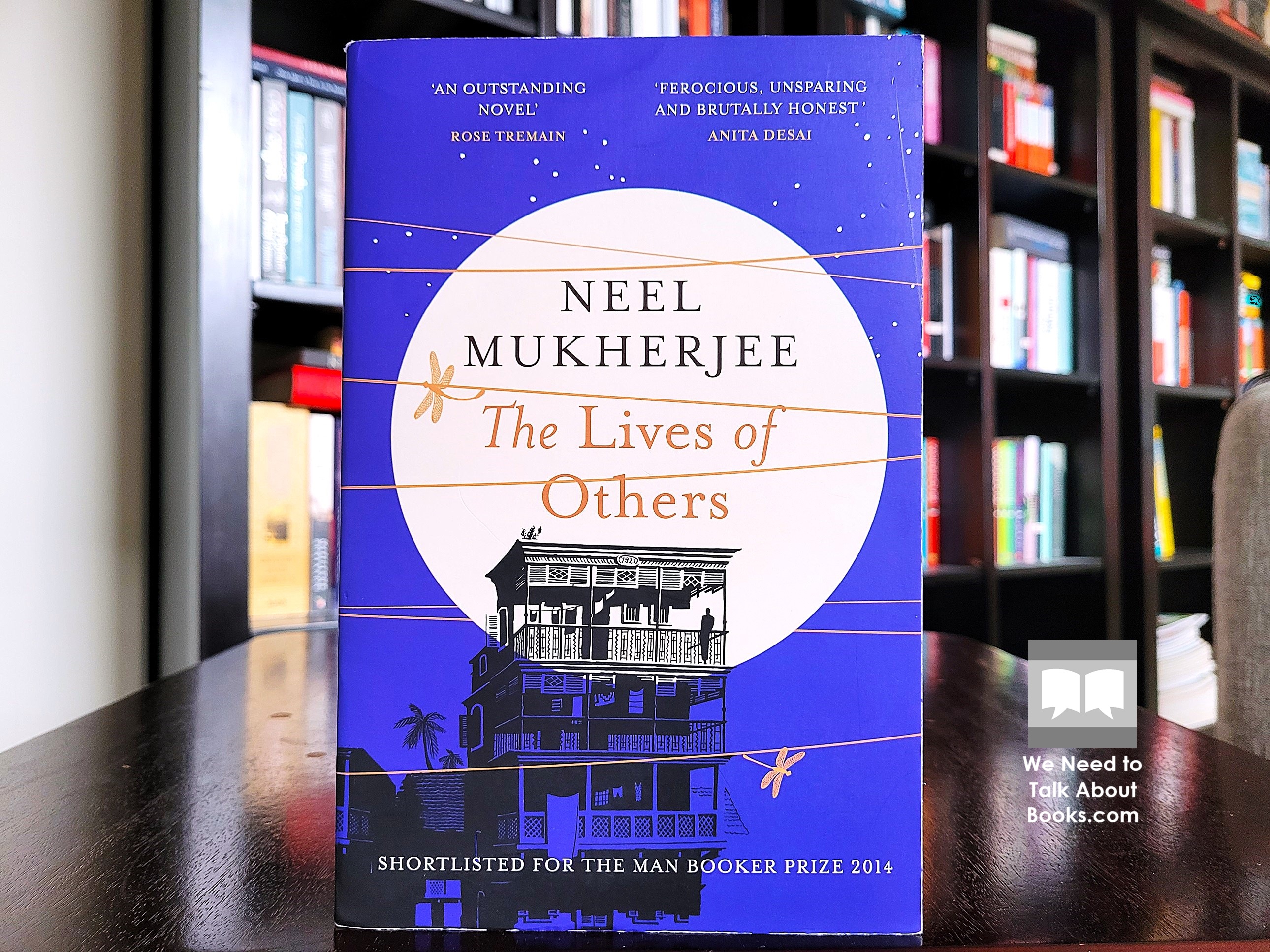
The Lives of Others is a story of a tumultuous period for the Ghosh family living in Calcutta in the late 1960’s. Three generations of the family live together in a four-storey house along with servants. Some of whom have been employed longer than the adult children have been alive. Even before the story begins, things are far from harmonious within the large house. In addition to the different levels of the house, which partly resemble the divisions within the family; rivalries, jealousies and prejudices build further barriers between the family members, their servants and the world outside.
Living on the top floor of the house, above the noise of the street and the mosquitos, are Prafullanath Ghosh and his wife Charubala. Prafullanath is the family patriarch. Almost seventy years old now, he is diabetic, arthritic and has survived two heart attacks.
Prafullanath came from a family of jewellery store owners. Each branch of the family had their own store but the best belonged to Prafullanath’s father. But Prafullanath was the second son and when his parents died his brother effectively disinherited him.
A contact put him in touch with a paper merchant who had no son to pass his business on to. Prafullanath grabs the opportunity. Hard working and with a head for business, he takes a risk in changing the business’ strategy, focusing its efforts and buying up other businesses ruthlessly. It pays off handsomely and Charu Paper and Sons becomes a huge success and Prafullanath marries the merchant’s daughter.
But that was all a long time ago. They lost two paper mills after independence and Partition put them on the other side of the border to East Pakistan. More recently, Prafullanath’s efforts at modernising his factories, paid for with high-risk borrowing, have been botched. One factory has been locked up for two years. There is growing labour unrest and unionism and the possibility of the Communist Party coming to power. Creditors won’t be held off for much longer and they may have to sell the business. Prafullanath has already had to sell off much of his wife’s jewellery and the family has moved from uptown north Calcutta to their current location.
Adinath is the Ghosh’s eldest son. Denied the opportunity to follow his aspiration to become an engineer, he has been raised to inherit the business. That is if there is any business left to inherit.
Consumed with how to solve the family business crisis, Adinath has not noticed the changes in his two university-age sons. His younger son is experimenting with Western Counterculture. Listening to The Beatles and The Grateful Dead and trying alcohol and drugs. But Adinath has also neglected to pay attention to his elder son, Supratik. He has not noticed that Supratik has not been eating, has become cadaverous, uncommunicative and stays out late.
Adinath’s younger brother, the Ghosh’s second child, Priyonath, also saw his aspirations thwarted by his father’s will that he too works in the family business. Priyo does an equal amount of wpork as Adinath but is probably paid less. While Adinath is expected to inherit the family business and home, Priyo is not expected to receive anything. As if his father has completely forgotten his own experience as the second son.
Meanwhile Priyo also supports Purba, his widowed sister-in-law. His support and their strained finances is a major source of arguments Priyo has with his wife in their seventeen year marriage, but Priyo does not want to confront his family about any unequal treatment.
In contrast, the family has used their wealth to allow the third brother, Bholonath, to follow his passion. A lover of literature, the family has created a publishing wing to their business and made Bholonath its director. Bholonath, though, has little head for business and uses his cushy job to fund an expensive education for his daughter.
Chhaya is the only daughter of the Ghoshes. She seems to spend her days in a state of perpetual animosity towards her sisters-in-law. Any sign that she is not getting her due is taken as an insult; a sign of the fate of the unmarried sister.
As a young woman she had many suitors and would get a proposal a month. But they never worked out and offers dried up. The family wondered if her educational accomplishments hurt her marriage prospects. They tried lowering their standards, increasing the dowry, with no success. Before long she had reached the age of thirty, considered a point of no return. Though they might wonder at the reasons, they can’t escape the fact that possessing dark skin and strabismus (being cross-eyed) she is considered ugly.
To occupy herself, Chhaya plots revenge on others in the family, particularly the women, and delights in opportunities to harm them. But behind the animosity between the women is also the fear of what will become of them if the family finances finally collapse.
Sharing their concern is Madan. Taken in as a servant when he was only ten years old, Madan is now an old man. He practically raised the family’s children and they have come to think of him as part of the family and love his cooking.
A humble man who knows his place, Madan has only once asked for anything – that the family might find a job for his teenage son, Dulal, at one of their factories. The family obliges, even seeing the advantage of having an inside man at the factory to report to them. Dulal turns out to be a star worker. He rises fast and learns the business inside and out. So much so, that when the workers become unhappy, Dulal is the obvious choice to be their leader in negotiations with the family. It puts his father in an extremely awkward position where he would have to make an incredibly difficult decision.
Purba married the family’s fourth son, Somnath. After Somnath’s death, she and her two children are not treated as equals by the rest of the family. They share a dingy room on the house’s ground floor and make do with watery daal. She is expected to work like a servant for the rest of the family and takes the verbal abuse of her mother-in-law.
Though still only a young child, Purba’s son Sona understands that education is the key to escape this life and he is determined to succeed. It helps that he is gifted at mathematics. So much so that he tutors others in his same grade. But neither Sona nor anyone else knows just how gifted he is or how far it might take him.
But the story really begins when Adinath’s troubled eldest son Supratik leaves home. While attending university, Supratik has become conscious of the distinctions between the city’s many poor and the wealthy like his family. He witnesses riots and looting. He becomes a member of the student wing of the Communist Party. He organises posters and slogans, sit-ins and road blocks. Soon he can list several events in the city that he was a part of.
He ignores the criticism of others who say he does not get his hands dirty. The truth is he sees student activism as amateurish. He makes a distinction between the pragmatists and the idealists within the Party. The pragmatists he says are self-interested, corrupt, power-hungry and not truly interested in revolution.
Supratik, in contrast, is looking for an opportunity to make his mark.
Ma, I feel exhausted with consuming, with taking and grabbing and using. I am so bloated that I feel I cannot breathe anymore. I’m leaving to find some air, someplace where I shall be able to purge myself, push back against the life given me and make my own. I feel I live in a borrowed house. It’s time to find my own. Trying to discover my whereabouts won’t get you anywhere, so save that energy; You might find you need it for something else. I’ll write periodically to let you know I’m alive. Forgive me. Yours, Supratik.
The Lives of Others is the second novel by Neel Mukherjee and was shortlisted for the 2014 Booker Prize. If you are familiar with the Booker Prize, you may find The Lives of Others to be the sort of novel routinely featured amongst the nominees for the Prize. A family drama in a non-Western country where the family finds itself battered not only by circumstances of their own making, but by the social, political, religious and economic turmoil of their time and environment. Often colonial and post-colonial.
In my reading experience this means I am mostly comparing The Lives of Others to other shortlisted novels set in India. For example, Such a Long Journey by Rohinton Mistry and The Moor’s Last Sigh by Salman Rushdie. But I wonder if I were to read more of the novels nominated for the Prize set in other countries, as I plan to, I would see a similar pattern.
Like other novels of this type, the writer throws the reader into the deep-end somewhat in the early chapters. We are quickly introduced to a large cast of characters for us to keep track of. Some anecdotes and backstory are shared, which are clearly designed to shock and confront the reader early. Also, they serve to set certain conceptions of the characters in the reader’s mind for the story to conflict with later on. From there things settle down and we take deeper dives into the past and present of each character in turn.
For most of the novel, this narrative alternates with the writings of Supratik. Having left home, much to his mother’s despair, Supratik is keeping a log of his revolution-inciting activities in the form of letters. But who are the letters to? Himself? An explanation to his mother? A lover?
For most of my time reading The Lives of Others, I had difficulty enjoying it. Author Anita Desai is quoted on the book cover as saying the novel is “Ferocious, unsparing and brutally honest”. Perhaps it is. As a consequence, it is also difficult to like most of the characters or to champion a happy outcome for them. One example of the method I described above, where the author creates an early extreme impression of a character, is of Cchaya, the Ghosh’s daughter. I found her to be quite evil. Others I was quite disgusted by.
Cchaya carried tales, not all of which were innocent. She got a thrill out of poisoning people’s minds and playing them off against each other.
Not that long ago I watched the seven seasons of the television show Sons of Anarchy. By the beginning of the seventh season I couldn’t help but feel that all the remaining characters were irredeemably bad and I did not want to see a happy ending for any of them! I almost felt the same for The Lives of Others.
At one point, I was beginning to find it to be an angry novel. I felt I could be pretty neutral reading it, but I had to wonder if it assumes the reader holds a prejudice against the rich. Alternatively, I might have a very different response if I held a prejudice against the communists. Perhaps this reflects the misplaced anger of the characters.
That being said, as a reader of Indian history and fiction, I found The Lives of Others does bring to the reader’s attention certain political dynamics of the time. The rich in the novel are portrayed as having mixed, even confused, loyalties. During the colonial period, they show some support for the Indian Independence movement. But they are certainly not supporters of Gandhi. Their support for subverting the British is motivated by how that may help the interests of their businesses. A similar mix of priorities could be argued for the communist position.
Despite being given a special place in the novel’s narrative structure, it would be incorrect to say Supratik is the focus of the novel. Yet, his story does provoke a lot of big questions beyond the scope of what is otherwise a family saga. Such as how to effectively help the poor without causing more harm. About the virtues and faults of violent struggle versus democratic means to effect change. About how to be an effective advocate for a group you do not belong to. And whether it is more worthy to try and incite a radical change to an entire society or to work for small victories closer to home.
‘All this well-heeled comfort, this house, this large family, nothing wanting, no lack, no troubles, don’t you find it a bit sealed off from the big world outside?’
‘I have no idea what you’re saying. Where do you see no lack, no troubles? Do you run the family? What do you know of how it works? Do you know what bad times our business is going through?’ […]
‘Don’t you ever think that we have too much, and others have too little?’ […]
‘What on earth are you talking about? I don’t understand you anymore. It is not up to us to look after everyone in the universe. The rule of the world is to look after your family, your elders, your children, and see that you do the best you can for them all the time.’ […]
‘Do you ever think that that’s wrong? That what you’ve been given is wrong and that you have to make the world from scratch again? […] Are you happy with the inequalities of our family? Of the power-on-top-ruling-people-below kind of hierarchy? Do you think it’s right? Has the thought ever crossed your mind that the family is the primary unit of exploitation?’
‘Inequalities? Power on top? Hierarchy? Exploitation? What are you saying?’ she found herself repeating like a slow learner.
‘Fine, stay inside your bubble for as long as you can, because you won’t be able to for much longer, the clock’s ticking.’
As the novel goes on, I found myself warming to it more. I don’t think it is coincidental that this occurred as things got more difficult for the characters. As their chickens come home to roost and as their worldviews became challenged by factors they had not considered.
In the end, I think the key to understanding The Lives of Others lies in its title. Most of the characters are very self-centred and consumed with their own wants. They are blind to the experience and perspectives of others and consequently have no sympathy. Not just the others within their sphere, but the others of their community, city and society as a whole. Even Supratik, who has made it his mission to work for the betterment of others at society’s bottom, is ignorant of what is going on within his own family, the consequences of his actions or the conflicts in his beliefs.
It struck him again, with vivid force, that all this talk of ‘the outside world’ turned round one thing only: what the outside world made of your own life. You were forever at the centre of things, the subject of the sentence; it was not the outside world you were thinking of, but where you stood in the regard of that world. He wanted to say to his father that others thought of their own lives too, perhaps more often, more deeply, than they did of his father’s. The assumption that his father would always have some sort of a privileged access to that outside world, much more so than his son, by virtue of his age, grated Supratik’s nerves raw. He wanted to quiz him, firing one question after another to this ridiculous man about the world outside.
 We Need to Talk About Books
I put this on my wishlist because of a glowing review from someone I know, but since then I’ve read other reviews which offer a more nuanced view of it, and I’ve relegated it to one of those books I’ll borrow it from the library if I see it there…
LikeLiked by 2 people
Understandable. I just saw he had a new novel out last year and the descriptions sound similar to how I felt about this one – bleak, full of ethical dilemmas, maybe strangely uplifting for some readers
LikeLike
Well, we do need writers to speak out about moral issues… the trouble is, there are so many in our twisted world, that readers can become overwhelmed.
LikeLiked by 1 person