
Black Swan Green is a semiautobiographical coming-of-age novel set in village England in the early 1980’s. Evocative of the period and in the difficulties faced by its preadolescent protagonist, it nevertheless contains a subtle optimism that brighter days lie ahead.
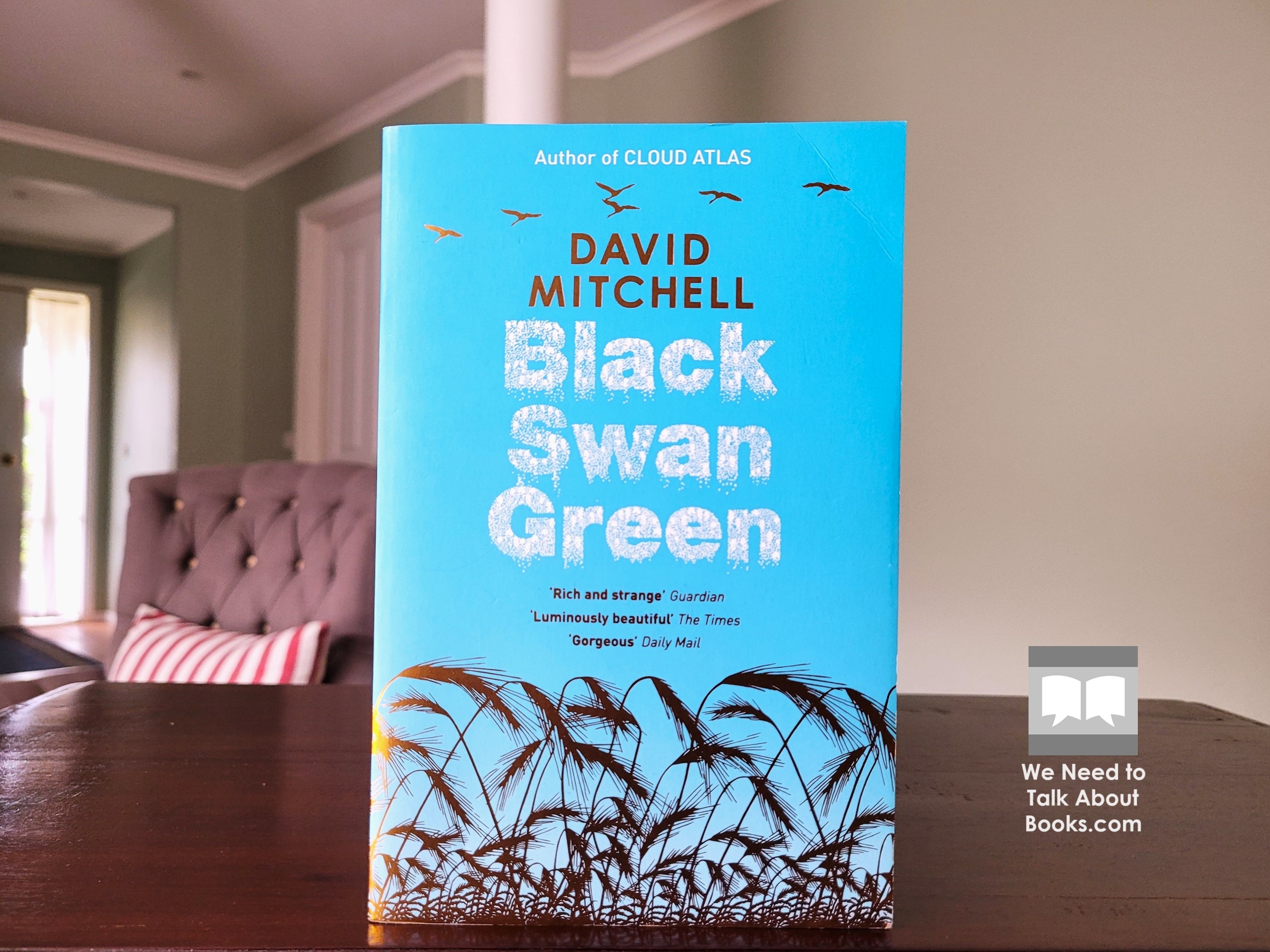
Thirteen-year-old Jason Taylor feels his life is far from enviable. He lives in a small rural English village with a sister who hates him, a father he fears and the feeling that something is not right between his parents. He has little in common with his friends apart from the fact that they share some of the same problems; of family, of bullies, of girls. Jason also has a stammer, which he is painfully conscious of and acts as a major social impediment.
Picked-on kids act invisible to reduce the chances of being noticed and picked on. Stammerers act invisible to reduce the chances of being made to say something we can’t. Kids whose parents argue act invisible in case we trigger another skirmish. The Triple Invisible Boy, that’s Jason Taylor.
There is also his deepest secret. A love for writing, art and especially poetry.
What Jason cannot appreciate is the period he is living through. In 1982 he is witness to the sudden sharp rise of neoconservatism, an unexpected foreign war and is surrounded by xenophobia and homophobia, which he is not yet old enough or aware enough to question.
David Mitchell’s semiautobiographical novel of a young man struggling through early adolescence is more empathetically disquieting than pleasantly nostalgic. Mitchell does an excellent job of recreating the difficulties of being a preadolescent boy of that age. It comes through in many instances in the novel from the subtle to the glaring. It is in the politics of young boys; of the ways you have to prove yourself to be cool, of being ranked, of hiding your true self, of being bullied and being the bully. It is in their rules of language; of sexual innuendo, homophobia and racism, of pretending to be dumber than you are. It is in the hypocrisy of the rules laid down by parents and teachers and the feeling that you are always in trouble.
Equally excellent is the job Mitchell does of evoking the period of the novel. He does this through the characters reactions to the events of the time such as Thatcherism and the Falklands War. Also, through many pop culture references; Kramer vs Kramer, Chariots of Fire, Connors vs McEnroe.
Mitchell does such a good job that I wonder if Black Swan Green, first published in 2006, makes some of today’s readers squeamish? Black Swan Green contains much that is realistic for the time but not politically correct today. My own adolescence is not so far removed from the period of Black Swan Green for me to recognise many cultural commonalities. Foremost is the frequent use of the word ‘gay’ to mean ‘uncool, lame, effeminate’ as well as many other undesirable meanings. The other main example from the novel comes from the reactions of the village to the arrival of a gypsy camp.
‘I believe the truth is, you use your pseudonym because your poetry is a shameful secret. I am correct?’
‘“Shameful” isn’t the exact word, exactly.’
‘Oh, so what is the exact word, exactly?’
‘Writing poetry’s,’ I looked around the solarium, but Madam Crommelynck’s got a tractor beam, ‘sort of… gay.’
‘“Gay”? A merry activity?’
This was hopeless. ‘Writing poems is… what creeps and poofters do.’
‘So you are one of these “creeps”?’
‘No.’
‘Then you are a “pooof-ter”, whatever one is?’
‘No!’
‘Then your logic is eluding me.’
‘If your dad’s a famous composer, and your mum’s an aristocrat, you can do things that you can’t do if your dad works at Greenland Supermarkets and if you go to a comprehensive school. Poetry’s one of those things.’
‘Aha! Truth! You are afraid the hairy barbarians will not accept you in their tribe if you write poetry.’
‘That’s more or less it, yeah…’
We do seem to be living through a period where people are especially sensitive to such things and it is not difficult to find lists of books and films that ‘could not be made today’ and writers and actors saying they would not make their previously celebrated work today. But I hope this does not dissuade writers from recreating the past with realism, however uncomfortable that might make readers. I hope to one day read or watch an unvarnished version of the period of my own youth. The TV series Mad Men, for example, succeeds in evoking the past in its sometimes ugly reality without celebrating or excusing it. I believe there is value in doing so while the alternative – either avoiding certain periods or not portraying them accurately – creates other problems.
The realism did not quite seem absolute to me in one respect. For the most part, Jason was a believable thirteen-year-old boy. At times he seemed a little mature for that age. But at others, especially when dealing with the opposite sex, he seemed a little juvenile.
One of the things I liked best in the novel was that, despite how difficult Jason’s life is at present, there were moments of respite and reasons to hope. In particular, a connection and mentorship from an older woman that reminded me of Great Expectations.
‘A young man needs to learn when a woman wishes her cigarette to be lit.’
‘Sorry.’
An emerald dragon wraps Madam Crommelynck’s lighter. I was worried the smell of cigarette smoke’d stick to my clothes and I’d have to make up a story for Mum and Dad about where I’d been. While she smoked, she murmured my poem ‘Rocks’ from May’s magazine.
I felt giddy with importance that my words’d captured the attention of this exotic woman. Fear, too. If you show someone something you’ve written, you give them a sharpened stake, lie down in your coffin and say, ‘When you’re ready.’
The narrative of Black Swan Green does not quite proceed in a linear fashion. There are episodes that seem to be left unresolved and left me wondering if what I had read was part of a dream. But things come together quite well for a satisfying conclusion.
Black Swan Green was the second David Mitchell novel I have read after Cloud Atlas. I did not intend to read more. But I think I have sufficiently enjoyed these to want to come back to him again. Maybe, since I want to increase my Fantasy reading, I will return for The Bone Clocks.
 We Need to Talk About Books
I read this just before I started blogging, so it was a pleasure to revisit it through your review, thank you.
LikeLike